Loading
Form preview
  • US Legal Forms
  • Other Templates
  • More Forms
  • More Multi-State Forms
  • Quitclaim Deed Texas 2020

Get Quitclaim Deed Texas 2020-2026

How it works

  1. Open form

    Open form follow the instructions

  2. Easily sign form

    Easily sign the form with your finger

  3. Share form

    Send filled & signed form or save

How to fill out the Quitclaim Deed Texas online

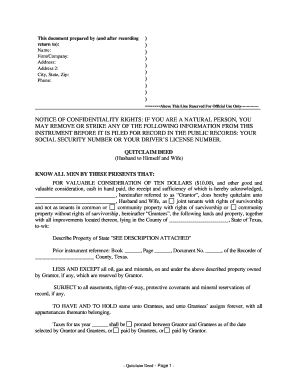
The Quitclaim Deed in Texas is a legal document used to transfer property ownership between parties. This guide provides clear, step-by-step instructions to assist users in completing the Quitclaim Deed form online, ensuring a smooth and accurate filing process.

Follow the steps to complete the Quitclaim Deed efficiently.

  1. Press the ‘Get Form’ button to access the Quitclaim Deed form and open it in your preferred editing tool.
  2. Begin by entering the name of the individual or entity preparing the document in the designated field.
  3. Fill in the firm or company's name, followed by the complete address, including address line 2, city, state, and zip code.
  4. Provide the phone number of the individual or entity that prepares the document.
  5. In the section labeled 'KNOW ALL MEN BY THESE PRESENTS THAT,' write the name of the Grantor who is transferring the property.
  6. Specify the name(s) of the Grantees, in this case, the husband and wife, as the parties receiving the property.
  7. Describe the property being transferred in the field labeled ‘Describe Property of State’ — if a description is attached, state 'SEE DESCRIPTION ATTACHED'.
  8. Complete the prior instrument reference by noting the book, page, and document number related to the property.
  9. Include any reservations regarding oil, gas, and minerals owned by the Grantor in the appropriate section.
  10. Indicate any easements or rights-of-way that may affect the property in the designated section.
  11. State whether the property is part of the Grantor's homestead.
  12. Have the Grantor(s) sign and date the document where indicated.
  13. Include printed names of the Grantor(s) below their signatures.
  14. Ensure that there are two witnesses to the signing, and have them provide their signatures.
  15. Finally, have the document acknowledged by a notary public, who will complete the acknowledgment section with their information.
  16. After completing the form, make sure to save your changes, and choose to download, print, or share the completed Quitclaim Deed as needed.

Complete your Quitclaim Deed online today to ensure a seamless property transfer.

Get form

Experience a faster way to fill out and sign forms on the web. Access the most extensive library of templates available.
Get form

Related content

What form do I need to change the name on the deed...
Oct 6, 2025 — Lone Star Law's Deeds in Texas article says that a quitclaim deed is not a...
Learn more
Little Law, Big Deal | Texas Real Estate Research...
Oct 4, 2021 — Clients often ask lawyers for quitclaim deeds or sometimes “quick claim...
Learn more
athenahealth, Inc.
Deed. A quitclaim deed substantially in the form of Exhibit C attached hereto and...
Learn more

Related links form

Pastoral Recommendation Form - Rhema Bible Training College - Rbtc Rbtc Online Jamabandi Form Tezpur Assam Schedule VII Form No

Questions & Answers

Get answers to your most pressing questions about US Legal Forms API.

Contact support

In Texas, a quitclaim deed remains effective indefinitely once executed and recorded. It does not have a statute of limitations that limits its validity. However, factors surrounding the property, such as liens or changes in ownership, can impact its use. Therefore, while the deed itself is permanent, being aware of your property's status is essential.

A quitclaim deed itself does not expire. Once it is filed and recorded, it remains effective indefinitely. However, the relevance of the deed can change based on legal circumstances, such as the sale of the property or other transfers. If you're considering using a quitclaim deed, knowing these dynamics can help you make informed decisions.

Yes, a quitclaim deed must be notarized in Texas to be legally binding. This notarization verifies the identity of the signers and ensures the document is executed properly. While you can prepare the deed yourself, using a service like US Legal Forms can help you ensure all legal requirements are met smoothly and correctly.

Yes, you can sell property that is conveyed through a quitclaim deed in Texas, but certain conditions apply. A quitclaim deed transfers ownership without guaranteeing clear title, which may complicate future sales. Buyers generally prefer clear title, so it is advisable to conduct a title search or clear any potential issues before selling. Consulting a legal advisor can help you navigate these complexities.

In Texas, a quitclaim deed does not have a specific expiration date. Once executed and recorded, the deed remains valid indefinitely. However, it’s crucial to consider other factors, such as the resolution of any outstanding claims against the property. Therefore, while the deed itself does not expire, the context surrounding the property can change.

Typically, a quitclaim deed benefits individuals who are transferring property to family members or trusts. It provides a simple and quick method to convey ownership without complex formalities. This can be especially useful in estate planning or during divorce proceedings. Keep in mind, while it simplifies the process, it does not guarantee the absence of liens or other claims against the property.

Filling out a quitclaim deed in Texas requires clarity in capturing the details of the transaction. Begin with the grantor and grantee's names, followed by a thorough description of the property involved. Make sure to include any relevant legal descriptions. For an easy-to-follow format and additional tips, utilizing resources from USLegalForms can be quite helpful.

Using a quit claim deed in Texas simplifies the transfer of property between parties. It is particularly useful when there is a trust, family situation, or quick transfer needed without involving many legalities. Additionally, it provides a straightforward way to clear up ownership disputes. Consider USLegalForms for information and templates that can help streamline this process.

Yes, a quitclaim deed requires notarization in Texas. Both the grantor and grantee must be present for the signing of the document in front of a notary public. This step ensures that the deed is valid and legally recognized. Notarization helps safeguard the rights of both parties, creating a clear record of the transaction.

To record a quit claim deed in Texas, you need to take the completed and notarized document to the county clerk's office where the property is located. Ensure you have the required fees for recording, which can vary by county. Recording the deed provides public notice of the transfer and protects your interests in the property. For convenience, you can find instructions on USLegalForms.

Get This Form Now!

Use professional pre-built templates to fill in and sign documents online faster. Get access to thousands of forms.
Get form
If you believe that this page should be taken down, please follow our DMCA take down processhere.
Get Quitclaim Deed Texas
Get form
  • Adoption
  • Bankruptcy
  • Contractors
  • Divorce
  • Home Sales
  • Employment
  • Identity Theft
  • Incorporation
  • Landlord Tenant
  • Living Trust
  • Name Change
  • Personal Planning
  • Small Business
  • Wills & Estates
  • Packages A-Z
  • Affidavits
  • Bankruptcy
  • Bill of Sale
  • Corporate - LLC
  • Divorce
  • Employment
  • Identity Theft
  • Internet Technology
  • Landlord Tenant
  • Living Wills
  • Name Change
  • Power of Attorney
  • Real Estate
  • Small Estates
  • Wills
  • All Forms
  • Forms A-Z
  • Other Templates
  • Legal Hub
  • About Us
  • Help Portal
  • Legal Resources
  • Blog
  • Affiliates
  • Contact Us
  • Delete My Account
  • Site Map
  • Industries
  • Forms in Spanish
  • Localized Forms
  • State-specific Forms
  • Forms Kit
  • Real Estate Handbook
  • All Guides
  • Notarize
  • Incorporation services
  • For Consumers
  • For Small Business
  • For Attorneys
  • USLegal
  • FormsPass
  • pdfFiller
  • signNow
  • altaFlow
  • DocHub
  • Instapage
Form Packages
  • Adoption
  • Bankruptcy
  • Contractors
  • Divorce
  • Home Sales
  • Employment
  • Identity Theft
  • Incorporation
  • Landlord Tenant
  • Living Trust
  • Name Change
  • Personal Planning
  • Small Business
  • Wills & Estates
  • Packages A-Z
Form Categories
  • Affidavits
  • Bankruptcy
  • Bill of Sale
  • Corporate - LLC
  • Divorce
  • Employment
  • Identity Theft
  • Internet Technology
  • Landlord Tenant
  • Living Wills
  • Name Change
  • Power of Attorney
  • Real Estate
  • Small Estates
  • Wills
  • All Forms
  • Forms A-Z
  • Other Templates
Customer Service
  • Legal Hub
  • About Us
  • Help Portal
  • Legal Resources
  • Blog
  • Affiliates
  • Contact Us
  • Delete My Account
  • Site Map
  • Industries
  • Forms in Spanish
  • Localized Forms
  • State-specific Forms
  • Forms Kit
Legal Guides
  • Real Estate Handbook
  • All Guides
Prepared for you
  • Notarize
  • Incorporation services
Our Customers
  • For Consumers
  • For Small Business
  • For Attorneys
Our Sites
  • USLegal
  • FormsPass
  • pdfFiller
  • signNow
  • altaFlow
  • DocHub
  • Instapage
Social Media
Call us now toll free:
+1 833 426 79 33
As seen in:
© Copyright 1999-2026 airSlate Legal Forms, Inc. 17 Station Street, Ste. 203, Brookline, MA 02445
  • Your Privacy Choices
  • Terms of Service
  • Privacy Notice
  • Content Takedown Policy
  • Bug Bounty Program