Loading

Open form follow the instructions

Easily sign the form with your finger

Send filled & signed form or save
How to fill out the Personal Representative Deed online
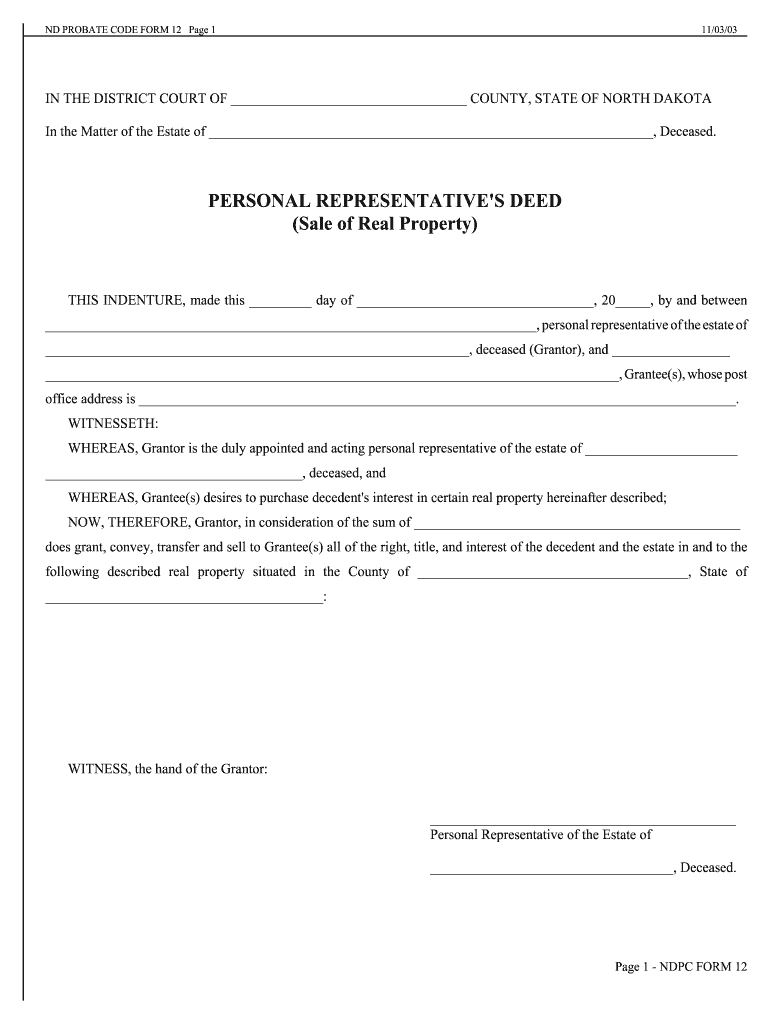
Filling out a Personal Representative Deed online allows users to efficiently manage the sale of real property related to a deceased person's estate. This guide will provide step-by-step instructions to help you complete the form accurately and with confidence.
Follow the steps to complete your Personal Representative Deed online
- Click ‘Get Form’ button to obtain the form and open it in the editor.
- Begin by filling in the 'IN THE DISTRICT COURT OF' section with the appropriate county and state details specific to your situation, ensuring accuracy.
- In the 'In the Matter of the Estate of' section, enter the full name of the deceased person whose estate is being addressed in this deed.
- Next, fill in the date when the deed is being executed in the blank space provided.
- In the section denoting the Grantor, specify your name as the personal representative, followed by the full name of the deceased.
- Include the names of the Grantee(s) who are purchasing the property alongside their post office address in the designated fields.
- Detail the consideration amount in the appropriate space, indicating the sum for which the property is being sold.
- Describe the real property being sold accurately, including any information necessary to identify the location and nature of the property.
- As the Grantor, provide your signature in the space allocated for the acknowledgment of the transaction.
- Complete the notarial acknowledgment section by providing the date of acknowledgment, your name, and having a notary public sign it.
- After all fields are completed, review the entire document for accuracy. Once satisfied, you can save your changes, download, print, or share the completed form as needed.
Act now to complete your Personal Representative Deed online and ensure a smooth transaction.
Experience a faster way to fill out and sign forms on the web. Access the most extensive library of templates available.
Related content
This deed conveys property from a personal representative to a grantee for a sum...
It is a deed conveying title where the seller (grantor) makes six covenants or promises to...
Jan 26, 2017 — Under certain conditions, when a person dies the executor or personal...
Get answers to your most pressing questions about US Legal Forms API.
How is a personal representative appointed in California?
In California, a personal representative is appointed through a court process during probate proceedings. An interested party, often someone named in the will, petitions the court to appoint a personal representative. The court evaluates the petition and determines whether the applicant is fit for the role. This process helps ensure that the estate is managed correctly, reflecting the deceased's wishes while complying with state laws.
What is a personal representative deed in Florida?
In Florida, a personal representative deed serves a similar purpose as in other states, allowing the personal representative to transfer real property owned by a deceased individual. This legal document helps ensure that the estate is settled fairly and according to the wishes of the deceased. It legally establishes the representative's authority, which is crucial for carrying out the estate's obligations. This deed is an essential component in the probate process.
What is the difference between a successor and a personal representative?
A successor gathers the assets of the deceased and ensures they are distributed according to the will or state laws, while a personal representative takes on the active role of managing the estate during the probate process. Successful roles may also refer to a trustee in a trust setting, which holds a different legal function than a personal representative deed. Each role contributes to the overall administration of an estate, but their responsibilities can vary significantly.
What is the difference between an executor and a personal representative in Washington state?
In Washington state, an executor is specifically named in a will to carry out the deceased's wishes, while a personal representative can be appointed if there is no will. Both roles aim to manage the estate, but the key difference lies in how they are appointed. An executor usually has a direct connection to the deceased, whereas a personal representative might be appointed by the court. Understanding these distinctions helps clarify the processes involved in estate management.
Which is the most common deed used in Washington to transfer real property?
The most common deed used in Washington to transfer real property is the warranty deed. This type of deed guarantees that the seller has clear title to the property and has the right to sell it. In many cases, a personal representative deed is utilized when the property owner has passed away to ensure that property transfers smoothly to heirs. When engaging in real estate transactions, always confirm the type of deed being used for clarity.
What is the personal representative of the deceased?
The personal representative of the deceased is an individual or entity appointed to handle the estate after someone passes away. This representative oversees the distribution of assets, settles debts, and ensures that the probate process is conducted properly. Their role is central to fulfilling the deceased's wishes, as outlined in their will or state law if no will exists. Understanding this role is vital for anyone involved in estate planning or settlement.
What is a personal representative deed in Washington state?
A personal representative deed in Washington state is a legal document that allows a personal representative to transfer real property owned by the deceased. This deed serves as proof that the representative has the authority to manage the estate, which includes selling or distributing property. By utilizing a personal representative deed, the representative can ensure that the estate is handled according to the wishes of the deceased. This deed is crucial for settling the estate efficiently and legally.
Who can be a personal representative in Washington state?
In Washington state, a personal representative can be an individual or a corporation appointed to manage the estate of a deceased person. Usually, this role is filled by a family member, close friend, or professional fiduciary. It's important to note that the chosen representative must be at least 18 years old and legally competent. The personal representative deed facilitates the transfer of the deceased's assets to the rightful heirs.
What power does a personal representative have?
A personal representative holds considerable power, including the authority to settle debts, manage assets, and distribute property according to the will. Their responsibilities require careful attention to legal requirements and the best interests of beneficiaries. By using a Personal Representative Deed, individuals can formalize this authority and streamline the management process, ensuring all actions are legally binding and transparent.
Can a personal representative transfer property to himself?
A personal representative can transfer property to himself under certain conditions, but this must be done with caution. The transfer should be fair and aligned with the best interests of the estate and its beneficiaries. Using a Personal Representative Deed in such transactions can help establish legitimacy and safeguard against potential conflicts of interest.
Use professional pre-built templates to fill in and sign documents online faster. Get access to thousands of forms.
If you believe that this page should be taken down, please follow our DMCA take down process here.