Loading
Form preview
  • US Legal Forms
  • Other Templates
  • More Forms
  • More Multi-State Forms
  • Pediatric Stroke Outcome Measure 2020

Get Pediatric Stroke Outcome Measure 2020-2026

How it works

  1. Open form

    Open form follow the instructions

  2. Easily sign form

    Easily sign the form with your finger

  3. Share form

    Send filled & signed form or save

How to fill out the Pediatric Stroke Outcome Measure online

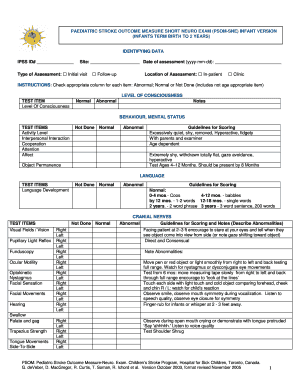
The Pediatric Stroke Outcome Measure is an essential tool designed to assess the outcomes of stroke in infants and young children. This guide provides a comprehensive overview of how to effectively fill out the form online, ensuring a clear understanding of each section and its requirements.

Follow the steps to accurately complete the Pediatric Stroke Outcome Measure.

  1. Click 'Get Form' button to obtain the Pediatric Stroke Outcome Measure and open it in your online editor.
  2. Begin by entering the identifying data at the top of the form. Include the IPSS ID#, site, date of assessment, type of assessment (initial visit or follow-up), and location of assessment (in-patient or clinic).
  3. Move to the section assessing the level of consciousness. For each test item listed, mark whether the observation is normal, abnormal, or not done, detailing any notes relevant to the assessment.
  4. Proceed to the behavior and mental status section, checking the applicable columns for each tested item such as activity level, cooperation, and attention. Make sure to adhere to the scoring guidelines provided for these observations.
  5. Complete the language section by evaluating language development. Again, indicate whether the observation is normal, abnormal, or not done while considering the scoring guidelines.
  6. In the cranial nerves section, assess various items, such as visual fields, pupillary light reflex, and hearing. Fill in the responses for right and left sides where applicable, and provide any additional notes for abnormalities observed.
  7. Continue through the rest of the form, filling out sections on gross motor skills, power, motor testing, and fine motor/coordination using the same approach of marking normal, abnormal, or not done, and providing notes where necessary.
  8. At the end of the form, use the scoring sheet to summarize your impressions across various domains including sensorimotor deficits, language deficits, and cognitive or behavioral deficits. Tally the total scores as directed.
  9. Review the final questions regarding recovery, daily help needed, emotional impact, and the use of assistive devices. Answer each question accurately.
  10. Once you have completed all sections of the form, ensure all information is correct, and then you can save changes, download, print, or share the completed Pediatric Stroke Outcome Measure.

Take action today by filling out your Pediatric Stroke Outcome Measure online for a comprehensive assessment.

Get form

Experience a faster way to fill out and sign forms on the web. Access the most extensive library of templates available.
Get form

Related content

The pediatric stroke outcome measure: a validation...
by L Kitchen · 2012 · Cited by 295 — The PSOM is a valid and reliable outcome measure...
Learn more
Consensus-Based Evaluation of Outcome Measures in...
by SJ Feldman · 2023 · Cited by 13 — Only three measures were found to be validated...
Learn more
Enhancing Your Adaptive Behavior Evaluations
... Pediatric stroke outcome measure: Predictor of multiple impairments in childhood...
Learn more

Related links form

Product Sale Money Tracking Form - Girl Scouts - Dakota Horizons - Gsdakotahorizons 2x2 Ad Order Form For Newspapers - Virginia Press Association - Vpa 9502EN How To Claim The Personal Property Of Someone Who Has Died: DoItYourself Affidavit Procedure Vendor Application Form - Abilene Independent School District - Abileneisd

Questions & Answers

Get answers to your most pressing questions about US Legal Forms API.

Contact support

Statistics indicate that pediatric strokes are relatively rare but can have severe consequences. Approximately 2-13 children per 100,000 experience a stroke annually in the U.S. Raising awareness and utilizing the Pediatric Stroke Outcome Measure can help improve early detection and treatment, ultimately enhancing the prognosis for affected children.

The Pediatric Stroke Outcome Measure is a comprehensive tool designed to assess recovery in children after a stroke. It evaluates various factors, including motor skills and cognitive abilities, to provide healthcare professionals with valuable insights. Utilizing this measure ensures that children receive personalized care tailored to their specific challenges.

Pediatric strokes are generally classified into two main categories: ischemic and hemorrhagic. Ischemic strokes occur due to a blockage in blood vessels, while hemorrhagic strokes result from bleeding in the brain. Understanding these classifications is essential for applying the Pediatric Stroke Outcome Measure effectively.

The outcomes of childhood strokes can vary widely, influencing physical and cognitive development. Children may experience challenges with mobility, learning, and social interactions. Early intervention, along with the Pediatric Stroke Outcome Measure, plays a crucial role in improving these outcomes and enhancing a child's quality of life.

While there are various tools available, the gold standard for stroke patients often refers to the Modified Rankin Scale (mRS). This measure evaluates the degree of disability or dependence in daily activities after a stroke. However, for pediatric cases, the Pediatric Stroke Outcome Measure is the more relevant tool, providing insights specific to younger patients.

The Pediatric Stroke Outcome Measure (PSOM) is specifically designed to evaluate outcomes in children affected by stroke. It assesses motor, cognitive, and behavioral recovery, allowing healthcare providers to tailor treatment plans. Utilizing the PSOM helps parents and clinicians understand the child's progress in a way that is meaningful and practical.

The SIS, or Stroke Impact Scale, is a tool used to assess the impact of stroke on a person's life. It measures various aspects, including physical, emotional, and social functioning. Although it primarily focuses on adult strokes, understanding its concept can aid in comparing with the Pediatric Stroke Outcome Measure, ensuring comprehensive care.

Charting a stroke assessment involves a systematic approach. You will gather patient data, including vital signs, neurological function, and any physical impairments. By documenting these findings thoroughly, healthcare professionals can effectively monitor progress and apply the Pediatric Stroke Outcome Measure to evaluate recovery.

Treating a childhood stroke often requires an interdisciplinary approach, focusing on restoring blood flow and minimizing brain damage. Treatment may include medications, rehabilitation therapies, and sometimes surgical interventions, depending on the child's condition. Utilizing the Pediatric Stroke Outcome Measure helps healthcare professionals assess recovery and tailor treatments effectively.

The time it takes for the brain to settle after a stroke varies greatly among individuals, depending on the severity of the stroke and its location. Generally, initial stabilization occurs within a few days, but recovery can take weeks or even months. Continuous monitoring using tools like the Pediatric Stroke Outcome Measure can track progress during this recovery phase effectively.

Get This Form Now!

Use professional pre-built templates to fill in and sign documents online faster. Get access to thousands of forms.
Get form
If you believe that this page should be taken down, please follow our DMCA take down processhere.
Get Pediatric Stroke Outcome Measure
Get form
  • Adoption
  • Bankruptcy
  • Contractors
  • Divorce
  • Home Sales
  • Employment
  • Identity Theft
  • Incorporation
  • Landlord Tenant
  • Living Trust
  • Name Change
  • Personal Planning
  • Small Business
  • Wills & Estates
  • Packages A-Z
  • Affidavits
  • Bankruptcy
  • Bill of Sale
  • Corporate - LLC
  • Divorce
  • Employment
  • Identity Theft
  • Internet Technology
  • Landlord Tenant
  • Living Wills
  • Name Change
  • Power of Attorney
  • Real Estate
  • Small Estates
  • Wills
  • All Forms
  • Forms A-Z
  • Other Templates
  • Legal Hub
  • About Us
  • Help Portal
  • Legal Resources
  • Blog
  • Affiliates
  • Contact Us
  • Delete My Account
  • Site Map
  • Industries
  • Forms in Spanish
  • Localized Forms
  • State-specific Forms
  • Forms Kit
  • Real Estate Handbook
  • All Guides
  • Notarize
  • Incorporation services
  • For Consumers
  • For Small Business
  • For Attorneys
  • USLegal
  • FormsPass
  • pdfFiller
  • signNow
  • altaFlow
  • DocHub
  • Instapage
Form Packages
  • Adoption
  • Bankruptcy
  • Contractors
  • Divorce
  • Home Sales
  • Employment
  • Identity Theft
  • Incorporation
  • Landlord Tenant
  • Living Trust
  • Name Change
  • Personal Planning
  • Small Business
  • Wills & Estates
  • Packages A-Z
Form Categories
  • Affidavits
  • Bankruptcy
  • Bill of Sale
  • Corporate - LLC
  • Divorce
  • Employment
  • Identity Theft
  • Internet Technology
  • Landlord Tenant
  • Living Wills
  • Name Change
  • Power of Attorney
  • Real Estate
  • Small Estates
  • Wills
  • All Forms
  • Forms A-Z
  • Other Templates
Customer Service
  • Legal Hub
  • About Us
  • Help Portal
  • Legal Resources
  • Blog
  • Affiliates
  • Contact Us
  • Delete My Account
  • Site Map
  • Industries
  • Forms in Spanish
  • Localized Forms
  • State-specific Forms
  • Forms Kit
Legal Guides
  • Real Estate Handbook
  • All Guides
Prepared for you
  • Notarize
  • Incorporation services
Our Customers
  • For Consumers
  • For Small Business
  • For Attorneys
Our Sites
  • USLegal
  • FormsPass
  • pdfFiller
  • signNow
  • altaFlow
  • DocHub
  • Instapage
Social Media
Call us now toll free:
+1 833 426 79 33
As seen in:
© Copyright 1999-2026 airSlate Legal Forms, Inc. 17 Station Street, Suite 303, Brookline, MA 02445
  • Your Privacy Choices
  • Terms of Service
  • Privacy Notice
  • Content Takedown Policy
  • Bug Bounty Program