Get Shared Water Surface Monitoring Agreement 2020-2025
How it works
-

Open form follow the instructions
-

Easily sign the form with your finger
-

Send filled & signed form or save
How to fill out the Shared Water Surface Monitoring Agreement online
Filling out the Shared Water Surface Monitoring Agreement can feel daunting, but this guide will walk you through the process step-by-step. Whether you are a first-time user or someone looking for clarification, these instructions aim to make the online completion of the agreement seamless and straightforward.
Follow the steps to fill out your agreement successfully
- Click ‘Get Form’ button to obtain the Shared Water Surface Monitoring Agreement and open it in your editor.
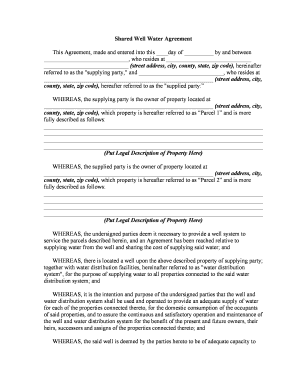
- In the first section, enter the date of the agreement in the format of '____ day of __________'. This date marks when the agreement is officially created.
- Next, fill in the names and addresses of both parties involved. The first section requires the supplying party’s name and their full address, while the following field requires the supplied party’s name and their full address.
- Specify the legal description of the property for both Parcel 1 (owned by the supplying party) and Parcel 2 (owned by the supplied party). This may require a detailed description, depending on local regulations.
- Read through the WHEREAS clauses carefully. These outline the purpose of the agreement and the responsibilities of each party regarding the water distribution system.
- Continue filling out the numbered sections detailing rights, obligations, and payment terms. Be thorough in completing financial details, such as the annual fee amount and payment due dates.
- Make sure to clearly describe any easements granted for maintaining the water system in the specified area.
- Sign and date the agreement at the end. Include any necessary acknowledgment by a notary public, varying by state, if applicable.
Complete your Shared Water Surface Monitoring Agreement online today to ensure clear communication and responsibilities between all parties.
The movement of water between storage containers increases the chances of cross contamination, and storage can provide mosquito breeding sites if containers are not covered properly. When sharing systems become institutionalized, strict obligations to share very limited water could harm the donor household.
Industry-leading security and compliance
-
In businnes since 199725+ years providing professional legal documents.
-
Accredited businessGuarantees that a business meets BBB accreditation standards in the US and Canada.
-
Secured by BraintreeValidated Level 1 PCI DSS compliant payment gateway that accepts most major credit and debit card brands from across the globe.