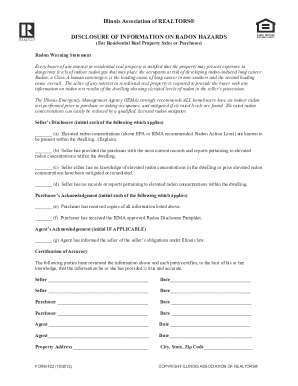
ILLINOIS ASSOCIATION OF REALTORS DISCLOSURE OF INFORMATION ON RADON HAZARDS (For Residential Real Property Sales or Purchases) Radon Warning Statement Every buyer of any interest in residential real.
Open form follow the instructions
Easily sign the form with your finger
Send filled & signed form or save
How to fill out the Radon Disclosure online
Filling out the Radon Disclosure form is an essential step in the residential property sales or purchases process in Illinois. This guide will walk you through each section of the form to ensure you provide the correct information about radon hazards and comply with state guidelines.
Follow the steps to complete the Radon Disclosure form accurately.
- Press the ‘Get Form’ button to acquire the Radon Disclosure form and open it for editing.
- Begin by reading the Radon Warning Statement. This section informs users that the property may expose them to dangerous levels of radon gas, which is linked to lung cancer. Ensure you understand the significance of this information.
- In the Seller’s Disclosure section, review the options and initial each statement that applies. You will indicate whether elevated radon concentrations are known, if you have provided records regarding radon levels, or if there is no knowledge of any concentration levels.
- In the Purchaser’s Acknowledgment portion, initial the statements indicating that you have received copies of all pertinent information and the IEMA approved Radon Disclosure Pamphlet.
- If applicable, complete the Agent’s Acknowledgment by initialing the statement confirming they have informed the seller about their obligations under Illinois law.
- Proceed to the Certification of Accuracy section. Here, each party involved must print their name and sign to certify that the information provided is accurate to the best of their knowledge.
- Complete the Property Address section by filling in the property’s address, city, state, and zip code accurately.
- Finally, review all sections for accuracy and completeness. Once confirmed, you can save your changes, download the form, print it, or share it as needed.
Complete your Radon Disclosure form online today to ensure compliance and safeguard health.
Experience a faster way to fill out and sign forms on the web. Access the most extensive library of templates available.
Related content
Apr 22, 2025 — The agreement notifies purchasers of the potential health problems caused...
Test for radon when buying or selling. Fix if levels are 4 pCi/L or higher. Levels below 4...
New Jersey requires Radon Resistant Construction for all homes and schools in high-radon...
Get answers to your most pressing questions about US Legal Forms API.
What areas is radon most common?
Radon is most common in homes located in the northern and central parts of the U.S., especially states with high geological radon levels. Areas with significant amounts of natural uranium in the soil increase radon prevalence. Always check the Radon Disclosure for specific risks in your area before making property decisions.
How can I get radon?
You can inadvertently allow radon into your home through soil, water supplies, or construction materials. Radon gas seeps from the ground and can enter through cracks or openings. To mitigate this, ensure comprehensive Radon Disclosure when considering properties, as it will highlight potential entry points.
Where is radon most likely to accumulate in a home?
Radon is most likely to accumulate in lower levels of your home, such as basements and crawl spaces. Since radon is a heavy gas, it tends to settle in those areas, often becoming trapped. A thorough Radon Disclosure will help you identify these risky spots and take necessary action.
What homes are most at risk for radon?
Homes in certain geographic areas, particularly those with high levels of uranium in the soil, are at greater risk for radon. Properties with basements or those built on slab foundations can also trap radon. Always check for a Radon Disclosure to understand the risks associated with a specific property.
What homes are most likely to have radon?
Homes built on rock, particularly granite and other natural materials, are more likely to have higher radon levels. Additionally, older homes that have poor ventilation may also experience higher radon concentration. This is why obtaining a Radon Disclosure before buying a home can help you make informed decisions.
How do I get exposed to radon?
You can get exposed to radon when it enters your home through cracks in the foundation, gaps around pipes, or other openings. This radioactive gas can accumulate indoors, especially in lower areas like basements. Understanding radon exposure is crucial for your health, which is why Radon Disclosure is so important.
Is radon disclosure required in Colorado?
Yes, radon disclosure is mandated in Colorado as part of real estate transactions. Sellers are required to inform potential buyers about any known radon levels and provide a radon test report if available. This legal requirement helps protect buyers from unforeseen health risks associated with radon exposure. Utilizing platforms like US Legal Forms can simplify the process of preparing and managing radon disclosure documents.
What is a radon test report?
A radon test report outlines the levels of radon detected in a specific property. Typically, these reports are generated after conducting a radon test, which measures the concentration of the gas over a specified duration. This documentation is crucial, as it informs potential homeowners about the safety of the environment they are considering. Including radon disclosure in real estate deals ensures that buyers are fully informed of the test results.
What is the biggest source of radon?
The biggest source of radon originates from natural radioactive decay in soil and rock, especially granite and limestone. As radon gas seeps through cracks and openings in foundations, it can build up in homes and enclosed spaces. Homeowners should be aware that construction materials, well water, and even certain soils can contribute to radon presence. Ensuring radon disclosure can help prospective buyers understand the potential risks associated with the property.
How do you read a radon report?
Reading a radon report is simple when you know what to look for. Focus on the reported picocuries per liter (pCi/L) to gauge your home's radon level. Assess the time period of the test, as long-term tests are more reliable, and consider any recommendations on mitigation actions based on the results.
Use professional pre-built templates to fill in and sign documents online faster. Get access to thousands of forms.
If you believe that this page should be taken down, please follow our DMCA take down process here.