
Open form follow the instructions

Easily sign the form with your finger

Send filled & signed form or save
How to fill out the CERVICAL SPINE ASSESSMENT online
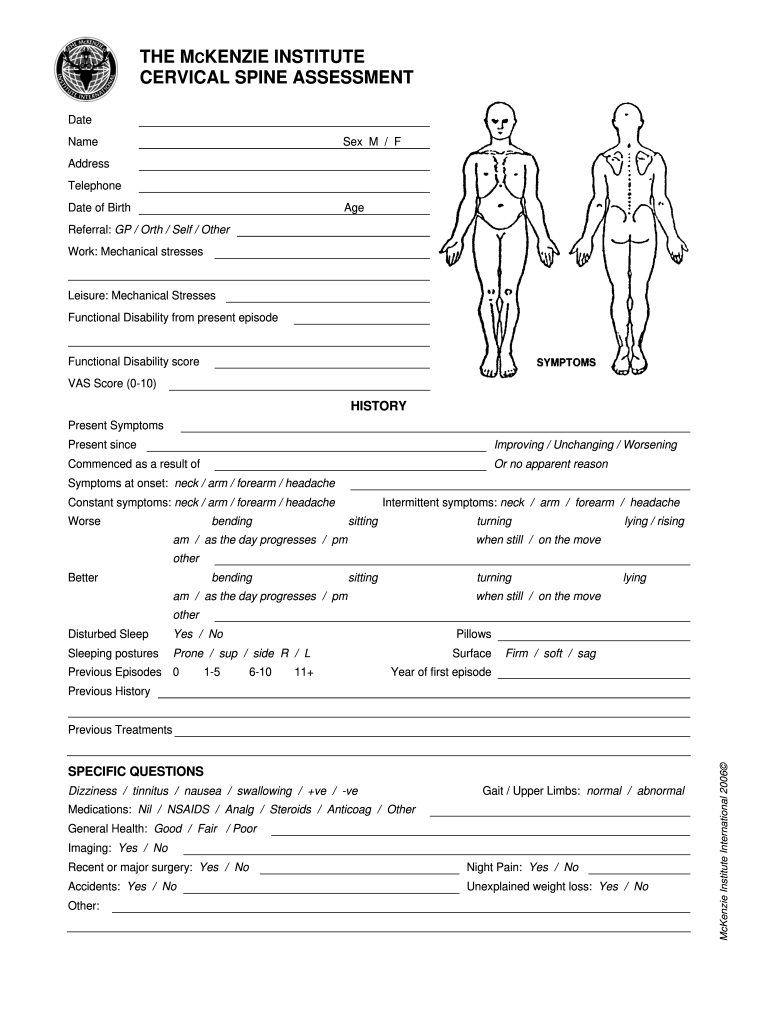
Completing a cervical spine assessment online is a crucial step in evaluating neck discomfort and related symptoms. This guide will provide detailed instructions on filling out the form correctly and efficiently.
Follow the steps to successfully complete the assessment.
- Click ‘Get Form’ button to access the cervical spine assessment and open it in your preferred editing tool.
- Fill in your personal information including the date, your name, sex, address, telephone number, date of birth, and age. Make sure to provide accurate data as this will help your healthcare provider understand your case better.
- Indicate your referral source by selecting from the given options such as GP, Orthopedic, Self, or Other. This helps in noting the context of your assessment.
- Assess and record any mechanical stresses related to your work and leisure activities. This information can influence the analysis of your spine health.
- Next, evaluate your functional disability due to the current episode. Record your disability score and your Visual Analog Scale (VAS) score, which allows you to express your pain level from 0 to 10.
- In the history section, detail your present symptoms, how long they have persisted, whether they are improving, unchanging, or worsening, and the circumstances surrounding their onset.
- Document any constant or intermittent symptoms you experience and identify factors that worsen or improve these symptoms based on daily activities.
- Note any sleep disturbances and your sleeping postures, as these can provide important insights into your condition.
- Fill in sections regarding previous episodes and medical history, ensuring to provide accurate data to guide your assessment.
- Complete the specific questions section without leaving any applicable items blank. This includes aspects related to dizziness, medications, general health, and any past treatments.
- Proceed to examine your posture by selecting options for both sitting and standing positions. Document any additional observations regarding your posture.
- Record any neurological observations, including motor and sensory deficits, and assess your movement loss for specific actions.
- In the test movements section, describe the effects your pain experiences during and after the testing.
- Finally, classify provisional results into categories and outline the principles of management recommended for your condition, detailing any necessary equipment provided.
- Once all sections are completed, review your entries for accuracy. Save changes to your assessment, then choose to download, print, or share the form as required.
Complete your cervical spine assessment online today to take an important step towards addressing your neck health.
Experience a faster way to fill out and sign forms on the web. Access the most extensive library of templates available.
Related content
by N Strimpakos · 2011 · Cited by 160 — A comprehensive assessment of neck function...
(consider the Canadian C-spine rules through-out your examination). Observation: Joint...
Cervical Spine. Flexion. □ 45–50. Extension. □ 45–75. Lateral flexion. □ 45...
Get answers to your most pressing questions about US Legal Forms API.
How do you document a normal spine assessment?
Documenting a normal spine assessment involves recording findings clearly and accurately in the patient's medical record. This documentation should include details on range of motion, muscle strength, and any tests performed during the cervical spine assessment. Utilizing platforms like USLegalForms can assist in maintaining organized records and ensuring compliance with legal standards.
What is the general examination of the spine?
A general examination of the spine includes observing posture, assessing spinal curvature, and checking range of motion. During the cervical spine assessment, a healthcare professional will palpate the area to identify any abnormalities. An accurate examination helps in understanding the overall health of your spine and strategizing further action.
How do you assess the spine?
Assessing the spine involves a series of physical tests, including range of motion evaluations, strength checks, and postural assessment. Your healthcare provider will look for signs of inflammation, tenderness, or misalignment in the cervical area. A thorough cervical spine assessment can help identify problems early on, allowing for timely intervention.
What are the 5 D's for neck pain?
The 5 D's for neck pain include dizziness, diplopia (double vision), dysphagia (difficulty swallowing), drop attacks, and numbness. These symptoms can indicate serious issues involving the cervical spine. If you experience any of these symptoms during a cervical spine assessment, it is important to seek professional medical advice.
How to do cervical assessment?
A cervical assessment typically involves physical examination, observational tests, and sometimes imaging studies. A healthcare professional may evaluate your neck's range of motion, check for tenderness, and assess muscle strength. For a comprehensive cervical spine assessment, consider using resources like USLegalForms to establish an accurate examination process.
How to check if your spine is normal?
To check if your spine is normal, start by performing simple movements like turning your head and tilting it from side to side. Observe if you experience any pain or discomfort during these motions. Regular cervical spine assessments conducted by a healthcare professional can also provide insights into your spinal health.
What is C3, C4, C5, C6, and C7 of the spine?
C3, C4, C5, C6, and C7 refer to specific cervical vertebrae located in the neck. These vertebrae play a crucial role in supporting the head, protecting the spinal cord, and allowing for neck movement. Understanding their functions is essential during a cervical spine assessment, as any abnormalities can indicate underlying issues.
What are normal findings of the spine assessment?
Normal findings during a cervical spine assessment typically include full range of motion without pain, symmetrical muscle strength, and proper spinal alignment. Additionally, there should be no signs of tenderness or swelling in the cervical region. A normal assessment indicates that the spine is functioning correctly and the nerves are transmitting signals effectively.
What are the three components of cervical examination?
The three main components of a cervical examination are inspection, palpation, and range of motion assessment. Inspection involves visually examining the neck for abnormalities, while palpation helps identify tender areas or muscle spasms. Lastly, performing range of motion tests allows you to assess mobility and flexibility. Integrating these components leads to a thorough cervical spine assessment.
What are the 4 tests for cervical radiculopathy?
The four tests for cervical radiculopathy include the Spurling's test, neck distraction test, upper limb tension test, and the cervical compression test. Each test serves to evaluate nerve root involvement and the source of pain. Effectively applying these tests during a cervical spine assessment can enhance diagnosis and treatment strategies. Understanding each test will improve your clinical effectiveness.
Use professional pre-built templates to fill in and sign documents online faster. Get access to thousands of forms.
If you believe that this page should be taken down, please follow our DMCA take down process here.