Open form follow the instructions
Easily sign the form with your finger
Send filled & signed form or save
How to fill out the Bankruptcy Schedule F Template online
The Bankruptcy Schedule F Template is a crucial document for individuals filing for bankruptcy. This guide provides clear and supportive instructions on how to accurately fill out this template online.
Follow the steps to complete the Bankruptcy Schedule F Template.
- Click the ‘Get Form’ button to obtain the form and open it in the editor.
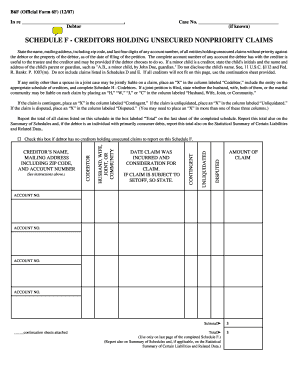
- Begin by entering the debtor's information at the top of the form, including the name and case number if known. Ensure that all details are accurate.
- In the section labeled 'Creditor’s name, mailing address including zip code, and account number,' enter the details for each creditor holding unsecured nonpriority claims against the debtor.
- For each creditor, complete the fields for 'Amount of claim,' 'Date claim was incurred and consideration for claim,' and any applicable boxes for 'Contingent,' 'Disputed,' or 'Unliquidated' claims.
- If there are joint claims, indicate this in the 'Husband, Wife, Joint, or Community' section by entering 'H,' 'W,' 'J,' or 'C' as applicable.
- If any creditor is a minor child, include the child's initials and the name and address of their parent or guardian, without disclosing the child's name.
- Continue filling out each creditor entry, using the continuation sheet if necessary, until all claims are documented.
- At the end of the form, calculate and report the total of all claims in the box labeled 'Total.' This total should also be reported in the Summary of Schedules.
- Once all information is complete, review the document for any errors, make necessary corrections, and then proceed to save your changes or download, print, or share the completed form.
Take the next step in your bankruptcy process by completing your Bankruptcy Schedule F Template online today.
Experience a faster way to fill out and sign forms on the web. Access the most extensive library of templates available.
Related content
Bankruptcy forms include those for individual and non-individual debtors, such as...
The debtor must file a list containing the name and address of each entity included or to...
Jan 26, 2017 — Schedule C (Form 1040) or Schedule F (Form. 1040); partnerships deduct...
Get answers to your most pressing questions about US Legal Forms API.
How hard is it to file bankruptcy by yourself?
Filing for bankruptcy by yourself can be challenging but is certainly doable with the right tools. The Bankruptcy Schedule F Template can simplify the process by helping you organize your unsecured debts accurately. However, be prepared to invest time in understanding the laws and procedures involved. Many find it helpful to seek guidance from legal professionals to navigate the process effectively.
What is a Schedule F for bankruptcy?
Schedule F is a crucial document in the bankruptcy process as it lists your unsecured debts, including credit cards and medical bills. The Bankruptcy Schedule F Template helps you provide a clear overview of these liabilities. By accurately completing this schedule, you ensure that all creditors are duly informed of your debts, enabling a smoother bankruptcy process.
Where do I get the forms to file bankruptcy?
You can obtain bankruptcy forms, including the Bankruptcy Schedule F Template, from the US Courts website or your local bankruptcy court. Additionally, many legal service websites offer downloadable and fillable versions of these forms. Utilizing reliable resources makes accessing the necessary paperwork easy and straightforward.
What is the fastest way to file for bankruptcy?
The fastest way to file for bankruptcy is to prepare all necessary documentation in advance. Using the Bankruptcy Schedule F Template allows you to organize your unsecured debts quickly and efficiently. Online filing services can expedite the process. Just ensure that all your information is accurate and up to date.
Where do I start to file bankruptcies?
Starting your bankruptcy process begins by assessing your financial situation. You can utilize online resources, including the Bankruptcy Schedule F Template, to identify your debts and categorize them properly. Next, you may want to consult with a legal professional or visit your local bankruptcy court. Gathering the required paperwork is your first step toward filing.
What paperwork do I need to file for Chapter 7?
To file for Chapter 7 bankruptcy, you will need to gather specific documents, such as your bankruptcy petition, schedules, and statements. The Bankruptcy Schedule F Template is essential because it details your unsecured debts. In addition, you should have proof of income, tax returns, and a list of your assets. Organizing these documents can simplify the filing process significantly.
What is the minimum amount for a bankruptcy notice?
There is no specific minimum amount required for a bankruptcy notice, as it covers all qualifying debts, regardless of their size. This notice serves as a legal alert regarding your financial obligation status and proceedings. A Bankruptcy Schedule F Template can assist you in detailing debts accurately, which helps in understanding your overall financial picture. It is important to list all debts, even if they are small, to ensure full transparency in your filing.
How to set aside a bankruptcy notice?
Setting aside a bankruptcy notice requires formal action in court. Begin by filing a motion that outlines the reasons you believe the notice should be overturned. Utilizing a Bankruptcy Schedule F Template can help you present a comprehensive account of your debts, supporting your motion effectively. It is crucial to act promptly to address any legal obligations related to the bankruptcy notice.
How do I set aside a bankruptcy notice?
To set aside a bankruptcy notice, you need to file a motion with the court that issued the notice. This involves submitting documents that explain why the notice should be reconsidered or dismissed. A Bankruptcy Schedule F Template can guide you in organizing the required information about your debts, making your case clearer to the court. Working with a legal professional can also enhance your chances of success.
Which bankruptcy clears all debt without paying?
Chapter 7 bankruptcy allows you to clear most debts without payment. This process typically results in a discharge of unsecured debts after liquidating non-exempt assets. Many individuals utilize a Bankruptcy Schedule F Template to organize their debts effectively, making it easier to navigate this bankruptcy type. It's a fresh start that many seek when overwhelmed by financial obligations.
Use professional pre-built templates to fill in and sign documents online faster. Get access to thousands of forms.
If you believe that this page should be taken down, please follow our DMCA take down process here.