Loading
Get Hits Screening Tool 2020-2026
How it works
-

Open form follow the instructions
-

Easily sign the form with your finger
-

Send filled & signed form or save
How to fill out the Hits Screening Tool online
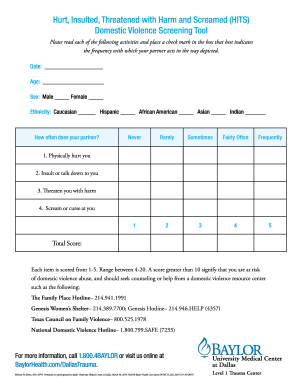
The Hits Screening Tool is designed to assess the frequency of potentially harmful behaviors in a partner. This guide provides step-by-step instructions for filling out the form online, ensuring you have the necessary support and guidance throughout the process.
Follow the steps to fill out the Hits Screening Tool accurately.
- Press the ‘Get Form’ button to access the Hits Screening Tool and open it in your preferred online editor.
- Begin by filling in the date and your age in the designated fields. This information is essential for tracking and context.
- Indicate your sex by checking the appropriate box: Male or Female. This demographic information helps in understanding the survey context.
- Select your ethnicity by marking one of the available options: Caucasian, Hispanic, African American, Asian, or Indian. This helps in gathering relevant demographic data.
- For each of the behaviors listed under 'How often does your partner?', check the box that reflects the frequency from the following options: Never, Rarely, Sometimes, Fairly Often, or Frequently. This scoring is crucial for assessing potential risk.
- After evaluating the frequency of actions, calculate your total score by adding the values from items 1-4. The scores range from 4 to 20.
- Review your total score. A score higher than 10 may indicate a risk of domestic violence, prompting the need for resources or counseling.
- If necessary, reach out to listed domestic violence resources for support. This step is critical for ensuring safety and access to help.
- Once you have filled out the entire form, you can save your changes, download a copy for your records, print it, or share it as needed.
Take action now and complete the Hits Screening Tool online.
A hits score represents the cumulative risk assessed by the Hits Screening Tool based on the user's responses. This score helps indicate the level of risk an individual may face in their current situation. It serves as a valuable metric for identifying urgent needs for assistance or intervention. Users can rely on the hits score to guide them in making critical decisions regarding their safety.