Open form follow the instructions
Easily sign the form with your finger
Send filled & signed form or save
How to fill out the Transfer On Death Deed New Mexico online
This guide provides comprehensive instructions for filling out the Transfer On Death Deed in New Mexico. By following these steps, you can ensure that your property is transferred according to your wishes after your passing.
Follow the steps to complete your deed accurately.
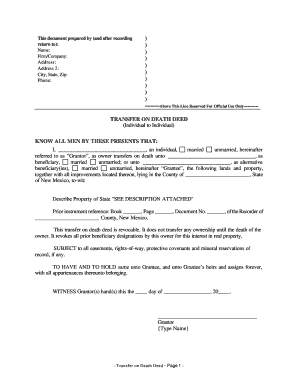
- To start, click the ‘Get Form’ button to obtain the Transfer On Death Deed form and open it in your preferred editor.
- Begin by entering your name as the Grantor in the first section. Specify your marital status by selecting either 'married' or 'unmarried'.
- Next, indicate the name of the beneficiary who will receive the property upon your death. Again, specify their marital status as 'married' or 'unmarried'.
- If applicable, list any alternative beneficiaries in the designated sections, noting their marital status as needed.
- Describe the property being transferred. If further details are attached, mention 'SEE DESCRIPTION ATTACHED'.
- Include the prior instrument reference along with the corresponding book, page, and document numbers related to the property.
- Acknowledge the revocable nature of the deed, noting that ownership is transferred only upon the death of the Grantor and that all prior beneficiary designations are revoked.
- Finalize the document by signing it on the designated date and including your typed name beneath your signature.
- Have the deed acknowledged in front of a notary public, who will complete their portion of the document. Provide your printed name and the notary’s commission expiration date if needed.
- After completing the form, review all entries for accuracy. You can then save your changes, download, print, or share the form as necessary.
Complete your Transfer On Death Deed online today to ensure your wishes are honored.
Experience a faster way to fill out and sign forms on the web. Access the most extensive library of templates available.
Related content
An individual may transfer property to one or more beneficiaries effective at the...
What does the Transfer on Death (TOD) deed do? When you die, this deed transfers the...
Jan 30, 2018 — If you are a widowed taxpayer who doesn't meet the 2-year ownership and...
Get answers to your most pressing questions about US Legal Forms API.
How to get a deed transferred to your name after death?
To transfer a deed to your name after the death of the property owner, you will need to follow the process outlined in New Mexico’s Transfer On Death Deed provisions. Start by obtaining a death certificate and any necessary documentation. Next, complete and file the appropriate transfer forms with your local clerk's office. If you encounter issues or have questions, platforms like US Legal Forms can provide the necessary resources to guide you through the process efficiently.
Does a TOD avoid inheritance tax?
A Transfer On Death Deed in New Mexico does not inherently avoid inheritance tax. While the deed streamlines the transfer process, any potential tax implications depend on your overall estate size and your locality’s regulations. It is vital to consult with a tax professional to understand how a TOD might affect your taxes in context.
Does New Mexico allow transfer on death deeds?
Yes, New Mexico does allow Transfer On Death Deeds. This legal option enables property owners to transfer ownership to a designated beneficiary upon their death. It is designed to simplify the transfer process and avoid probate, making it an attractive choice for many. Always ensure that the deed complies with local regulations when creating one.
What are the downsides of TOD?
One downside of a Transfer On Death Deed in New Mexico is that it may not eliminate all complexities regarding your estate. For instance, certain types of property, like that under a trust, might not be effectively managed through a TOD. Additionally, this system does not address issues arising from disagreements among heirs. Proper planning can mitigate these concerns.
What are the disadvantages of a transfer on death deed?
While a Transfer On Death Deed in New Mexico offers benefits, it also comes with some disadvantages. One key issue is that if you have outstanding debts, creditors may still claim your property before the transfer. Additionally, you cannot use the property as collateral for loans after establishing a TOD. It's crucial to weigh these factors when considering your estate planning strategies.
Which is better, TOD or beneficiary after death?
A Transfer On Death Deed in New Mexico allows for a straightforward transfer of property upon death, avoiding probate. Choosing a TOD can be more efficient than naming a beneficiary, as the deed directly names the recipient. Each option has its benefits, and your choice should depend on your specific situation and preferences. Consulting with an estate planning professional can help clarify your best path.
Can you sell a house with a transfer on death deed?
Yes, you can sell a house that has a Transfer On Death Deed in New Mexico. The deed does not restrict your ability to sell the property while you are alive. When you decide to sell, simply revoke the Transfer On Death Deed. Make sure to follow the proper legal procedures to ensure everything is in order.
Where to file a transfer on death deed?
To file a Transfer On Death Deed New Mexico, you should visit your local county clerk’s office. It is essential to ensure the deed is recorded properly to become legally valid. Platforms like US Legal Forms can provide guidance and the necessary forms to simplify this process, making it easy to ensure your deed is filed correctly.
How do I file a transfer on death deed in New Mexico?
Filing a Transfer On Death Deed New Mexico is a straightforward process. You’ll need to complete the specific form available from legal resources or platforms like US Legal Forms. After filling out the deed, you should sign and record it at your local county clerk's office to make it official. This ensures your wishes regarding property transfer are honored.
How are assets transferred from a deceased estate?
Assets in a deceased estate can be transferred in several ways, with a Transfer On Death Deed being one efficient option in New Mexico. If no such deed exists, the assets typically go through probate, where a court oversees the distribution according to the will or state law. This can be a lengthy process, highlighting the benefits of planning ahead with a Transfer On Death Deed.
Use professional pre-built templates to fill in and sign documents online faster. Get access to thousands of forms.
If you believe that this page should be taken down, please follow our DMCA take down process here.