Loading

Open form follow the instructions

Easily sign the form with your finger

Send filled & signed form or save
How to fill out the Complaint Partition online
Filling out a Complaint Partition form online can seem daunting, but with clear guidance, you can complete it with confidence. This guide provides step-by-step instructions to help you navigate each section effectively.
Follow the steps to complete your Complaint Partition form online.
- Press the ‘Get Form’ button to access the form and open it in your preferred editor.
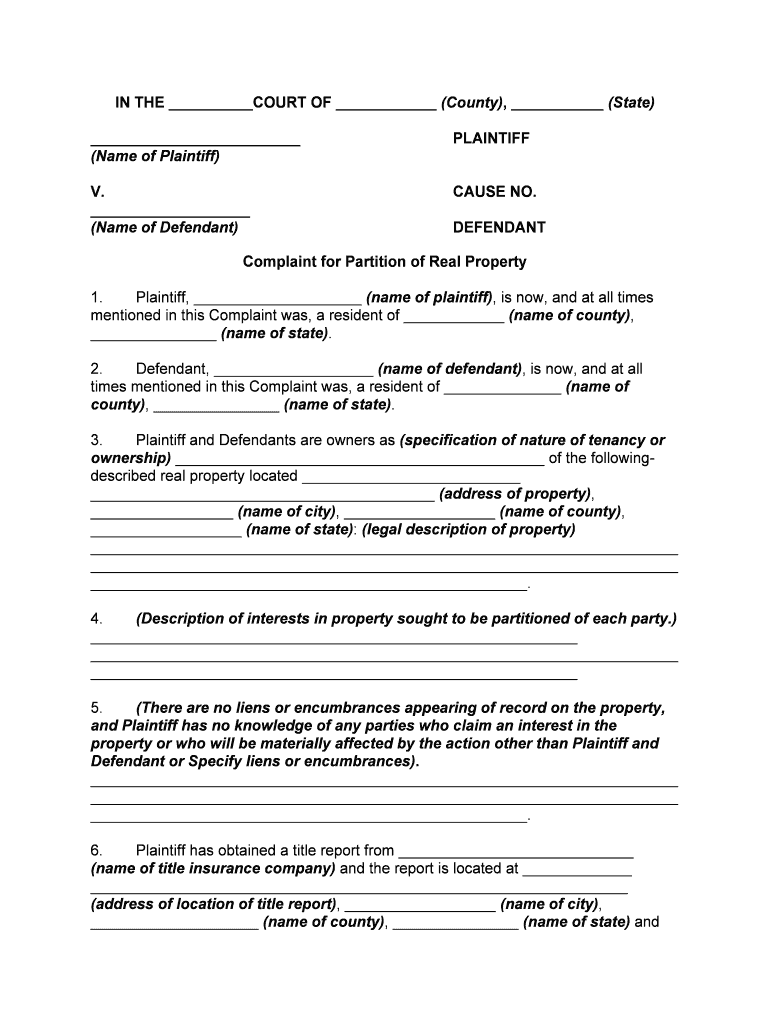
- Begin filling out the complaint by entering the court details, specifying the name of the county and state where the filing is taking place.
- In the plaintiff section, input your name and ensure that you are accurately reflecting your county and state of residence.
- Proceed to the defendant section by entering the name of the defendant along with their corresponding county and state.
- Indicate the nature of ownership between the parties and provide the address of the property in question, along with its legal description.
- Detail the interests in the property sought to be partitioned by each party involved.
- If applicable, mention if there are any liens or encumbrances on the property, specifying whether you are aware of any claims by other parties.
- State the name of the title insurance company from which you obtained a title report, and provide its location details for inspection.
- Articulate the common benefit of the partition action and account for any reasonable attorney’s fees that may incur.
- Conclude by affirmatively asking the court for the partition of the property and note any additional relief you are seeking.
- Sign the form as the plaintiff and, if represented, have your attorney sign as well, including their bar number.
- Finally, ensure the document is notarized where required and save the changes made. You can then download, print, or share the completed form as needed.
Complete your Complaint Partition online today for a smoother filing experience.
Experience a faster way to fill out and sign forms on the web. Access the most extensive library of templates available.
Related content
Accordingly, Plaintiff(s) asks that the Court partition the land by division or by sale...
Aug 5, 2013 — One of the perils of owning real estate in co-ownership is the right of a...
Informed consent can be divided across several screens for easier retention. Participants...
Get answers to your most pressing questions about US Legal Forms API.
What is the doctrine of partition?
The doctrine of partition is a legal principle that grants co-owners the right to seek separation of their jointly held property. This doctrine underpins the complaint partition process, allowing owners to assert their rights and pursue fair distribution. Familiarizing yourself with this doctrine can empower you in discussions regarding property disputes.
What are the rules for partition?
The rules for partition generally require clear ownership interest among co-owners and a fair approach to dividing the property. Courts may mandate mediation prior to proceeding with litigation to encourage settlements. Understanding these rules can be instrumental in navigating the partition process smoothly.
What is the latest judgement for partition?
The latest judgment regarding complaint partition emphasizes the need for equitable distribution among co-owners. Courts today focus on fair outcomes, considering property values and owners' investments. Staying updated on recent case law can provide insights into how similar cases may be resolved.
What is the partition rule?
The partition rule allows co-owners to divide or sell property when they cannot agree on its use or management. This legal framework supports owners seeking to resolve disputes through court intervention. Following the partition rule ensures that all parties have their rights protected and promotes a fair process.
How do you start a partition action?
To initiate a complaint partition, the first step is to file a petition in the appropriate court. This petition should detail the property in question and the ownership shares of all parties involved. Once filed, the court will notify all parties, setting the stage for mediation or litigation to resolve the partition.
What are the requirements of a partition?
In a complaint partition, the primary requirement is joint ownership of property among the parties involved. Each owner must typically have a clear share in the property for the partition action to proceed. Understanding property rights and how they apply in your situation can simplify the partition process and lead to effective resolutions.
What does partition mean in legal terms?
In legal terms, partition refers to the division of property among co-owners so each can enjoy their share independently. A Complaint Partition allows one co-owner to request a legal judgment that facilitates this division. This concept commonly applies to real estate, where multiple parties own an interest in a property. Understanding this term can empower you to make informed decisions in shared ownership situations.
What happens in a partition action?
In a partition action, the court examines the ownership interests of each party and the property involved. The process typically includes evaluating how to divide or sell the property to ensure that everyone receives their fair portion. Depending on the situation, the court may appoint a referee or a third party to assist in the division. Successfully navigating a Complaint Partition can ease tensions among co-owners.
What is an example of a partition action?
An example of a partition action could involve siblings who inherit a family home but disagree on whether to keep or sell it. One sibling may file a Complaint Partition to request that the court decide how to divide or sell the property. This action aims to resolve ownership disputes fairly and efficiently. It serves as a practical means to handle shared property ownership.
What happens after a partition is filed?
Once a Complaint Partition is filed, the court will review the case and notify all parties involved. They may schedule a hearing to determine the best course of action for partitioning the property. After the hearing, the court will issue an order, which may include dividing the property or ordering a sale. It is essential to follow the court's instructions to ensure a smooth resolution.
Use professional pre-built templates to fill in and sign documents online faster. Get access to thousands of forms.
If you believe that this page should be taken down, please follow our DMCA take down process here.