Get If We Had No Moon Answers
How it works
-

Open form follow the instructions
-

Easily sign the form with your finger
-

Send filled & signed form or save
How to fill out the If We Had No Moon Answers online
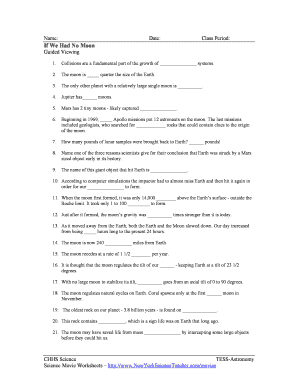
Filling out the If We Had No Moon Answers form is a straightforward process that allows users to engage with essential concepts about the moon and its impact on Earth. This guide provides a step-by-step approach to ensure that you accurately complete the form and gain a deeper understanding of the subject matter.
Follow the steps to successfully complete the If We Had No Moon Answers form.
- Click the ‘Get Form’ button to access the If We Had No Moon Answers document and open it in your preferred editor.
- Begin with the first field asking about collisions as a fundamental part of the growth of systems; fill in the blank appropriately.
- Move to the next statement regarding the size of the moon in relation to Earth; input the correct fraction.
- Continue to the question about the planet with a single large moon; provide the correct planet name.
- In the section about Jupiter, indicate the number of moons it has.
- For Mars, note its two moons and specify their nature as captured objects.
- Fill in details about the Apollo missions and the types of rocks searched for by geologists.
- Indicate the total weight of lunar samples brought back to Earth.
- Answer the question regarding one reason scientists suggest a Mars-sized object struck Earth during its early history.
- Name the giant object that impacted Earth.
- Complete the statement regarding the conditions for the moon's formation and its distance from Earth during its emergence.
- Provide information on the moon's gravity strength compared to today.
- Fill in the progression of Earth's day length.
- Indicate the current distance of the moon from Earth.
- Specify the rate at which the moon moves away from Earth.
- Conclude with details on how the moon stabilizes Earth's axial tilt.
- Fill in the effects of a lack of a large moon on Earth's axial tilt.
- Mention how the moon regulates natural cycles on Earth.
- Identify where the oldest rock on the planet is found.
- Provide information on the elements found in that rock that signify ancient life.
- Complete the statement about the moon's role in protecting Earth from mass extinction events.
- Note the possible presence of water ice at the moon's poles.
- Indicate the potential source of water on the moon.
- Mention the spacecraft that detected hydrogen and its significance.
- Provide information regarding the cost-effectiveness of launching from the moon.
- Complete the statement regarding the Medusa spacecraft and its unique design.
- Indicate the number of planets discovered around other stars.
Start completing the If We Had No Moon Answers form online today to enhance your understanding of lunar science!
If we had no moon, we'd certainly miss the soothing brightness it casts during the night, providing natural illumination. The tides, critically shaped by the moon, would lose their rhythmic pattern, affecting countless marine species and activities like fishing. Moreover, the moon has been a pivotal figure in many mythologies and cultural narratives worldwide. Reflecting on these aspects helps us appreciate the immense influence our moon has over life on Earth.