How it works
  • Open form

    Open form follow the instructions

  • Easily sign form

    Easily sign the form with your finger

  • Share form

    Send filled & signed form or save

How to fill out the Institutional Representation Of Democracy Worksheet online

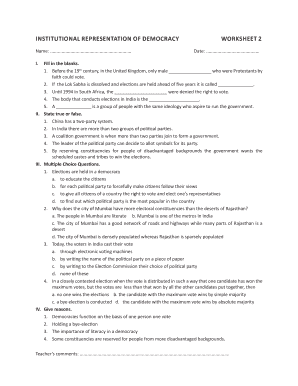
Filling out the Institutional Representation Of Democracy Worksheet online is an important step in understanding democratic processes. This guide provides clear instructions on how to complete each section of the form effectively.

Follow the steps to complete the worksheet online.

  1. Click ‘Get Form’ button to access the worksheet and open it in your editor.
  2. Begin with Section I, where you need to fill in the blanks. Each statement requires specific historical or factual information regarding democracy and voting rights. Take your time to ensure accuracy and completeness.
  3. Proceed to Section II, which asks you to evaluate statements as true or false. Carefully read each statement and think critically about democratic principles and political systems.
  4. Move on to Section III, where you will answer multiple-choice questions. Review each question attentively, considering what you know about democracy, representation, and electoral processes.
  5. In Section IV, you will provide reasons for certain statements about democracy. Formulate clear and concise explanations based on your understanding of the subjects discussed in the previous sections.
  6. Once you have completed all sections, ensure all information is correct. You can then save your changes, download the form, print it out, or share it as needed.

Start completing the Institutional Representation Of Democracy Worksheet online today!

Get form

Experience a faster way to fill out and sign forms on the web. Access the most extensive library of templates available.

Related content

Federalist Paper #10

8. How do factions contribute to the failure of a pure democracy? 9. Explain the formula...

Learn more
Basic Concepts Of Democracy Worksheet Answers

debate, competition, and representation of diverse interests within society, which...

Learn more
Think Outside The Boss: How To Create A Worker...

Mar 13, 2013 — A business founded on democratic workplace principles should spend extra...

Learn more
Questions & Answers

Get answers to your most pressing questions about US Legal Forms API.

Contact support

What is institutional representation?

In film theory, the institutional mode of representation (IMR) is the dominant mode of film construction, which developed in the years after the turn of the century, becoming the norm by about 1914. Although virtually all films produced today are made within the IMR, it is not the only possible mode of representation.

The United States is a representative democracy. This means that our government is elected by citizens. Here, citizens vote for their government officials. These officials represent the citizens' ideas and concerns in government.

Liberal democracy, emphasising individual freedom and scepticism toward power concentrated into groups or government; and. Social democracy, emphasising equality through the collective action of groups, government and organisations.

Its foundation is based on the country's people. We hav two types of democracies that is Parliamentary Democracy and presidential democracy: In a Parliamentary Democracy, the President appoints the Prime Minister from the leader of the party with the most Loksabha seats.

Features of democracy often times include freedom of assembly, association, personal property, freedom of religion and speech, citizenship, consent of the governed, voting rights, freedom from unwarranted governmental deprivation of the right to life and liberty, and minority rights.

India is a Sovereign Socialist Secular Democratic Republic with a Parliamentary form of government which is federal in structure with unitary features. There is a Council of Ministers with the Prime Minster as its head to advice the President who is the constitutional head of the country.

Consensus democracy – rule based on consensus rather than traditional majority rule. Constitutional democracy – governed by a constitution. Deliberative democracy – in which authentic deliberation, not only voting, is central to legitimate decision making.

Liberal democracy, emphasising individual freedom and scepticism toward power concentrated into groups or government; and. Social democracy, emphasising equality through the collective action of groups, government and organisations.

Get This Form Now!

Use professional pre-built templates to fill in and sign documents online faster. Get access to thousands of forms.

If you believe that this page should be taken down, please follow our DMCA take down process here.

Get Institutional Representation Of Democracy Worksheet