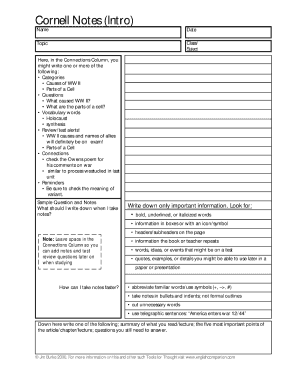
Cut unnecessary words. use telegraphic sentences: America enters war 12/44 . How can I take notes faster? Cornell Notes (Intro). Note: Leave space in the .
Open form follow the instructions
Easily sign the form with your finger
Send filled & signed form or save
How to fill out the English Companion Cornell Notes Form online
Filling out the English Companion Cornell Notes Form online can streamline your note-taking process and enhance your learning experience. This guide provides detailed instructions to help you navigate the form with ease.
Follow the steps to complete your form accurately and efficiently.
- Click the ‘Get Form’ button to access and open the form in your online editor.
- Begin by entering your name in the designated field. This ensures that your notes are properly attributed to you.
- Proceed to the date section. Fill in the date when you are completing the notes. This helps in organizing your study materials.
- Next, identify the topic of your notes. Enter a clear, concise title that reflects the subject matter you will be discussing.
- Utilize the main notes section to jot down key ideas, concepts, and information during your learning session. Keep it organized and legible.
- In the summary section, summarize the main points of the notes you've taken. This reinforces your understanding and retention of the material.
- Review all your entries for accuracy and completeness before finalizing your notes.
- Once you are satisfied with the content, save your changes to ensure all your information is stored securely.
- You can choose to download, print, or share the completed form with others as needed.
Start filling out your documents online for a more efficient and organized approach.
Experience a faster way to fill out and sign forms on the web. Access the most extensive library of templates available.
Related content
• Works with a partner to ask and answer questions using the completed Cornell Notes...
As you're taking notes, keep cue column empty. Soon after the lecture, reduce your notes...
Taking Notes with Column Notes. Based on the Cornell note taking system, Kurzweil 3000...
Get answers to your most pressing questions about US Legal Forms API.
What are the 5 R's of Cornell notes?
The 5 R's of Cornell notes include Record, Reduce, Reflect, Recite, and Review. First, you record detailed notes during lectures, then reduce them into key points or cues. Afterward, reflect on what you learned, recite or sketch the content from memory, and finally, review the notes regularly. Implementing the English Companion Cornell Notes Form can streamline this process, helping you to remember information more effectively.
What is the format for Cornell notes?
The format for Cornell notes involves dividing your page into three distinct sections: the left column for cues, the right column for comprehensive notes, and a footer for summarization. This layout encourages students to jot down essential points while also prompting self-reflection on the material. By using the English Companion Cornell Notes Form, you ensure that your notes are not only neatly organized but also effective for review and retention.
How do you structure Cornell notes?
To structure Cornell notes, create a large right section for detailed notes, a left column for cues or questions, and a summary area at the bottom. This organization encourages active listening and helps you engage with the content. You can then use the English Companion Cornell Notes Form template to align with this structure, which further enhances clarity and focus during and after lectures or while studying. This method benefits various learning styles.
What are three major components of Cornell notes?
The three major components of Cornell notes are the cue column, the note-taking area, and the summary section. The cue column is where you write keywords or questions that trigger your memory. In the note-taking area, you fill in detailed notes from lectures or readings, and the summary section at the bottom allows you to capture the main ideas. Utilizing the English Companion Cornell Notes Form helps keep these components organized, paving the way for effective study sessions.
How to make a Cornell notes template?
To create a Cornell notes template, you can start by dividing a sheet of paper or a digital document into three sections: a narrow left column, a wider right column, and a summary area at the bottom. The left column is for keywords or questions, the right section is for detailed notes, while the bottom section serves as a summary. Using the English Companion Cornell Notes Form can simplify this task by providing a clear structure, ensuring that you capture all the essential information.
Is there a Cornell notes template on Google Docs?
Yes, a Cornell notes template is available on Google Docs. This can make your note organization easier as you can access it from anywhere with internet access. Simply search for 'Cornell notes template' within the Google Docs template gallery, or you can personalize the English Companion Cornell Notes Form to fit your learning needs. This flexibility can significantly improve your note-taking efficiency.
Can ChatGPT make Cornell notes?
Yes, ChatGPT can help you create Cornell notes using the English Companion Cornell Notes Form. By interacting with the AI, you can structure your notes effectively, while also ensuring that you capture important concepts and details. This technology streamlines your note-taking process, making it more efficient and simpler. Ultimately, you can enhance your learning experience with well-organized notes.
What are 5 reasons Cornell notes are useful?
Cornell notes are useful because they encourage critical thinking, highlight main ideas, promote active engagement, reinforce memory, and facilitate efficient review. These benefits lead to greater retention and understanding of the material. Implementing the English Companion Cornell Notes Form can enhance these advantages, making learning more efficient and enjoyable.
What are the 5 phases of taking notes?
The 5 phases of taking notes typically encompass planning, recording, processing, reviewing, and applying. This sequence guides you through effective note-taking practices, ensuring that you capture and utilize information wisely. By adopting the English Companion Cornell Notes Form, you can navigate these phases seamlessly.
What are the 5 Rs of summarising?
The 5 Rs of summarising include recalling, reducing, rephrasing, reorganizing, and reviewing. These steps help condense information into digestible summaries, enhancing understanding. With the English Companion Cornell Notes Form, you can easily incorporate these R's to create effective summaries that aid your study sessions.
Use professional pre-built templates to fill in and sign documents online faster. Get access to thousands of forms.
If you believe that this page should be taken down, please follow our DMCA take down process here.