Open form follow the instructions
Easily sign the form with your finger
Send filled & signed form or save
How to fill out the AOA Diabetes Eye Examination Report online
This guide provides clear instructions on completing the AOA Diabetes Eye Examination Report online. We aim to ensure that individuals can easily navigate each section of this important document.
Follow the steps to complete your AOA Diabetes Eye Examination Report accurately.
- Click ‘Get Form’ button to obtain the form and open it in the editor.
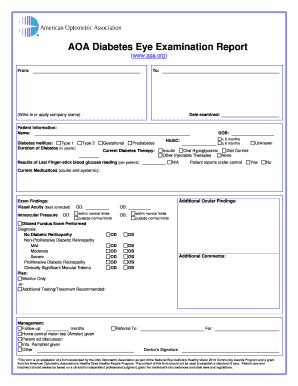
- Begin by entering the date of examination in the designated field. This ensures the report is properly dated and reflects when the examination occurred.
- In the Patient Information section, input the patient's name and date of birth (DOB). These details are vital for identifying the individual receiving the exam.
- Indicate the type of diabetes the patient has by selecting Type 1, Type 2, Gestational, or Prediabetes. Additionally, specify the duration of diabetes in years for a clearer clinical context.
- Document the current diabetes therapy method. Options include , Oral Hypoglycemic, Diet Control, Other Injectable Therapies, or None. Each selection provides insight into the patient's management plan.
- Record the results of the last finger-stick blood glucose reading reported by the patient. If not applicable, mark as N/A. Also, indicate whether the patient's glucose levels are under control.
- List the current medications the patient is taking, both ocular and systemic, to give a comprehensive view of their health management.
- Under Exam Findings, enter the visual acuity and intraocular pressure values obtained during the examination.
- Note any additional ocular findings, and specify whether they are within normal limits or outside normal limits. Include findings for both OD (right eye) and OS (left eye) as applicable.
- Indicate if a dilated fundus exam was performed and document the diagnosis. Select from options like No Diabetic Retinopathy, Non-Proliferative Diabetic Retinopathy, Proliferative Diabetic Retinopathy, and Clinically Significant Macular Edema.
- Outline the management plan, including whether monitoring only is required or if additional testing/treatment is recommended. Clearly specify follow-up timelines.
- Record any additional comments that are relevant to the patient's care or the examination's findings.
- Finally, ensure the referring doctor and the type of referral are documented. Add the doctor's signature as the last step.
- Once all sections are completed, save changes, download, print, or share the form as needed.
Complete the AOA Diabetes Eye Examination Report online today to ensure accurate documentation of your examination.
Experience a faster way to fill out and sign forms on the web. Access the most extensive library of templates available.
Related content
by SL Jones · 2007 · Cited by 4 — Background: The purpose of this study was to revise...
Interpreting the AOA Diabetic Eye Exam Report. After the examination, the eye care...
... diabetic patient needs an eye exam or multiple comorbid conditions) provided by Molina...
Get answers to your most pressing questions about US Legal Forms API.
What is the gold standard investigation for diabetic retinopathy?
The gold standard investigation for diabetic retinopathy is fundus photography, often combined with a dilated eye exam. This method provides high-resolution images of the retina, allowing for the identification of potential issues. The Aoa Diabetes Eye Examination Report captures these findings in a comprehensive manner, facilitating ongoing monitoring and treatment planning.
What is a diabetic eye exam report?
A diabetic eye exam report documents the findings from your eye examination, focusing on any changes related to diabetes. This report typically includes images of the retina, notes on ocular health, and recommendations for further care. Using the Aoa Diabetes Eye Examination Report, healthcare providers can ensure your treatment aligns with your eye health needs.
What are the ocular findings of diabetic retinopathy?
Ocular findings of diabetic retinopathy can include microaneurysms, hemorrhages, and exudates. These signs indicate damage to the retina caused by high blood sugar levels. Regular assessments with the Aoa Diabetes Eye Examination Report help monitor these changes and guide timely interventions to preserve your vision.
What does a diabetic eye test consist of?
A diabetic eye test generally includes a range of assessments, such as visual acuity, intraocular pressure measurement, and fundoscopic examination. During the test, your doctor may use dilating drops to get a clearer view of your retina. The findings are compiled into an Aoa Diabetes Eye Examination Report, summarizing your eye health status.
What is the ocular investigation for diabetic retinopathy?
An ocular investigation for diabetic retinopathy typically includes methods like fundus photography and Optical Coherence Tomography (OCT). These tools provide detailed images and information about your retina's condition. The results contribute to the Aoa Diabetes Eye Examination Report, ensuring your treatment plan is tailored to your needs.
What is the best investigation for diabetic retinopathy?
The best investigation for diabetic retinopathy is often a comprehensive dilated eye examination. This allows an eye specialist to evaluate the retina in detail. Though various tools exist, the Aoa Diabetes Eye Examination Report serves as an essential documentation method, helping to track the progression and management of diabetic conditions effectively.
Can you drive home after a diabetic eye exam?
After a diabetic eye exam, you may drive home if your vision remains unaffected. Typically, your eye doctor performs tests that may cause temporary changes to your vision, such as dilation drops. If you feel unsure, consider arranging transportation. Always prioritize safety when considering your ability to drive.
What do they do for a diabetic eye exam?
During a diabetic eye exam, the eye care professional conducts several tests to evaluate your eye health. This often includes visual acuity tests, dilation to examine the retina, and imaging techniques. The Aoa Diabetes Eye Examination Report provides a detailed summary of these tests, helping you understand your eye health comprehensively.
Are diabetic eye exams covered by medical insurance?
In many cases, diabetic eye exams are covered by medical insurance, particularly if you have diabetes. Coverage can vary by plan, so it's important to verify your benefits before your appointment. The Aoa Diabetes Eye Examination Report may be needed to substantiate the medical necessity for the examination.
What are the ADA guidelines for diabetic retinopathy screening?
The American Diabetes Association (ADA) guidelines recommend yearly diabetic retinopathy screenings for all individuals with diabetes. Early detection through these screenings can help prevent vision loss. By utilizing the Aoa Diabetes Eye Examination Report, patients can stay informed about their screening history and follow the ADA's recommendations effectively.
Use professional pre-built templates to fill in and sign documents online faster. Get access to thousands of forms.
If you believe that this page should be taken down, please follow our DMCA take down process here.