Open form follow the instructions
Easily sign the form with your finger
Send filled & signed form or save
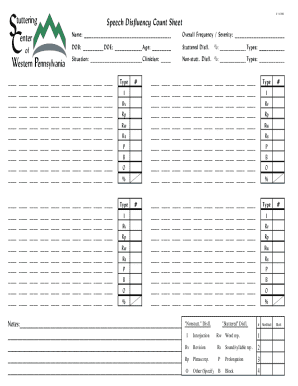
How to fill out the Disfluency Count Sheet online
The Disfluency Count Sheet is a valuable tool for clinicians and individuals assessing speech disfluencies. This guide provides clear, step-by-step instructions to help users accurately complete the form online.
Follow the steps to fill out the Disfluency Count Sheet online effectively
- Use the ‘Get Form’ button to access the Disfluency Count Sheet and open it in your preferred online document editor.
- In the first section, enter the individual's name in the designated space. This identifies the person being evaluated.
- Next, fill out the overall frequency and severity rating, ensuring a comprehensive assessment.
- Input the date of birth (DOB) and date of evaluation (DOE), along with the individual's current age.
- In the section labeled 'Stuttered Disfl.', note the percentage of stuttered disfluencies and specify the types.
- Describe the situation where the disfluencies were observed, and provide the clinician's name for reference.
- In the 'Non-stuttered Disfl.' section, record the percentage and types of non-stuttered disfluencies observed.
- Proceed to fill in relevant types of disfluencies under the appropriate headers, such as Interjection, Word Rep., Revision, etc. Ensure to fill in all observed instances.
- Complete the 'Notes' section with any additional comments or observations regarding the individual’s speech patterns.
- After completing all sections, review the document for accuracy. Once satisfied, you can save changes, download, print, or share the form as necessary.
Take the next step in documenting speech disfluencies by completing the Disfluency Count Sheet online today.
Experience a faster way to fill out and sign forms on the web. Access the most extensive library of templates available.
Related content
Sep 9, 2021 — Speech samples are integral to determine whether or not a student has a...
Feb 15, 2003 — The sheet tracks "Stuttered Disfl. %" and "Non-stutt. Disfl. %" and types...
Get answers to your most pressing questions about US Legal Forms API.
How to count syllables in stuttered speech?
Counting syllables in stuttered speech requires careful listening. Break down each word into its constituent syllables while keeping track of any stuttered instances. You can use a simple tally on your Disfluency Count Sheet to mark stuttered syllables as they occur. This method ensures accurate data collection and assists in evaluating speech fluency.
How to use a disfluency count sheet?
Using a Disfluency Count Sheet involves recording instances of disfluencies during speech. As you listen, mark each occurrence systematically, noting the type of disfluency such as repetitions or prolongations. Later, you can analyze these records to understand patterns in speech. This tool can enhance treatment strategies and track progress effectively.
How do you calculate %SS for stuttering?
To calculate the percentage of syllables stuttered (%SS), count the number of syllables in the entire speech sample. Then, determine how many syllables were stuttered. Divide the number of stuttered syllables by the total syllables, and multiply the result by 100. A Disfluency Count Sheet is an excellent tool for gathering this data systematically.
How do you calculate disfluency rate?
To calculate the disfluency rate, first determine the total number of disfluencies observed in the speech sample. Next, divide that number by the total number of words spoken in the same sample. Finally, multiply the result by 100 to express it as a percentage. Using a Disfluency Count Sheet can help you track these figures accurately.
How to count stuttered syllables?
Counting stuttered syllables involves listening to a speech sample and identifying each occurrence of stuttering, including repetitions, blocks, and prolongations. As you listen, keep a tally of each stuttered syllable. This method provides an accurate picture of the stuttering severity. A Disfluency Count Sheet can help you record these counts in an efficient manner.
How do you calculate Diadochokinetic rate?
The Diadochokinetic rate is determined by assessing how many times a person can rapidly produce selected sounds or syllables, usually over a 60-second interval. Count the total number of syllables produced, and divide by the total time taken in seconds. This gives you the rate, which can be helpful in evaluating speech fluency. A Disfluency Count Sheet can assist you in organizing these counts effectively.
How to calculate disfluency rate?
To calculate the disfluency rate, you need to identify the total number of disfluencies a person exhibits during speech. Next, divide this number by the total syllables spoken. Finally, multiply the result by 100 to get the disfluency rate as a percentage. You can use a Disfluency Count Sheet to help document and analyze these metrics systematically.
How to calculate %ss stuttering?
To determine the %ss of stuttering, refer to your Disfluency Count Sheet for data on stuttered syllables. Divide the number of stuttered syllables by the total syllables, then multiply by 100. This calculation gives a precise percentage of speech affected by stuttering.
How do you calculate the frequency of a stutter?
To calculate the frequency of a stutter, use the data gathered on the Disfluency Count Sheet. Count the total number of stuttered instances and divide that by the total number of syllables spoken. This calculation offers insights into how frequently stuttering occurs in a speech sample.
How do you count disfluencies?
Counting disfluencies involves identifying repetitions, prolongations, and blocks as they occur in speech. Use the Disfluency Count Sheet to log each instance clearly. Consistent and careful observation allows for accurate recording, which helps in analyzing the individual's speech patterns.
Use professional pre-built templates to fill in and sign documents online faster. Get access to thousands of forms.
If you believe that this page should be taken down, please follow our DMCA take down process here.