Loading
Form preview
  • US Legal Forms
  • Other Templates
  • More Forms
  • More Uncategorized Forms
  • Sample Escheatment Letter

Get Sample Escheatment Letter

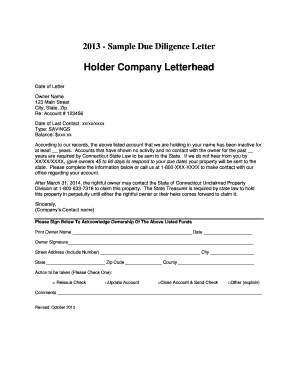
2013 - Sample Due Diligence Letter Holder Company Letterhead Date of Letter Owner Name 123 Main Street City, State, Zip Re: Account # 123456 Date of Last Contact: xx/xx/xxxx Type: SAVINGS Balance:.

How it works

  1. Open form

    Open form follow the instructions

  2. Easily sign form

    Easily sign the form with your finger

  3. Share form

    Send filled & signed form or save

How to fill out the Sample Escheatment Letter online

Filling out the Sample Escheatment Letter online can help you reclaim dormant funds and ensure compliance with state laws. This guide will provide you with a step-by-step approach to navigate through each section effectively.

Follow the steps to complete your Sample Escheatment Letter.

  1. Press the ‘Get Form’ button to obtain the letter and access it in the online editor.
  2. Begin by entering the date of the letter at the top of the form. This should reflect the date you are completing the form online.
  3. Fill in your name and address details in the specified fields. Include your street address, city, state, and zip code carefully.
  4. Locate the section labeled 'Re:' and enter your account number, which is essential for identifying your specific account.
  5. In the field marked 'Date of Last Contact,' provide the date of your last interaction regarding this account, if available.
  6. Indicate the type of account (e.g., savings) by checking the appropriate box or writing in the type of account next to 'Type:'.
  7. Enter the balance of the account in the section provided. Ensure that the amount is accurate to avoid discrepancies.
  8. Review the guidance provided in the letter concerning the inactivity of the account and the need for response within the specified timeframe.
  9. In the section for owner acknowledgment, print your name, date, and signature. This acknowledges your ownership of the account.
  10. Complete the street address section, including the number, city, state, and zip code, as well as your county.
  11. Choose an action to be taken by checking one of the boxes provided (e.g., reissue check, update account, close account & send check, or other). If 'other' is selected, provide an explanation in the comments section.
  12. In the comments section, add any additional notes or information that may be relevant to your request.
  13. Once all fields are filled out, review the entries for accuracy, then proceed to save changes, download, print, or share the completed letter according to your needs.

Complete your documents online and secure your unclaimed property today.

Get form

Experience a faster way to fill out and sign forms on the web. Access the most extensive library of templates available.
Get form

Related content

General Due Diligence Sample Letter
According to our records, there has been no activity on your account for more than...
Learn more
...
Below is a sample due diligence letter for use in contacting payees regarding their...
Learn more
CERCLA.pdf
Apr 24, 2013 — TITLE I—HAZARDOUS SUBSTANCES RELEASES, LIABILITY,. COMPENSATION. Sec...
Learn more

Related links form

MSDS - Christo-Lube MCG 111 - Aerocon Systems Generator Set Data Sheet Form - Cummins Inc. SAN CARLOS APACHE TELECOMMUNICATIONS UTILITY, INC PDF Form For Funeral Announcements - Scatui

Questions & Answers

Get answers to your most pressing questions about US Legal Forms API.

Contact support

Yes, escheatment is closely related to unclaimed property, as it describes the legal process that occurs when such property is transferred to the state. While unclaimed property refers to the assets themselves, escheatment is the method by which the state acquires these assets. Knowing the difference can be helpful, and a Sample Escheatment Letter serves as a valuable tool in addressing any queries you might have.

An escheatment notice is a written communication typically sent by the state to inform individuals about their unclaimed property. This notice outlines the assets in question, along with instructions for claiming them. Understanding the notice and having a Sample Escheatment Letter handy can streamline your efforts to reclaim your property.

The most common reason for escheatment is inactivity, such as failure to communicate with account holders regarding their assets. Financial accounts that remain dormant for several years may be classified as unclaimed and subsequently revert to the state. A Sample Escheatment Letter can help you understand the ownership complexities entailed in these situations.

An escheatment refund typically occurs when a state returns unclaimed funds to the rightful owner after the property is claimed. This can happen once you submit proper documentation, such as a Sample Escheatment Letter, to demonstrate your ownership. Receiving a refund can bring considerable relief as you reclaim what is rightfully yours.

Another term for unclaimed property is abandoned property. This includes various forms of financial assets that have lost their owners due to inactivity over time. If you're dealing with unclaimed property, consulting a Sample Escheatment Letter can clarify the steps needed to claim your assets.

Unclaimed property is often referred to as abandoned property, which includes funds, accounts, or assets that have remained untouched for a specific duration. Different states may have varying definitions, but the concept remains the same. A Sample Escheatment Letter is useful for understanding how to claim or respond to these properties effectively.

Escheatment refers to the legal process where unclaimed property reverts to the state after a defined period of inactivity. This process ensures that unclaimed assets are managed and eventually redistributed. Understanding this concept can help you navigate issues around unclaimed assets and the need for a Sample Escheatment Letter in communication with state officials.

Yes, unclaimed property letters are legitimate documents often sent by state authorities or financial institutions. They notify individuals about unclaimed assets that may belong to them. When you receive a letter, it is important to verify its authenticity using a Sample Escheatment Letter as a guide to understand what the letter should look like.

Claiming unclaimed property typically does not lead to legal trouble if you are the rightful owner. However, you must ensure that your claim is legitimate and backed by proper documentation. Using a Sample Escheatment Letter can help streamline this process, providing clarity on how to lawfully reclaim your assets without complications.

The US unclaimed property law is designed to protect the interests of owners of abandoned property. It requires businesses and institutions to report unclaimed assets to the state after a certain period of inactivity. A Sample Escheatment Letter is a key tool in this law that helps individuals comprehend their rights and responsibilities regarding unclaimed property.

Get This Form Now!

Use professional pre-built templates to fill in and sign documents online faster. Get access to thousands of forms.
Get form
If you believe that this page should be taken down, please follow our DMCA take down processhere.
Get Sample Escheatment Letter
Get form
  • Adoption
  • Bankruptcy
  • Contractors
  • Divorce
  • Home Sales
  • Employment
  • Identity Theft
  • Incorporation
  • Landlord Tenant
  • Living Trust
  • Name Change
  • Personal Planning
  • Small Business
  • Wills & Estates
  • Packages A-Z
  • Affidavits
  • Bankruptcy
  • Bill of Sale
  • Corporate - LLC
  • Divorce
  • Employment
  • Identity Theft
  • Internet Technology
  • Landlord Tenant
  • Living Wills
  • Name Change
  • Power of Attorney
  • Real Estate
  • Small Estates
  • Wills
  • All Forms
  • Forms A-Z
  • Other Templates
  • Legal Hub
  • About Us
  • Help Portal
  • Legal Resources
  • Blog
  • Affiliates
  • Contact Us
  • Delete My Account
  • Site Map
  • Industries
  • Forms in Spanish
  • Localized Forms
  • State-specific Forms
  • Forms Kit
  • Real Estate Handbook
  • All Guides
  • Notarize
  • Incorporation services
  • For Consumers
  • For Small Business
  • For Attorneys
  • USLegal
  • FormsPass
  • pdfFiller
  • signNow
  • altaFlow
  • DocHub
  • Instapage
Form Packages
  • Adoption
  • Bankruptcy
  • Contractors
  • Divorce
  • Home Sales
  • Employment
  • Identity Theft
  • Incorporation
  • Landlord Tenant
  • Living Trust
  • Name Change
  • Personal Planning
  • Small Business
  • Wills & Estates
  • Packages A-Z
Form Categories
  • Affidavits
  • Bankruptcy
  • Bill of Sale
  • Corporate - LLC
  • Divorce
  • Employment
  • Identity Theft
  • Internet Technology
  • Landlord Tenant
  • Living Wills
  • Name Change
  • Power of Attorney
  • Real Estate
  • Small Estates
  • Wills
  • All Forms
  • Forms A-Z
  • Other Templates
Customer Service
  • Legal Hub
  • About Us
  • Help Portal
  • Legal Resources
  • Blog
  • Affiliates
  • Contact Us
  • Delete My Account
  • Site Map
  • Industries
  • Forms in Spanish
  • Localized Forms
  • State-specific Forms
  • Forms Kit
Legal Guides
  • Real Estate Handbook
  • All Guides
Prepared for you
  • Notarize
  • Incorporation services
Our Customers
  • For Consumers
  • For Small Business
  • For Attorneys
Our Sites
  • USLegal
  • FormsPass
  • pdfFiller
  • signNow
  • altaFlow
  • DocHub
  • Instapage
Social Media
Call us now toll free:
+1 833 426 79 33
As seen in:
© Copyright 1999-2026 airSlate Legal Forms, Inc. 17 Station Street, Suite 303, Brookline, MA 02445
  • Your Privacy Choices
  • Terms of Service
  • Privacy Notice
  • Content Takedown Policy
  • Bug Bounty Program