Loading
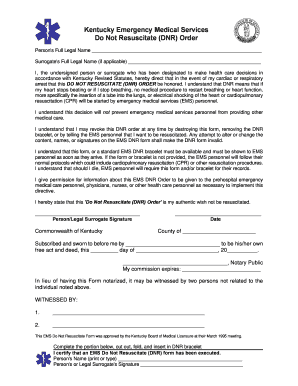
Get Ky Do Not Resuscitate (dnr) Order
How it works
-

Open form follow the instructions
-

Easily sign the form with your finger
-

Send filled & signed form or save
How to fill out the KY Do Not Resuscitate (DNR) Order online
This guide provides clear and comprehensive instructions on how to complete the Kentucky Do Not Resuscitate (DNR) Order online. It is essential to understand the components of the form to ensure that your wishes regarding medical treatment are accurately reflected.
Follow the steps to complete the online KY DNR Order form easily.
- Press the ‘Get Form’ button to access the KY DNR Order document online and open it in your preferred editor.
- Begin by entering the person's full legal name in the designated field at the top of the form.
- If applicable, provide the surrogate's full legal name in the next section, ensuring accuracy for those authorized to make healthcare decisions.
- Read the directive carefully, acknowledging your understanding that the DNR order means no attempts will be made to restart breathing or heart function.
- Sign and date the form in the space provided to affirm your intention, which is crucial for the document's validity.
- Consider having the form notarized by a Kentucky Notary Public or witnessed by two individuals not related to you, as this enhances the document's legality.
- Detach the EMS DNR bracelet insert located at the bottom of the form, complete the required information, and then place it on your wrist or ankle.
- Ensure the original DNR Order or the bracelet is readily available to emergency medical services personnel, as they must see it to comply with your wishes.
- Finally, save your changes, and download or print the completed form for your records.
Complete your KY DNR Order online today to ensure your wishes are respected.
A KY Do Not Resuscitate (DNR) Order has limitations regarding its scope and application. It only applies to resuscitation efforts in the event of cardiac arrest, meaning other medical treatments and interventions can still be administered. It's essential to communicate your complete healthcare wishes, including other aspects of end-of-life care, with your healthcare providers.