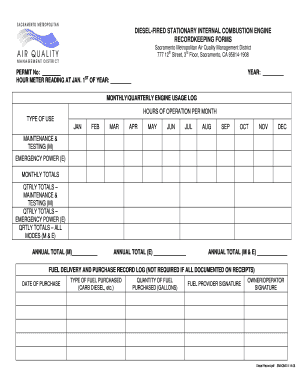
HOUR METER READING AT JAN. 1ST OF YEAR: YEAR: MONTHLY/QUARTERLY ENGINE USAGE LOG HOURS OF OPERATION PER MONTH TYPE OF USE JAN FEB MAR APR MAY JUN JUL AUG SEP OCT NOV DEC MAINTENANCE & TESTING (M) EMERGENCY POWER (E) MONTHLY TOTALS QTRLY TOTALS MAINTENANCE & TESTING (M) QTRLY TOTALS EMERGENCY POWER (E) QRTLY TOTALS ALL MODES (M & E) ANNUAL TOTAL (M) ANNUAL TOTAL (E) ANNUAL TOTAL (M & E) FUEL DELIVERY AND PU.
Open form follow the instructions
Easily sign the form with your finger
Send filled & signed form or save
How to fill out the CA Air Quality Recordkeeping Forms online
This guide provides a comprehensive overview of how to accurately complete the CA Air Quality Recordkeeping Forms for diesel-fired stationary internal combustion engines. By following the outlined steps, users can ensure compliance and maintain effective recordkeeping practices.
Follow the steps to fill out the CA Air Quality Recordkeeping Forms accurately.
- Click the ‘Get Form’ button to obtain the CA Air Quality Recordkeeping Form, and open it in your chosen editing interface.
- Enter the permit number in the designated field at the top of the form.
- Record the hour meter reading as of January 1st of the current year in the appropriate field.
- Enter the year for which you are submitting the records.
- Provide a monthly/quarterly log documenting hours of operation for each month, categorizing as 'Maintenance & Testing (M)' or 'Emergency Power (E)'.
- Sum the hours of operation for each type of use monthly and provide quarterly totals for maintenance, emergency power, and overall.
- If applicable, maintain a fuel delivery and purchase record log, listing the date of purchase, type of fuel, quantity, and fuel provider signature.
- Complete the detailed diesel-fired internal combustion engine usage log, indicating the date, time of operation, total hour meter reading, and purpose of operation.
- Verify all entries for accuracy and completeness before saving.
- Once all information is completed, save the changes, download, print, or share the filled form as necessary.
Start filling out your CA Air Quality Recordkeeping Forms online today to ensure compliance.
Experience a faster way to fill out and sign forms on the web. Access the most extensive library of templates available.
Related content
The directory includes forms from Administrative Services, Air Quality Planning, Emissions...
See Air Quality Permitting Process below. Recordkeeping. The owning department should keep...
by M Dunleavy — THE REGULATIONS REPRODUCED HERE HAVE BEEN PROVIDED BY THE. DEPARTMENT OF...
Get answers to your most pressing questions about US Legal Forms API.
Who regulates air quality in California?
Air quality in California is regulated primarily by the California Air Resources Board (CARB) and local air districts. These agencies work together to set and enforce air quality standards to mitigate pollution and protect public health. Using CA Air Quality Recordkeeping Forms can simplify compliance for businesses, ensuring they meet reporting requirements effectively. This not only helps companies abide by the law but also positions them as responsible corporate citizens in their communities.
Is poor air quality an OSHA violation?
Poor air quality can indeed be an OSHA violation if it leads to unsafe working conditions documented within OSHA standards. Employers have a duty to protect their employees from harm, which includes providing a safe work environment with acceptable air quality levels. Utilizing CA Air Quality Recordkeeping Forms helps employers keep track of air quality data and monitor compliance with regulations. By staying proactive, businesses can prevent violations and foster a healthier workplace.
Does California have a Clean Air Act?
Yes, California has its own Clean Air Act, which sets standards for air quality to protect public health and the environment. This act gives authority to agencies like the CARB to enforce regulations that limit air pollution. Compliance often requires the use of CA Air Quality Recordkeeping Forms, which help organizations document their efforts in reducing emissions. By following these guidelines, businesses can contribute to cleaner air and safer communities.
Who is responsible for measuring air quality?
In California, air quality measurement is primarily managed by local air quality management districts and the California Air Resources Board (CARB). These agencies monitor pollutants and collect data to ensure compliance with air quality standards. By using CA Air Quality Recordkeeping Forms, businesses can report their data accurately and stay informed about their obligations. Keeping records helps to maintain transparency and accountability in air quality management.
What area does AQMD cover?
AQMD specifically covers various regions in California, focusing on areas that require careful air quality management due to high population density or heavy industrial activity. This includes urbanized areas like Los Angeles and San Bernardino. For businesses within these areas, CA Air Quality Recordkeeping Forms are vital to ensure adherence to local regulations and effectively manage air quality.
What is the difference between AQMD and CARB?
The key difference between AQMD and CARB lies in their jurisdiction and focus. AQMD operates at a regional level, managing local air quality, while the California Air Resources Board (CARB) oversees state-wide air quality and greenhouse gas emissions policies. When working with CA Air Quality Recordkeeping Forms, it’s important to recognize which regulatory body impacts your specific operations.
What does the AQMD stand for?
AQMD stands for Air Quality Management District. These districts are local agencies focused on improving air quality through regulation and oversight of pollution sources. Understanding AQMD operations is essential for utilizing CA Air Quality Recordkeeping Forms effectively, ensuring you meet local air quality standards.
What is AQMD in construction?
In construction, AQMD refers to the air quality management district regulating emissions from construction activities. These regulations aim to protect air quality during building projects by ensuring that dust and other pollutants remain within acceptable limits. By leveraging CA Air Quality Recordkeeping Forms, construction companies can document compliance and avoid penalties throughout their projects.
What is an AQMD permit?
An AQMD permit is a crucial document that allows for the legal operation of facilities emitting air pollutants in California. It ensures compliance with air quality regulations and helps manage air quality more effectively. Utilizing CA Air Quality Recordkeeping Forms in conjunction with your AQMD permit can streamline your recordkeeping process and stay aligned with regulatory requirements.
What does this new law proposed by the California Air Resources Board do?
SACRAMENTO – The California Air Resources Board (CARB) today approved a first-of-its-kind rule that requires a phased-in transition toward zero-emission medium-and-heavy duty vehicles. Known as Advanced Clean Fleets, the new rule helps put California on a path toward accomplishing Gov.
Use professional pre-built templates to fill in and sign documents online faster. Get access to thousands of forms.
If you believe that this page should be taken down, please follow our DMCA take down process here.