Tutions, attach one certified statement of each account. Page 3 of 5 AO 239 (Rev. 01/15) Application to Proceed in District Court Without Prepaying Fees or Costs (Long Form) 5. List the assets, and their values, which you own or your spouse owns. Do not list clothing and ordinary household furnishings. Assets owned by you or your spouse $ Home (Value) Other real estate (Value) $ $ Motor vehicle #1 (Value) Make and year: Model: Registration #: Motor vehicle #2 (Value) $ Make and year: M.
Open form follow the instructions
Easily sign the form with your finger
Send filled & signed form or save
How to fill out the AO 239 online
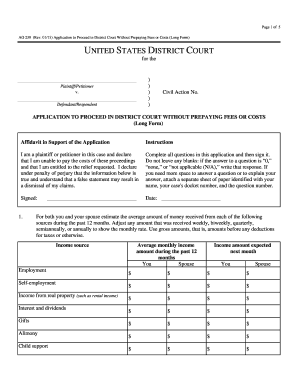
Filling out the AO 239, the application to proceed in district court without prepaying fees or costs, is an important step for individuals seeking relief while facing financial constraints. This guide provides clear, step-by-step instructions to ensure users can effectively complete the form online.
Follow the steps to complete the AO 239 application smoothly.
- Press the ‘Get Form’ button to access the document and open it in your preferred editor.
- Begin by entering the appropriate information in the top section, including the district and court details, as well as the names of the plaintiff/petitioner and defendant/respondent.
- Fill out the civil action number if applicable, or leave it blank if not yet assigned.
- Proceed to the affidavit section where you declare your inability to pay the court costs. Make sure to read this section thoroughly before confirming your understanding.
- Answer all the questions in the income section. Provide monthly estimates for each income source for both you and your spouse, ensuring you adjust figures for any frequency other than monthly.
- Complete the employment history section for both you and your spouse over the past two years, noting gross monthly pay for each position.
- Summarize cash and bank account information, listing the financial institutions, account types, and the amounts held in each account.
- List all assets owned by you or your spouse, providing their values, and outline any debts owed to you or your spouse.
- Detail the average monthly expenses for your household, including items such as rent, utilities, food, and other living costs.
- If applicable, describe any expected changes in income or expenses over the next 12 months, and any additional expenses related to the lawsuit.
- Review all entries for accuracy and completeness. Ensure all blanks are filled; if necessary, indicate zero or not applicable.
- Finally, sign and date the form before saving, downloading, printing, or sharing the completed application as required.
Complete your AO 239 application online today to ensure your legal rights are protected.
Experience a faster way to fill out and sign forms on the web. Access the most extensive library of templates available.
Related content
AO 239 (Rev. 01/15) Application to Proceed in District Court Without Prepaying Fees or...
by A HAMMOND · 2019 · Cited by 121 — Twenty-two district courts use the AO 239, the...
The system uses the Comfort Controller 6400, which provides HVAC control, and the Local...
Get answers to your most pressing questions about US Legal Forms API.
What does proceed in forma pauperis mean?
Proceeding in forma pauperis allows individuals to waive filing fees due to financial hardship. This legal status ensures that everyone has access to the court, regardless of income level. When using the AO 239, you may find guidance on how to apply for this status. Make sure to gather all necessary documentation to support your application.
How much are court costs in California?
Court costs in California can accumulate depending on the case type and additional services needed. These costs often include fees for processing, witness fees, and more, potentially totaling several hundred dollars. With the assistance of the AO 239, you can outline expected expenses and prepare accordingly. Always research or ask for estimates to stay informed.
Are there fees for going to court?
Yes, there are typically fees associated with going to court. These fees include filing fees, service fees, and other costs related to the legal process. By understanding the AO 239 form, you can better prepare for these expenses. It’s wise to consult resources that outline all potential fees involved.
What are the requirements for federal court?
Federal court requirements primarily include the need for federal jurisdiction, which can stem from constitutional issues, federal statutes, or diversity jurisdiction. Furthermore, a case related to AO 239 may also follow specific procedural rules regarding filing and service. Ensuring compliance with these requirements enhances your chances for a successful hearing, so rely on trusted platforms like USLegalForms for guidance.
What makes a case go to federal court?
Several factors can prompt a case to go to federal court, including federal questions, diversity of citizenship, and significant federal interests. A case tied to AO 239 might indicate a federal legal issue, which typically mandates movement to the federal system. Understanding these distinctions can guide your legal strategy and determine the best approach for your situation.
What are the requirements for a case to be in the federal court?
For a case to be heard in federal court, it must either arise under federal law or meet the criteria of diversity jurisdiction. Additionally, a federal claim must generally seek remedies specified under AO 239. If your case meets these conditions, filing in federal court may be your best option to ensure appropriate jurisdiction and focus on your legal matters.
What qualifies for a federal case?
A case typically qualifies for federal court if it involves a federal law issue or if there is complete diversity of citizenship between parties with an amount in controversy exceeding $75,000. Factors may vary, but when your case touches on matters related to AO 239, it could lead to eligibility for federal jurisdiction. It's essential to consult legal resources to confirm your case's qualifications before proceeding.
How does the US district court work?
The US district court operates as the trial court in the federal judicial system, handling both civil and criminal cases. Cases typically begin here and often involve a jury trial or a judge's ruling based on the evidence presented. Understanding the workings of these courts can be overwhelming, but tools like AO 239 provide valuable insights into the judicial process. This knowledge can greatly assist anyone preparing for court proceedings.
What cases go to US district court?
US district courts handle various cases, including federal law violations, civil rights disputes, and cases where the United States government is a party. Additionally, they address matters involving diversity jurisdiction, which occurs when parties are from different states. For individuals seeking clarity on their legal options, resources like AO 239 can provide essential guidance. Always ensure your case qualifies under federal law before filing.
What are the 5 steps to initiate a lawsuit?
To initiate a lawsuit, start by identifying the parties involved and the legal basis for your claim. Next, prepare your complaint and file it with the appropriate court. Serve the defendant with the necessary papers, and then respond to any motions they file. Utilize resources like US Legal Forms to simplify document preparation at each step. Lastly, prepare for court, ensuring you understand the procedures involved.
Use professional pre-built templates to fill in and sign documents online faster. Get access to thousands of forms.
If you believe that this page should be taken down, please follow our DMCA take down process here.