Loading
Form preview
  • US Legal Forms
  • Form Library
  • Social Forms
  • Maryland Social Forms
  • Maryland Medical Protocols Self-study Guide 2015

Get Maryland Medical Protocols Self-study Guide 2015-2026

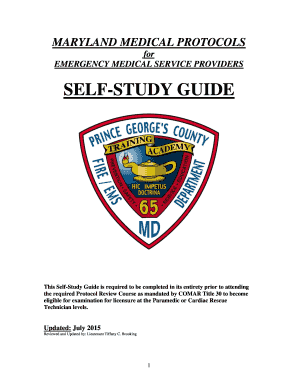
View Course as mandated by COMAR Title 30 to become eligible for examination for licensure at the Paramedic or Cardiac Rescue Technician levels. Updated: July 2015 Reviewed and Updated by: Lieutenant Tiffany C. Brooking 1 GENERAL INFORMATION If a Maryland State EMS provider is unable to obtain on-line medical consultation for a patient who has a life-threatening injury, what steps must be taken by the EMS provider? a. Notify SYSCOM immediately after arrival at the hospital. b. Complete a med.

How it works

  1. Open form

    Open form follow the instructions

  2. Easily sign form

    Easily sign the form with your finger

  3. Share form

    Send filled & signed form or save

How to fill out the Maryland Medical Protocols Self-Study Guide online

The Maryland Medical Protocols Self-Study Guide is a crucial document that emergency medical service providers must complete prior to attending the required Protocol Review Course. This guide will help you fill out the form thoroughly and correctly, ensuring your readiness for licensure.

Follow the steps to complete the self-study guide effectively.

  1. Click the ‘Get Form’ button to access the Maryland Medical Protocols Self-Study Guide and open it to begin filling out the required fields.
  2. Read the instructions carefully at the beginning of each section. Understanding the requirements for each component will help you respond accurately.
  3. Complete the 'General Information' section first. Ensure that you answer all questions related to emergency medical consultation, protocols, and patient care appropriately.
  4. Move on to the 'General Patient Care' section. Follow the prompts to assess a patient's mental status and document necessary procedures and findings.
  5. In the 'Treatment Protocols' section, carefully follow the provided guidelines and fill out the necessary treatment protocols based on the specific emergencies described.
  6. Carefully review your responses for any errors or omissions. Each section must be completed for your submission to be valid.
  7. Once all sections are complete, save your changes. You can then download the completed guide for your records, print it out, or share it as required.

Complete your Maryland Medical Protocols Self-Study Guide online today to ensure you're prepared for licensure!

Get form

Experience a faster way to fill out and sign forms on the web. Access the most extensive library of templates available.
Get form

Related content

Maryland Medical Protocols for EMS - 2021
The treatment protocols have been completely revamped this year to provide rapid access to...
Learn more
Resources | University of Maryland School of...
A resource for medical students from Charite University, University Hospital Zurich, and...
Learn more
Medicare
S-2. S-2, Part I. Expanded the questions that will generate other worksheets on the cost...
Learn more

Related links form

Rio Tinto Medical Plus Provider Details For EFT Payment - Medibank Swimming Pool Compliance Certificate Application - Kogarah ... Form 1 Notice To Defendant Service & Execution Of Process Act...

Questions & Answers

Get answers to your most pressing questions about US Legal Forms API.

Contact support

In Maryland, EMTs can provide a range of pre-hospital emergency care, including basic life support, administration of certain medications, and assistance with patient transport. They play a crucial role in the emergency response system, and their training helps them make critical decisions in high-pressure situations. To understand the scope of practice better, the Maryland Medical Protocols Self-Study Guide is an invaluable tool.

Priority 4 in Maryland EMS refers to situations that are considered non-urgent, meaning the patient does not require immediate intervention. These cases may involve providing care in a less urgent context, often allowing for more flexibility in response time. Understanding these categories is important for effective patient management. For more detailed information, consult the Maryland Medical Protocols Self-Study Guide.

The average response time for emergency medical services (EMS) in the United States generally ranges from 8 to 12 minutes. However, this can vary based on location, traffic conditions, and the time of day. Understanding these response times is crucial for planning and improving outcomes in emergencies. For those seeking to enhance their knowledge, the Maryland Medical Protocols Self-Study Guide can provide valuable insights into best practices.

Protocols in the medical field are standardized procedures designed to help healthcare providers deliver consistent and evidence-based care. They provide clear instructions for treatment options and interventions, which ultimately enhances patient safety. The Maryland Medical Protocols Self-Study Guide is an excellent resource for understanding and implementing these important protocols in your practice.

EMS protocols reinforce the clinical procedures EMS providers must follow to assess and treat patients. They offer a framework that guides medical decision-making in the field, ensuring uniformity in care delivery. The Maryland Medical Protocols Self-Study Guide encapsulates these protocols, making it a practical guide for any medical professional looking to enhance their skills.

EMS standards are established guidelines that govern the quality and performance of emergency medical services. These standards aim to ensure that all patients receive safe and effective care. To familiarize yourself with these standards and their applications, the Maryland Medical Protocols Self-Study Guide provides comprehensive information and is a valuable tool for every EMS provider.

An EMS protocol outlines the specific procedures and guidelines that emergency medical personnel must follow during patient care. These protocols help ensure consistency and quality of care across various situations. To deepen your understanding and application of EMS protocols, consider the Maryland Medical Protocols Self-Study Guide as an essential resource.

The five types of EMS systems include volunteer, fire-based, hospital-based, municipal, and private. Each system has its own structure and operational model tailored to meet the needs of the community it serves. Understanding these systems is essential, and the Maryland Medical Protocols Self-Study Guide offers valuable insights that can help you navigate them effectively.

Maryland EMS protocols are typically updated every three years, but changes may occur more frequently if needed. Staying current with these updates is crucial for EMS providers, as they ensure adherence to the latest medical standards and practices. By utilizing the Maryland Medical Protocols Self-Study Guide, you can easily stay informed about the latest updates and implement them in your practice.

Get This Form Now!

Use professional pre-built templates to fill in and sign documents online faster. Get access to thousands of forms.
Get form
If you believe that this page should be taken down, please follow our DMCA take down processhere.
Get Maryland Medical Protocols Self-Study Guide
Get form
  • Adoption
  • Bankruptcy
  • Contractors
  • Divorce
  • Home Sales
  • Employment
  • Identity Theft
  • Incorporation
  • Landlord Tenant
  • Living Trust
  • Name Change
  • Personal Planning
  • Small Business
  • Wills & Estates
  • Packages A-Z
  • Affidavits
  • Bankruptcy
  • Bill of Sale
  • Corporate - LLC
  • Divorce
  • Employment
  • Identity Theft
  • Internet Technology
  • Landlord Tenant
  • Living Wills
  • Name Change
  • Power of Attorney
  • Real Estate
  • Small Estates
  • Wills
  • All Forms
  • Forms A-Z
  • Form Library
  • Legal Hub
  • About Us
  • Help Portal
  • Legal Resources
  • Blog
  • Affiliates
  • Contact Us
  • Delete My Account
  • Site Map
  • Industries
  • Forms in Spanish
  • Localized Forms
  • State-specific Forms
  • Forms Kit
  • Real Estate Handbook
  • All Guides
  • Notarize
  • Incorporation services
  • For Consumers
  • For Small Business
  • For Attorneys
  • USLegal
  • FormsPass
  • pdfFiller
  • signNow
  • altaFlow
  • DocHub
  • Instapage
Form Packages
  • Adoption
  • Bankruptcy
  • Contractors
  • Divorce
  • Home Sales
  • Employment
  • Identity Theft
  • Incorporation
  • Landlord Tenant
  • Living Trust
  • Name Change
  • Personal Planning
  • Small Business
  • Wills & Estates
  • Packages A-Z
Form Categories
  • Affidavits
  • Bankruptcy
  • Bill of Sale
  • Corporate - LLC
  • Divorce
  • Employment
  • Identity Theft
  • Internet Technology
  • Landlord Tenant
  • Living Wills
  • Name Change
  • Power of Attorney
  • Real Estate
  • Small Estates
  • Wills
  • All Forms
  • Forms A-Z
  • Form Library
Customer Service
  • Legal Hub
  • About Us
  • Help Portal
  • Legal Resources
  • Blog
  • Affiliates
  • Contact Us
  • Delete My Account
  • Site Map
  • Industries
  • Forms in Spanish
  • Localized Forms
  • State-specific Forms
  • Forms Kit
Legal Guides
  • Real Estate Handbook
  • All Guides
Prepared for you
  • Notarize
  • Incorporation services
Our Customers
  • For Consumers
  • For Small Business
  • For Attorneys
Our Sites
  • USLegal
  • FormsPass
  • pdfFiller
  • signNow
  • altaFlow
  • DocHub
  • Instapage
Social Media
Call us now toll free:
+1 833 426 79 33
As seen in:
© Copyright 1999-2026 airSlate Legal Forms, Inc. 3720 Flowood Dr, Flowood, Mississippi 39232
  • Your Privacy Choices
  • Terms of Service
  • Privacy Notice
  • Content Takedown Policy
  • Bug Bounty Program