Open form follow the instructions
Easily sign the form with your finger
Send filled & signed form or save
How to fill out the Refrigerator & Freezer Temperature Log online
Filling out the Refrigerator & Freezer Temperature Log is essential for ensuring food safety and compliance with health regulations. This guide offers clear, step-by-step instructions to help you accurately complete the log online.
Follow the steps to fill out the Refrigerator & Freezer Temperature Log effectively.
- Press the ‘Get Form’ button to obtain the form and open it in your preferred editor.
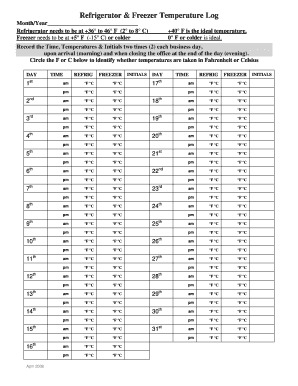
- Begin by entering the month and year at the top of the form. This helps to identify when the log is applicable.
- Next, locate the temperature requirements. Ensure that the refrigerator is set to a temperature between +36° to 46° F (2° to 8° C), and the freezer is at +5° F (-15° C) or cooler for optimal performance.
- You will need to record the time, temperatures, and your initials twice each business day — once in the morning upon arrival and once in the evening when closing.
- In the designated sections, circle either 'F' or 'C' to indicate whether the temperatures you record are in Fahrenheit or Celsius. This is crucial for clarity.
- Fill in the log with your observations. For each business day, enter the time of measurement, record the temperature for both the refrigerator and freezer, and provide your initials next to each entry.
- Ensure all fields for the days of the month are completed, including multiple entries for morning and evening temperatures.
- Once you have filled out the entire log, proofread your entries for any errors or missing information.
- Finally, save your changes, and choose to download, print, or share the completed log as necessary for your records.
Complete your Refrigerator & Freezer Temperature Log online to maintain food safety standards.
Experience a faster way to fill out and sign forms on the web. Access the most extensive library of templates available.
Related content
2. Document these temperatures by writing an “X” in the row that corresponds to the...
Refrigerator/Freezer Monthly Temperature Logs ... Please put initials in temperature box...
The McKesson triple display digital thermometer simultaneously shows the current, minimum...
Get answers to your most pressing questions about US Legal Forms API.
Is 1 or 7 the coldest setting on a fridge?
In most refrigerators, a setting of 7 represents the coldest temperature, while 1 denotes a warmer setting. If you're concerned about food safety, it's advisable to keep your fridge at a lower setting. The effectiveness of your Refrigerator & Freezer Temperature Log will be enhanced when you verify actual temperatures with a thermometer. Regular monitoring allows you to adjust settings as needed to ensure optimal food storage.
How do I monitor the temperature of my fridge and freezer?
Monitoring the temperature of your fridge and freezer can be easily achieved with a good thermometer, or you may consider using a digital thermometer with an alarm feature. Regular checks can be complemented by maintaining a dedicated Refrigerator & Freezer Temperature Log for daily entries. This practice not only ensures food safety but also lets you address problems before they compromise your food. Consider using the US Legal Forms platform to streamline your logging process.
How to fill out a temperature log for a refrigerator?
Filling out a temperature log for your refrigerator is straightforward. Begin by listing the date and time of each entry, followed by the recorded temperature. It’s also beneficial to include notes on any adjustments made or unusual occurrences. Regularly reviewing your Refrigerator & Freezer Temperature Log can highlight patterns and assist you in maintaining food safety effectively.
How do I record the temperature of my fridge?
To record the temperature of your fridge, start by placing a thermometer on the middle shelf, as this provides an accurate reading. After allowing the thermometer to stabilize, take note of the temperature and enter it into your Refrigerator & Freezer Temperature Log. Make sure to check the temperature after opening the fridge to ensure your readings reflect accurate conditions. Consistent logging helps you maintain proper food safety standards.
How often must fridge and freezer temperatures be recorded in a log?
It’s essential to record fridge and freezer temperatures at least once a day. However, during hotter months or when the fridge door is frequently opened, consider logging the temperature more frequently. Regular entries in your Refrigerator & Freezer Temperature Log help you identify any fluctuations that could affect food safety. This is particularly important in commercial settings or if you have perishable items.
Is my fridge colder on 1 or 5?
The number setting on your fridge typically indicates the temperature, with lower numbers representing warmer temperatures and higher numbers indicating colder temperatures. Therefore, a setting of 5 is generally colder than 1. To ensure food safety, it is advisable to use a thermometer alongside your Refrigerator & Freezer Temperature Log to confirm the actual temperature. This practice helps maintain the ideal environment for food storage.
Which is colder on a fridge, 1 or 7?
In most refrigerators, a setting of 1 is warmer while 7 is the coldest. Therefore, if you want to achieve lower temperatures, you should set your fridge closer to 7. For accurate tracking, always remember to log these settings in your Refrigerator & Freezer Temperature Log after making adjustments.
What is a temperature control log in a refrigerator?
A temperature control log in a refrigerator is a systematic record of temperature readings over time. It helps track the performance and efficiency of your fridge and freezer. By maintaining a thorough Refrigerator & Freezer Temperature Log, you can ensure your appliances run optimally and meet food safety standards.
How can you check the temperature of your fridge and freezer?
To check the temperature of your fridge and freezer, use an accurate thermometer placed inside each unit. Allow some time for the thermometer to stabilize, then read the temperature. Regular checks and entries in your Refrigerator & Freezer Temperature Log can alert you to any issues before they affect your food.
What do you record in the refrigerator log?
In the Refrigerator & Freezer Temperature Log, record the date, time, and temperature readings for both the fridge and freezer. You can also note any abnormalities, such as temperature changes or maintenance issues. This documentation supports food safety compliance and provides a helpful reference for future checks.
Use professional pre-built templates to fill in and sign documents online faster. Get access to thousands of forms.
If you believe that this page should be taken down, please follow our DMCA take down process here.