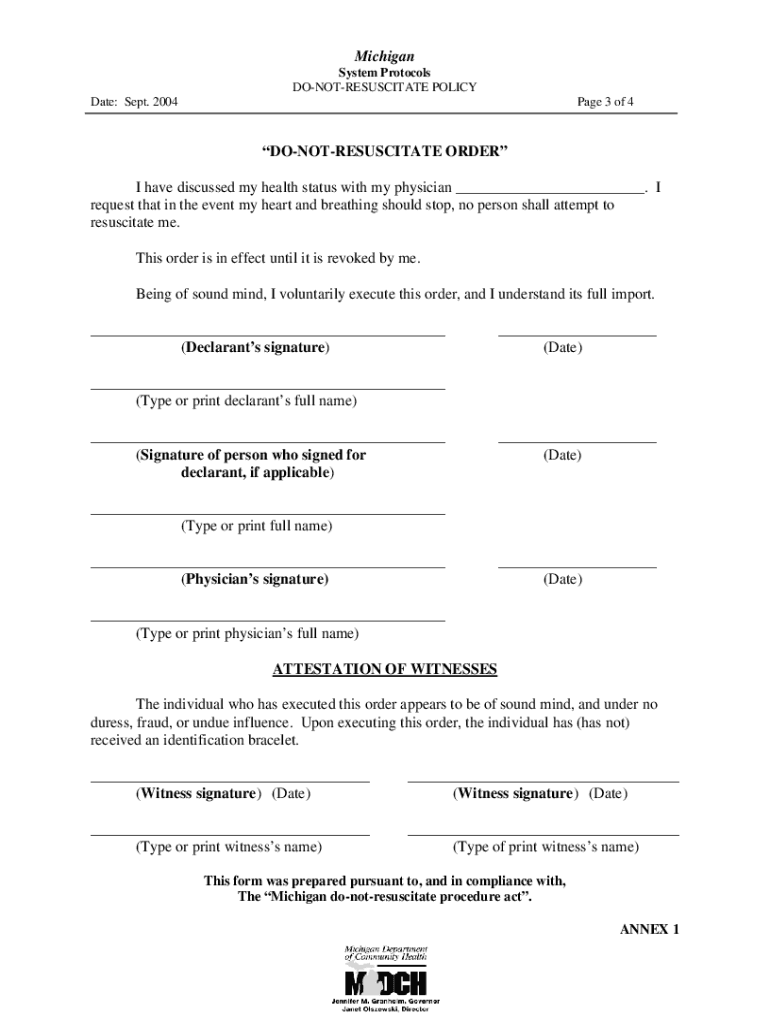
certain circumstances may accommodate patients who do not wish to receive and/or may not benefit from cardiopulmonary resuscitation. This policy is drafted in accordance with Public Act 368 of 1978, as amended, as well as Act 192 and 193 of the Public Acts of 1996. This policy is intended to facilitate kind, humane, and compassionate service for patients who have executed a valid “Do-not-resuscitate order” under the aforementioned Acts. 1. Definitions a. Attending Physician – means the ph.
Loading

Open form follow the instructions

Easily sign the form with your finger

Send filled & signed form or save
How to fill out the MI Do Not Resuscitate Policy online
Filling out the Michigan Do Not Resuscitate (DNR) Policy online is a crucial step for individuals who wish to ensure their preferences for end-of-life care are respected. This guide will walk you through the process in a clear and supportive manner, ensuring you can complete the form with confidence.
Follow the steps to complete the MI Do Not Resuscitate Policy online
- Click ‘Get Form’ button to access the MI Do Not Resuscitate Policy and open it for completion.
- Begin by entering your personal information in the designated fields. This typically includes your full name and date of birth to clearly identify you as the declarant.
- Consult with your attending physician to discuss your health status. Ensure that their name and contact information are accurately entered in the relevant section.
- Read the statements about your wishes regarding resuscitation carefully. You will need to affirm that you understand the implications of your decisions.
- Sign the form in the designated area as a declaration of your desire not to be resuscitated. If applicable, have your patient advocate sign as well.
- Ensure the form is dated appropriately, indicating when the order was executed. This adds validity to your directive.
- Finally, provide witness signatures in the specified sections. This is essential to attest that you executed the order willingly and with the understanding of its implications.
- After completing all necessary fields, review the form for accuracy. Save your changes, then download, print, or share the document as needed.
Complete your MI Do Not Resuscitate Policy online today to ensure your healthcare wishes are respected.
Experience a faster way to fill out and sign forms on the web. Access the most extensive library of templates available.
Related content
AN ACT to provide for the execution of a do-not-resuscitate order for an individual in a...
I request that in the event my heart and breathing should stop, no person shall attempt to...
• Do-Not-Resuscitate Order (DNR): a DNR is a medical order that says that...
Get answers to your most pressing questions about US Legal Forms API.
How do I opt for DNR?
To opt for a DNR, begin by discussing your wishes with your healthcare provider, ensuring they understand your preferences regarding resuscitation. Once you've made a decision, complete the necessary forms required under the MI Do Not Resuscitate Policy. These steps will help ensure your choices are respected in emergency situations.
How to do DNR paperwork?
Creating DNR paperwork involves filling out state-specific forms that comply with the MI Do Not Resuscitate Policy. Typically, this paperwork must include necessary declarations from both the patient and the physician. Platforms like USLegalForms make it easier to access the correct forms and guidelines to ensure everything is completed accurately.
What is necessary for a DNR to be valid?
For a DNR to be valid under the MI Do Not Resuscitate Policy, it’s crucial that the order be properly documented with all necessary signatures. The document must also conform to state regulations, clearly reflecting the patient’s desires. Regularly reviewing the DNR with healthcare providers helps ensure it's properly maintained.
How do you get a patient to be DNR?
To establish a DNR status for a patient, you should discuss the patient's healthcare preferences with them thoroughly. Once they make an informed decision, consult with their physician to complete the required forms under the MI Do Not Resuscitate Policy. This process is critical for respecting the patient's wishes during emergency medical situations.
What is needed for a DNR order to be valid?
To validate a MI Do Not Resuscitate Policy, you need documentation that is legally recognized by state laws. This includes clear communication of the patient's wishes regarding resuscitation and proper signatures from both the patient and physician. Keeping this document accessible can ensure that healthcare providers honor the DNR order.
What are the specifics of a DNR order?
A DNR order specifies that, in the event of cardiopulmonary arrest, medical staff should not perform cardiopulmonary resuscitation (CPR). It typically includes the circumstances under which a patient does not wish to be revived. Understanding these specifics helps ensure that the patient's healthcare choices are respected.
What must a DNR order have in order to be valid?
For a MI Do Not Resuscitate Policy to be valid, it must include the patient's name, the physician's signature, and clear instructions indicating the patient's wishes regarding resuscitation. Sometimes, a witness may also need to sign the document. Always consult your healthcare provider to ensure compliance with state laws.
What makes DNR invalid?
A MI Do Not Resuscitate Policy can be considered invalid if it lacks the appropriate signatures or if it is not properly formatted according to state regulations. Additionally, if the patient's wishes are unclear or if the DNR order is not in the patient's medical record, it may not be honored. It's essential to ensure that all legal requirements are met to uphold the DNR order.
What makes a DNR valid in Michigan?
A DNR is considered valid in Michigan when it meets specific legal requirements, including proper completion and signing by the patient or an authorized representative. The MI Do Not Resuscitate Policy outlines what constitutes a valid form, emphasizing the need to communicate your wishes clearly. Staying informed about these requirements can prevent confusion at critical moments.
What is the protocol for do-not-resuscitate?
The protocol for a do-not-resuscitate order generally involves healthcare providers respecting the wishes detailed in the DNR form during emergencies. This protocol is crucial under the MI Do Not Resuscitate Policy, and it requires that all medical personnel are aware of the order. You should ensure that your DNR is easily accessible within your medical records.
Use professional pre-built templates to fill in and sign documents online faster. Get access to thousands of forms.
If you believe that this page should be taken down, please follow our DMCA take down process here.