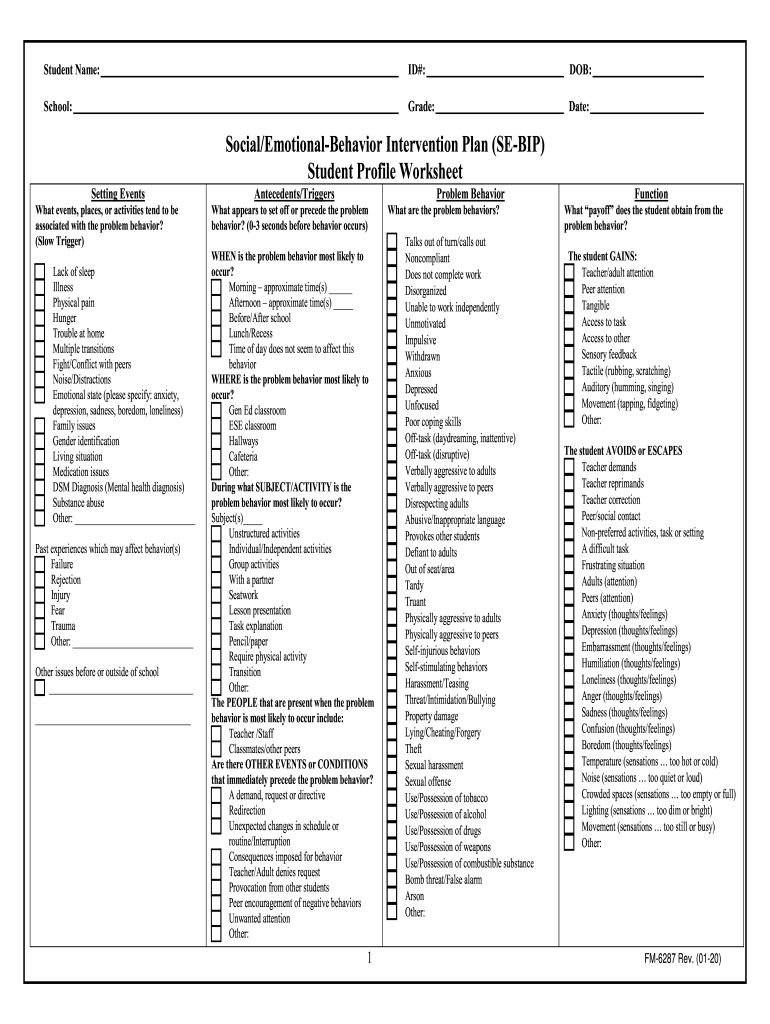
To be associated with the problem behavior? (Slow Trigger) Lack of sleep Illness Physical pain Hunger Trouble at home Multiple transitions Fight/Conflict with peers Noise/Distractions Emotional state (please specify: anxiety, depression, sadness, boredom, loneliness) Family issues Gender identification Living situation Medication issues DSM Diagnosis (Mental health diagnosis) Substance abuse Other: _______________________________ Past experiences which may affect behavior(s) Failure Rejection In.
Loading

Open form follow the instructions

Easily sign the form with your finger

Send filled & signed form or save
How to fill out the FM-6287 online
The FM-6287 form is designed to aid in the development of a Social/Emotional-Behavior Intervention Plan for students. This guide provides a comprehensive overview of the form and step-by-step instructions to ensure accurate completion in an online format.
Follow the steps to successfully complete the FM-6287 online.
- Press the ‘Get Form’ button to access the FM-6287 document and open it in your preferred online editor.
- Begin filling in the student's personal information, including their name, ID number, date of birth, school, grade, and the current date.
- Complete the Social/Emotional-Behavior Intervention Plan section by identifying the problem behavior, setting events, and antecedents that may trigger the behavior. Ensure to detail any specific conditions or events that may contribute to the behavior.
- Identify the problem behaviors accurately as listed in the form. Provide measurable examples of the behaviors observed in different settings and contexts.
- Specify the functional aspects of the problem behavior by determining what the student may gain or avoid through their actions. This information is crucial for addressing the root causes.
- Select and check the appropriate interventions that match the function of the problem behavior in the proactive, educative, and functional sections.
- Provide detailed descriptions of the selected interventions, including how they will be implemented and monitored over time.
- Fill out the crisis management plan if applicable by checking the relevant option and describing the procedures for de-escalating student behavior.
- Complete the training, implementation, and monitoring sections, ensuring to outline the resources needed and methods for tracking progress.
- After finalizing all sections, review the form for accuracy. Users can then save changes, download, print, or share the completed FM-6287 form as needed.
Complete the FM-6287 online to support students effectively.
Experience a faster way to fill out and sign forms on the web. Access the most extensive library of templates available.
Related content
Affected Area(s). Airspace Definition: Center: On the MC CLELLAN VOR/DME (MCC) 208 degree...
(SE-BIP) (FM 6287) is designed based on the FBA to chart interventions that will improve...
stereo FM. External influences may sometimes interfere with FM station reception even if...
Get answers to your most pressing questions about US Legal Forms API.
What are the 4 R's classroom rules?
The 4 R's classroom rules include respect, responsibility, readiness, and resourcefulness. These rules guide student behavior and establish expectations within the classroom. By promoting these principles, teachers can cultivate a positive and productive learning environment. Incorporating FM-6287 can reinforce these rules, making it easier to maintain a focused atmosphere.
How to fill out a behavior intervention plan?
To fill out a behavior intervention plan, begin by listing the identified behaviors that need intervention. Next, provide a detailed description of the strategies to be employed for each behavior. Outline the criteria for success and monitoring procedures as well. For a more efficient process, using FM-6287 offers a helpful structure and resources.
What are the four Rs of behavior intervention?
The four Rs of behavior intervention encompass relationships, respect, responsibility, and readiness. These concepts serve as the foundation for implementing effective behavioral strategies in a school setting. They underscore the importance of understanding student needs and nurturing a positive learning environment. Effective tools like FM-6287 can assist in structuring these interventions.
What are the four components of the behavior intervention plan?
The four critical components of a behavior intervention plan include assessment information, specific interventions, evaluation measures, and support systems. These elements work together to create a supportive framework for addressing challenging behaviors. By integrating these components, educators can ensure a targeted approach to positive behavior change. Legal guidance, such as FM-6287, can prove beneficial in managing this process.
What are the 4 R's in teaching?
In teaching, the 4 R's refer to relevance, rigor, relationships, and results. These principles guide educators in delivering effective and engaging instruction. Emphasizing these areas helps foster a connection between students and the material, promoting deeper understanding and retention. Implementing strategies based on FM-6287 will enhance the effectiveness of your teaching.
What are the 7 components of a behavior intervention plan?
A behavior intervention plan typically includes the following components: definition of target behaviors, assessment of behavioral needs, specific goals, strategies for intervention, methods for monitoring progress, actions for responses to desired behavior, and evaluation procedures. These elements collectively ensure a comprehensive plan is in place. Using resources like FM-6287 can help in drafting an effective plan.
What are the 4 R's of behavior intervention?
The 4 R's of behavior intervention include relationships, respect, responsibility, and reflection. These core principles help create a positive environment conducive to learning and behavioral improvement. By focusing on these areas, educators can effectively guide students toward better choices and foster a supportive atmosphere. For more structured approaches, consider using the FM-6287 framework.
How to create a behavior modification plan?
Creating a behavior modification plan requires a systematic approach, starting with identifying the specific behaviors to address. The FM-6287 solution offers a user-friendly framework for setting goals, choosing interventions, and tracking progress effectively. Engaging with all parties involved supports a well-rounded plan. Regular assessment and flexibility in the plan will enhance its success over time.
Who can write a behavior intervention plan?
A behavior intervention plan can be written by various professionals including teachers, school psychologists, and behavior specialists. Collaboration among these parties ensures a comprehensive understanding of the student’s needs. Utilizing the FM-6287 framework simplifies the planning process, enabling clear communication. Involving parents in this process also enhances the plan’s effectiveness and feasibility.
Can a student have a bip without an IEP?
Yes, a student can have a behavior intervention plan (BIP) without an Individualized Education Program (IEP). A BIP can be created for students who need behavioral support but do not qualify for special education services. FM-6287 aids educators and parents in developing effective BIPs that address specific behavioral issues. It's essential to tailor the plan to meet the individual needs of the student.
Use professional pre-built templates to fill in and sign documents online faster. Get access to thousands of forms.
If you believe that this page should be taken down, please follow our DMCA take down process here.