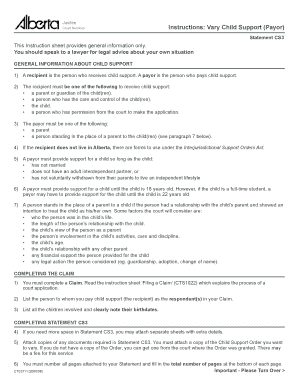
Wn situation GENERAL INFORMATION ABOUT CHILD SUPPORT 1) A recipient is the person who receives child support. A payor is the person who pays child support. 2) The recipient must be one of the following to receive child support: a parent or guardian of the child(ren). a person who has the care and control of the child(ren). the child. a person who has permission from the court to make the application. 3) The payor must be one of the following: a parent a person standing in.
Open form follow the instructions
Easily sign the form with your finger
Send filled & signed form or save
How to fill out the Canada CTS3711 - Alberta online
The Canada CTS3711 form is essential for individuals seeking to vary child support in Alberta. This comprehensive guide will provide you with step-by-step instructions on how to fill out the form online effectively.
Follow the steps to complete the Canada CTS3711 form online.
- Press the ‘Get Form’ button to access the form and open it in your preferred online editor.
- Read the general information about child support listed in the beginning of the document to understand your roles as a recipient or payor.
- Complete the Claim section by listing the respondent(s), which is the individual to whom you pay child support, and include all involved children along with their birthdates.
- In Statement CS3, if you require more space, feel free to attach additional sheets with more details.
- Attach all required documents, including a copy of the Child Support Order you wish to vary. If you do not have this, obtain it from the court where it was issued.
- Number all pages you attach to your Statement and indicate the total number of pages at the bottom of each one.
- Use this section to provide details about your situation and explain how circumstances have changed since the last Child Support Order.
- Clearly articulate the changes that have occurred, such as any modifications to your financial position or changes in the recipient’s financial situation.
- If applicable, provide specific details regarding the children’s individual circumstances, like special expenses or different living arrangements.
- Describe any special expenses related to the children as laid out in section 7 of the Alberta Child Support Guidelines.
- Supply all necessary financial information to substantiate your income; consider redacting sensitive information.
- If needed, write a request for financial information from the recipient and allow them 30 calendar days to respond.
- Utilize appropriate forms for requesting financial information, such as the Request for Financial Information or a Notice to Disclose.
- Include any financial details you have regarding the recipient to support your claims.
- Attach calculations that validate the amount of child support you propose to pay, and seek assistance if necessary.
- When asking to reduce arrears, submit tax returns for the relevant years and offer reasons for your request.
- Ensure that you serve all documents to the recipients as required.
- If applicable, serve the Director of Maintenance Enforcement if the recipient has ever received financial assistance from the government.
Start completing your Canada CTS3711 form online today to ensure proper handling of your child support variation.
Experience a faster way to fill out and sign forms on the web. Access the most extensive library of templates available.
Related content
Commercial swipe-fingerprint form factor. Ergonomics / Usability. CTS. Carpal Tunnel...
Diamond Princess is a British-registered cruise ship owned and operated by Princess...
Get answers to your most pressing questions about US Legal Forms API.
Can I file a Canadian tax return online?
Yes, you can file a Canadian tax return online, which is a convenient option for many, including newcomers under Canada CTS3711 - Alberta. The Canada Revenue Agency (CRA) offers various online platforms to complete your return. Utilizing these online services simplifies the process and provides quick confirmation of your tax filing.
What is the 90% rule for newcomers to Canada?
The 90% rule for newcomers to Canada refers to the requirement that newcomers must earn at least 90% of their income from Canadian sources to access certain tax benefits. This rule particularly impacts those who are part of the Canada CTS3711 - Alberta initiative. Familiarizing yourself with this rule can optimize your tax filings and benefits.
How long are you considered a newcomer to Canada?
You are considered a newcomer to Canada for up to five years after arriving as a permanent resident or becoming a naturalized citizen. This timeframe is crucial for understanding your tax obligations and benefits, especially if you are navigating the Canada CTS3711 - Alberta program. Being aware of your status helps in accessing the right resources as you settle in.
Do I have to file a tax return in Canada if I live abroad?
If you are a Canadian citizen or a permanent resident living abroad, you may still need to file a tax return in Canada, especially if you have income sources within Canada. This applies to newcomers under Canada CTS3711 - Alberta as well. Filing your return correctly ensures you meet your tax obligations and take advantage of eligible credits.
Who is eligible for the $1000 welcome to Canada bonus?
The $1000 welcome to Canada bonus is designed for newcomers who have recently settled in Canada under specific programs, including Canada CTS3711 - Alberta. Eligible individuals must meet certain residency requirements and apply within the established timelines. This bonus can provide essential support as you transition into Canadian life.
What is the new $7500 tax credit in Canada?
The new $7500 tax credit in Canada is aimed at helping taxpayers, particularly newcomers and residents of Alberta under the Canada CTS3711 program, by reducing the amount of tax they owe. This credit can be particularly beneficial for low- and middle-income families. Understanding how to qualify for and apply this credit can lead to significant savings on your taxes.
What documents do I need to file my taxes in Canada?
When filing your taxes in Canada, you need several documents including your T4 slips, which detail your income, and any receipts for deductible expenses. Additionally, if you are a newcomer under Canada CTS3711 - Alberta, you may need documentation proving your residency status. Gathering these documents ahead of time will streamline the tax filing process for you.
What is the 90% tax rule in Canada?
The 90% tax rule in Canada allows newcomers to claim certain tax benefits if they earn at least 90% of their income from Canadian sources. This rule is particularly relevant for those settling in Alberta under the Canada CTS3711 initiative. Understanding this rule helps in optimizing your tax situation and ensuring compliance with Canadian tax regulations.
What is Alberta in Canada known for?
Alberta is known for its stunning landscapes, including the Rockies and vast prairies, as well as its vibrant cities like Calgary and Edmonton. The province is rich in natural resources, particularly oil and gas, which play a vital role in Canada's economy. Additionally, Alberta hosts numerous cultural events and festivals, making it a dynamic destination for both locals and tourists in Canada CTS3711 - Alberta.
Why did Alberta want to leave Canada?
The desire for Alberta to separate from Canada stems from various political, economic, and cultural factors. Many Albertans feel that their interests are often overlooked at the federal level, leading to calls for greater autonomy. These discussions highlight the unique identity of Alberta within Canada and the need for dialogue on balancing local interests with national policies.
Use professional pre-built templates to fill in and sign documents online faster. Get access to thousands of forms.
If you believe that this page should be taken down, please follow our DMCA take down process here.