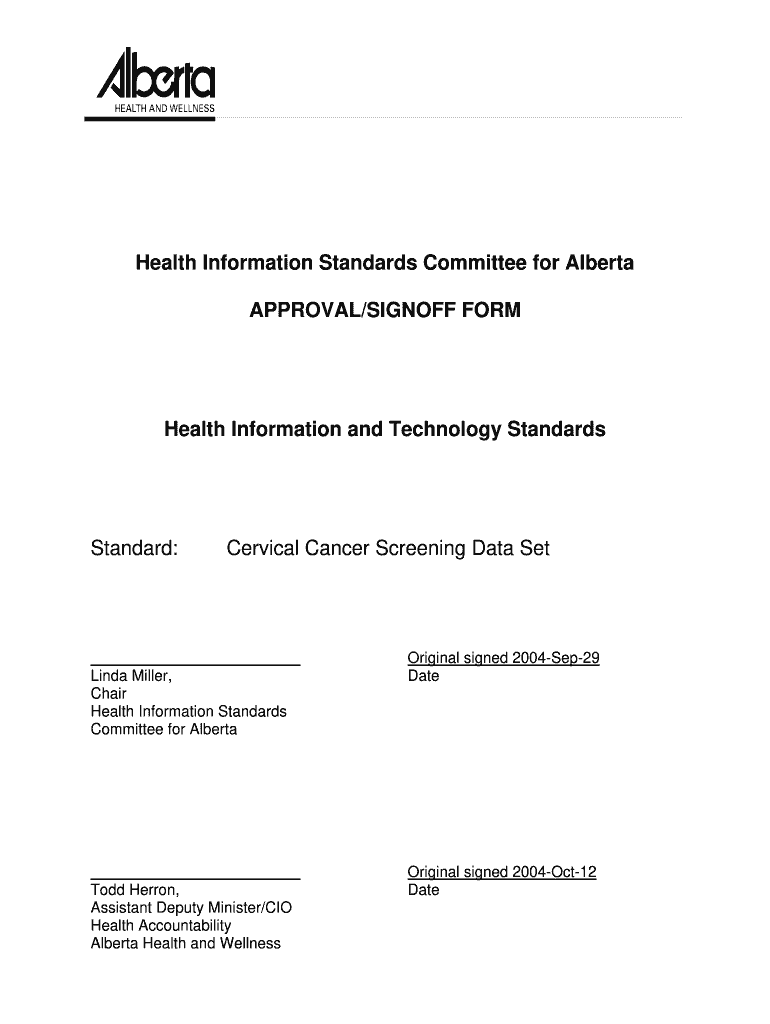
Ller, Chair Health Information Standards Committee for Alberta Original signed 2004-Sep-29 Date Todd Herron, Assistant Deputy Minister/CIO Health Accountability Alberta Health and Wellness Original signed 2004-Oct-12 Date This Page Intentionally Left Blank Health Information and Data Standards HEALTH INFORMATION STANDARDS COMMITTEE FOR ALBERTA Cervical Cancer Screening Data Set Status: Approved Version 1.0 Approved Date: 2004-Oct-12 Accepted in Draft Date: 200.
Loading

Open form follow the instructions

Easily sign the form with your finger

Send filled & signed form or save
How to fill out the Canada Cervical Cancer Screening Data Set online
The Canada Cervical Cancer Screening Data Set is a vital tool for the efficient management of cervical cancer screening programs. This guide provides user-friendly and step-by-step instructions on how to complete each section of the form online.
Follow the steps to fill out the Canada Cervical Cancer Screening Data Set.
- Use the ‘Get Form’ button to start accessing the Canada Cervical Cancer Screening Data Set. This will allow you to download or open the form in your preferred online editor.
- Begin with Section 1, which includes participant demographic information. Fill in fields such as name, date of birth, and contact information accurately to ensure proper identification.
- Proceed to Section 2 to document the screening event details. This includes the date of the screening, type of test performed, and results if available.
- In Section 3, input follow-up procedures, which outline the next steps needed based on the screening results. This includes scheduling additional appointments or referrals.
- Next, complete Section 4 regarding health service providers involved in the screening process. Ensure to fill out provider names and contact information.
- Once all sections have been filled out, review the entire form for accuracy and completeness. Make any necessary corrections at this stage.
- Finally, save your changes. You can choose to download, print, or share the completed form as required.
Start completing your Canada Cervical Cancer Screening Data Set online today for efficient screening management.
Experience a faster way to fill out and sign forms on the web. Access the most extensive library of templates available.
Related content
by O Tatar · 2024 · Cited by 8 — We used five Canadian-validated scales to measure HPV...
by B Haward · 2022 · Cited by 13 — The present study is part of a larger project aimed...
Dec 9, 2024 — There is limited or no evidence to support screening for cervical cancer...
Get answers to your most pressing questions about US Legal Forms API.
What is the chance of getting cervical cancer?
HPV can be passed on through close skin to skin contact, usually during sexual activity. Around 12 types of HPV are considered high risk for cancer of the cervix. Two of these types (HPV 16 and HPV 18) cause about 7 out of 10 (70%) cervical cancer cases.
What are the odds of getting cancer in Canada?
Based on 2015 estimates: Nearly 1 in 2 Canadians (45% of men and 43% of women) is expected to develop cancer during their lifetime. About 1 out of 4 Canadians (26% of men and 23% of women) is expected to die from cancer.
Can a gynecologist tell if you have cervical cancer?
The symptoms of cervical cancer are not always obvious. More commonly in the U.S., cervical cancer may be diagnosed on a routine pelvic exam performed by your gynecologist or other women's health provider. Abnormal cells may be detected on a Pap test or a mass may be seen on the cervix.
Can cervical cancer be detected during pelvic exam?
Some cervical cancer may be found during a pelvic exam. Your provider can't see precancer changes such as dysplasia. But the provider may see some invasive cancer during an exam. If something suspicious is seen during the pelvic exam, more tests will be needed.
Can you see cancer on the cervix?
There are usually no signs or symptoms of early cervical cancer but it can be detected early with regular check-ups. Signs and symptoms of cervical cancer include vaginal bleeding and pelvic pain. Tests that examine the cervix are used to detect (find) and diagnose cervical cancer.
How common is cervical cancer worldwide?
Cervical cancer is the fourth most common cancer in women. In 2018, an estimated 570 000 women were diagnosed with cervical cancer worldwide and about 311 000 women died from the disease.
Can a pelvic exam detect cancer?
Typically, a pelvic exam is the first step in diagnosing gynecologic cancers, which include cancers of the vulva, uterus, cervix, fallopian tubes, ovaries, bladder and rectum. A gynecologic oncologist may perform a pelvic exam to determine the exact type and stage of cancer.
What is the best test for cervical cancer?
The most common screening test to detect cervical cancer or precancerous cells (dysplasia) is the Pap test. During a Pap test, the doctor takes a sample of cells from the surface of the cervix inside the vagina, and then sends the sample to be reviewed by pathologists in a lab at DF/BWCC.
Can you see cervical cancer with pelvic exam?
Some cervical cancer may be found during a pelvic exam. Your provider can't see precancer changes such as dysplasia. But the provider may see some invasive cancer during an exam. If something suspicious is seen during the pelvic exam, more tests will be needed.
How common is cervical cancer in Canada?
Cervical cancer accounts for 1.3% of all new female cancers and 1.1% of all female cancer deaths. It is estimated that 1,350 women will develop cervical cancer in 2019 and that 410 will die from it. 1 in 168 women is expected to develop cervical cancer during her lifetime, and 1 in 478 will die of it.
Use professional pre-built templates to fill in and sign documents online faster. Get access to thousands of forms.
If you believe that this page should be taken down, please follow our DMCA take down process here.