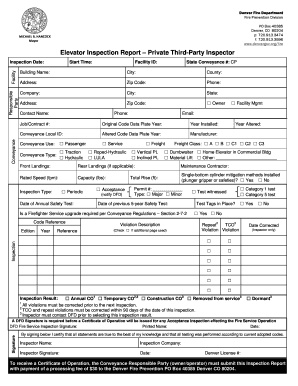
-Party Inspector Conveyance Responsible Party Facility Inspection Date: Start Time: Facility ID: State Conveyance #: CP Building Name: City: County: Address: Zip Code: Phone: Company: City: State: Address: Zip Code: Owner Contact Name: Phone: Email: Job/Contract #: Original Code Data Plate Year: Year Installed: Conveyance Local ID: Altered Code Data Plate Year: Manufacturer: Conveyance Use: Passenger Conveyance Type: Traction Hydraulic Service.
Open form follow the instructions
Easily sign the form with your finger
Send filled & signed form or save
How to use or fill out the CO Elevator Inspection Report - Private Third-Party Inspector - Denver online
The CO Elevator Inspection Report - Private Third-Party Inspector is an essential document used for evaluating and documenting the safety and compliance of elevators in Denver. This guide provides clear, step-by-step instructions to help users fill out the report online, ensuring accuracy and adherence to safety regulations.
Follow the steps to complete the inspection report accurately.
- Click ‘Get Form’ button to obtain the form and open it for completion.
- Begin by entering the inspection date and start time in the appropriate fields. This is crucial for tracking the inspection timeline.
- Fill in the facility ID and State Conveyance number. These identifiers help in referencing the specific elevator being inspected.
- Complete the building name, city, county, and full address of the facility. Make sure to include the zip code for accurate location identification.
- Enter the contact information of the responsible party, including their name, phone number, email, and company details.
- Indicate the type of conveyance and select the appropriate options, such as passenger, freight, or service elevator along with the conveyance type.
- Document the installation years and any alterations made to the conveyance. Provide details on the maintenance contractor and other relevant specifications.
- Select the inspection type and fill out details for annual or periodic inspections, including testing results and any violations found.
- In the violation section, outline any issues found during inspection, referencing code descriptions, and noting if additional pages are used.
- Ensure that the inspector includes their name, signature, and date at the bottom of the report. For compliance, a DFD signature is required for acceptance inspections.
- Once all fields are completed, save changes made to the report. You may choose to download a copy, print it, or share it as needed.
Complete your CO Elevator Inspection Report online today to ensure compliance and safety.
Experience a faster way to fill out and sign forms on the web. Access the most extensive library of templates available.
Related content
1 All violations must be corrected prior to the next inspection. 2 TCO and repeat...
Apr 27, 2023 — Colorado Contracts for Construction and General Conditions. B. Denver...
ITRC operates as a committee of the Environmental Research Institute of the States (ERIS)...
Get answers to your most pressing questions about US Legal Forms API.
What is the biggest red flag in a home inspection?
The biggest red flag in a home inspection often includes major structural issues, such as foundation cracks or water intrusion. These problems can indicate extensive damage or underlying concerns that may pose serious risks. Spotting these issues early through a comprehensive assessment helps homeowners address potential threats and avoid costly repairs. Utilizing a CO Elevator Inspection Report - Private Third-Party Inspector - Denver can similarly identify significant risks associated with elevators.
How to write up a home inspection report?
To write up an effective home inspection report, begin with a summary of your inspection findings followed by detailed sections for each component of the home. Make sure to include specific observations, recommendations, and any safety concerns. Use clear headings, bullet points, and straightforward language to enhance readability, helping homeowners understand their property condition.
How do I fill out a home inspection report?
Filling out a home inspection report involves documenting the condition of various home components systematically. You start by assessing major areas such as the roof, plumbing, electrical systems, and structure. When documenting your findings, ensure you use clear language to describe the condition and any necessary repairs. If you are unsure, resources like US Legal Forms can guide you through generating an effective inspection report.
Do private elevators need to be inspected?
Yes, private elevators require regular inspections to ensure safety and compliance with local regulations. A CO Elevator Inspection Report - Private Third-Party Inspector - Denver can help identify potential issues before they become costly problems. Regular checks protect users and maintain the elevator's functionality, providing peace of mind for property owners.
How do I fill out an inspection report?
To fill out a CO Elevator Inspection Report - Private Third-Party Inspector - Denver, start by gathering all necessary information about the elevator, including location and usage details. Next, follow the structured format in the report, ensuring you accurately record all findings, observations, and any code violations. Finally, review your information for completeness and clarity before submitting the report.
Who regulates elevators in Colorado?
In Colorado, elevators are regulated by the Colorado Department of Labor and Employment. They oversee inspections, maintenance, and compliance with safety codes. A CO Elevator Inspection Report - Private Third-Party Inspector - Denver is essential to adhere to state regulations. By getting inspections from a certified third-party inspector, you contribute to a safer environment for everyone using your elevator.
Does OSHA inspect elevators?
The Occupational Safety and Health Administration (OSHA) does not conduct routine elevator inspections, as this responsibility falls to local authorities and certified inspectors. However, OSHA sets safety standards that elevators must meet to ensure worker safety. A CO Elevator Inspection Report - Private Third-Party Inspector - Denver aligns with these standards, helping maintain a safe environment. Engaging with certified inspectors ensures compliance with all applicable regulations.
How often should an elevator be checked?
Elevators should generally be inspected at least once a year, but local regulations may dictate specific schedules. The CO Elevator Inspection Report - Private Third-Party Inspector - Denver provides a systematic evaluation of your elevator's safety and performance. Keeping to a regular inspection schedule helps identify issues early and ensures compliance with state laws. Ultimately, it safeguards users and prolongs the life of the elevator.
Do all elevators have to be ADA compliant?
Yes, most elevators must comply with the Americans with Disabilities Act (ADA) requirements to serve all individuals, regardless of ability. When obtaining a CO Elevator Inspection Report - Private Third-Party Inspector - Denver, you will also verify compliance with ADA guidelines. This compliance is crucial for public spaces and commercial buildings. It promotes accessibility and contributes to an inclusive environment for everyone.
Do residential elevators need to be inspected?
Residential elevators do indeed need inspection to maintain safe operation. A CO Elevator Inspection Report - Private Third-Party Inspector - Denver provides a thorough assessment of your elevator's functioning and compliance with safety regulations. Homeowners can ensure the safety of their family and guests by prioritizing these inspections. Routine checks can prevent costly repairs down the line.
Use professional pre-built templates to fill in and sign documents online faster. Get access to thousands of forms.
If you believe that this page should be taken down, please follow our DMCA take down process here.