Get Nd Sfn 2560 2018-2026
How it works
-

Open form follow the instructions
-

Easily sign the form with your finger
-

Send filled & signed form or save
How to fill out the ND SFN 2560 online
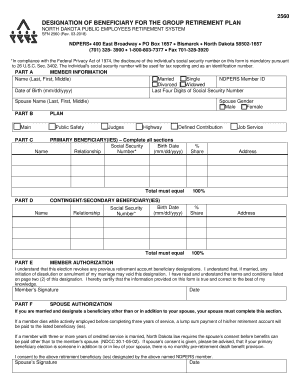
The ND SFN 2560 form, also known as the designation of beneficiary for the group retirement plan, is crucial for members of the North Dakota Public Employees Retirement System. This guide provides clear and supportive instructions on how to complete the form online, ensuring that your beneficiary designations are accurately recorded.
Follow the steps to fill out the ND SFN 2560 online:
- Press the ‘Get Form’ button to access the form and open it in the online editor.
- Fill in Part A with your personal information. This includes your name (last, first, middle), marital status (married, single, divorced, or widowed), NDPERS member ID, the last four digits of your social security number, and date of birth in mm/dd/yyyy format. If applicable, include your spouse's name and gender.
- In Part B, select your plan type from the options provided, such as Public Safety, Judges, Highway, or Defined Contribution.
- Proceed to Part C to specify your primary beneficiary(ies). For each beneficiary, fill out their name, relationship to you, social security number, and date of birth. Ensure the total percentage share equals 100%.
- If you have contingent or secondary beneficiaries, complete Part D in the same manner, ensuring the total percentage share again equals 100%.
- In Part E, read the member authorization carefully. By signing, you understand that this designation revokes any previous beneficiary designations. Include your signature and the date.
- If applicable, your spouse must complete Part F, providing their consent to the beneficiary designations if they differ from your spouse. They should sign and date this section.
- Review all filled sections for accuracy. Once confirmed, you can save changes, download, print, or share the completed form as needed.
Complete your ND SFN 2560 form online today to ensure your beneficiary designations are up to date.
Yes, you are usually entitled to your husband's superannuation if he dies, provided he named you as a beneficiary. You may need to submit the ND SFN 2560 form to claim these funds from the superannuation fund. Understanding the specific terms of his superannuation plan is essential, and UsLegalForms can guide you through this process with ease.