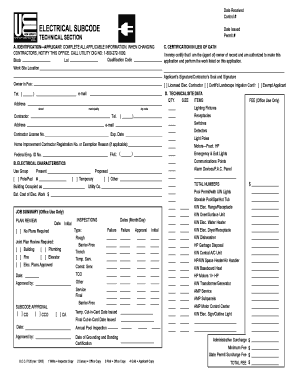
CALL UTILITY DIG NO: 1-800-272-1000. Qualification Code Block Lot C. CERTIFICATION IN LIEU OF OATH I hereby certify that I am the (agent of) owner of record and am authorized to make this application and perform the work listed on this application. Work Site Location Applicant’s Signature/Contractor’s Seal and Signature Owner in Fee: Tel. ( [ ] Licensed Elec. Contractor [ ] Certif'd Landscape Irrigation Cont'r [ ] Exempt Applicant e-mail ) D. TECHNICAL SITE DATA QTY. SIZE ITEMS Addres.

How it works
  • Open form

    Open form follow the instructions

  • Easily sign form

    Easily sign the form with your finger

  • Share form

    Send filled & signed form or save

How to fill out the NJ U.C.C. F120 online

Filling out the NJ U.C.C. F120 form is essential for electrical project permits in New Jersey. This guide will help you navigate the online version of the form with ease, ensuring that all sections are completed accurately for timely processing.

Follow the steps to complete the NJ U.C.C. F120 online form.

  1. Click the ‘Get Form’ button to access the NJ U.C.C. F120 form and open it in your preferred online editor.
  2. Fill out Section A with your identification information as the applicant. Ensure that you provide all applicable information. If there is a need to change contractors, notify the appropriate office.
  3. In Section B, detail the electrical characteristics of the project. Indicate the use group and the present and proposed electrical needs, marking if the site is temporary or requires additional utility company input.
  4. For Section C, certify in lieu of oath that you are the agent of the owner of record and have authorization for this application. Provide your signature and any necessary seals.
  5. Complete Section D with technical site data, including the quantity and sizes of electrical items. Input the contractor's details, ensuring the license number is accurate.
  6. Final checks should be made in the job summary and inspections sections. Note if plans are required and make sure to input expected inspection dates.

Start completing your NJ U.C.C. F120 form online today to ensure a smooth permitting process.

Get form

Experience a faster way to fill out and sign forms on the web. Access the most extensive library of templates available.

Related content

Electrical Subcode

... this form to your Local Construction Code Enforcement Office, please provide one...

Learn more
N.J. Admin. Code § 5:23-4.5 - Municipal enforcing...

F120, Electrical Subcode Technical Section. F130, Plumbing Subcode Technical Section...

Learn more
File Info : application/pdf, 90 Pages, 12.43MB

We and our partners share information on your use of this website to help improve your...

Learn more
Questions & Answers

Get answers to your most pressing questions about US Legal Forms API.

Contact support

Can you close without a certificate of occupancy in NJ?

In New Jersey, closing on a property typically requires a certificate of occupancy. Without it, buyers and sellers face potential legal challenges and complications during the transaction. The NJ U.C.C. F120 mandates this process to ensure safety and compliance. To avoid issues, it is essential to secure this certificate prior to closing, ensuring a smooth transaction for all parties involved.

The time it takes to get a building permit approved in New Jersey varies by municipality and the complexity of your project. Generally, you can expect a wait time ranging from a few days to several weeks. Factors like the completeness of your application and compliance with NJ U.C.C. F120 will also influence the approval process. To expedite this, ensure that your application is thorough and meets all local requirements.

The NJ UCC, or New Jersey Uniform Construction Code, sets standards for construction and building safety across the state. It provides guidelines to ensure all buildings meet safety, health, and structural requirements. Understanding the NJ U.C.C. F120 is crucial for anyone involved in construction or property management in New Jersey. Adhering to this code ensures that projects pass inspections and ultimately protect public safety.

A certificate of occupancy in New Jersey must include essential information such as the property's address, the owner's name, and the use of the building. It should also detail compliance with local zoning laws and reflect adherence to NJ U.C.C. F120 standards. This document acts as proof that the building is safe and meets all legal requirements, ensuring peace of mind for occupants and investors.

To obtain a certificate of occupancy in New Jersey, start by ensuring your construction complies with local codes. After finishing your project, you must apply to the municipal building department. The department will schedule an inspection to verify compliance with the NJ U.C.C. F120. Following a successful inspection, you will receive your certificate, allowing you to occupy the building.

In New Jersey, landlords cannot legally collect rent without a certificate of occupancy. The NJ U.C.C. F120 requires that all residential properties meet safety and health standards before they can be leased. Therefore, if your property lacks this certificate, you risk penalties and face challenges with legal enforcement. It is essential to secure a certificate to protect both your interests and those of your tenants.

To obtain a certificate of occupancy in NJ, you must first complete your construction or renovation according to the approved plans. Next, submit an application to your local building department, along with the necessary documentation. The department will inspect your property to ensure it complies with the NJ U.C.C. F120 standards. Once approved, you will receive your certificate, allowing you to legally occupy the building.

A UCC fixture filing in New Jersey remains valid for five years, just like any standard UCC filing. Ensuring that you renew the filing within this timeframe is vital for asserting your rights over the fixtures involved. Utilizing the NJ U.C.C. F120 will streamline this process and keep your interests protected.

In New Jersey, a UCC filing is good for five years. After the five-year mark, a continuation statement must be filed to keep your security interest valid. It's essential to remain proactive about these timelines to maintain security for your interests. The NJ U.C.C. F120 form is a reliable resource for managing these filings.

No, in New Jersey, performing electrical work without a license is not permitted. Only licensed electricians can handle specific electrical tasks to ensure safety and compliance with local codes. If you require electrical services, it's always wise to hire a qualified professional. Platforms like uslegalforms can help you find the right licensed professional.

Get This Form Now!

Use professional pre-built templates to fill in and sign documents online faster. Get access to thousands of forms.

If you believe that this page should be taken down, please follow our DMCA take down process here.

NJ U.C.C. F120 Form

This form is available in several versions. Select the version you need from the drop-down list below.

Get NJ U.C.C. F120