______________________________________________________________________________________________ City/State/Zip: ___________________________________________________________ Employer: _____________________________ Home Phone: _________________________ Cell Phone: _________________________ Work Phone: _________________________ Sex: Male Race: White Ethnicity: Pregnant - due date: ____/____/____ Female Black Hispanic Asian Pacific Islander Not Pregnant Amer Indian/Alaskan Native Marital St.

Open form follow the instructions

Easily sign the form with your finger

Send filled & signed form or save
How to fill out the NH Confidential STD Reporting Form online
Completing the NH Confidential STD Reporting Form online is essential for reporting sexually transmitted diseases accurately and promptly. This guide provides a clear step-by-step approach to ensure you fill out the form correctly and efficiently.
Follow the steps to complete the form with ease.
- Click 'Get Form' button to obtain the form and open it in the editor.
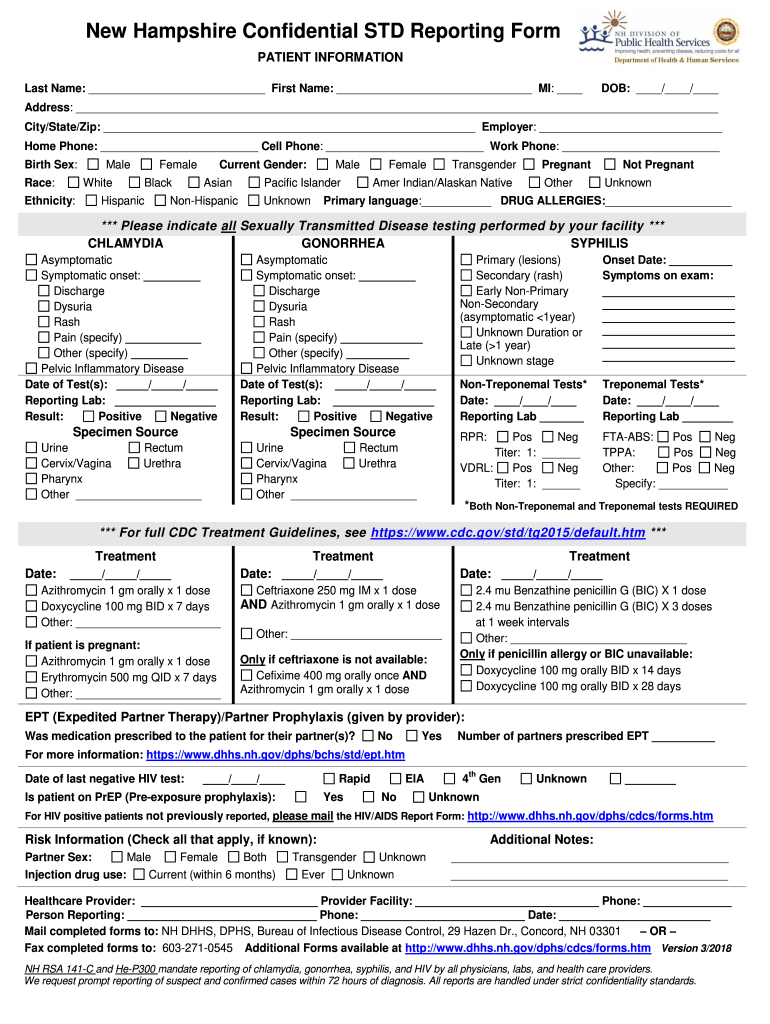
- Begin by filling out the patient information section. Input the last name, first name, and middle initial where indicated, along with the date of birth, address, city/state/zip, and employer information. Include contact numbers for home, cell, and work.
- Indicate the sex and race of the patient. Select the appropriate ethnicity and specify if the patient is pregnant along with the due date.
- Select the marital status, primary language, and make sure to indicate any sexually transmitted disease testing performed by your facility, including chlamydia, gonorrhea, and syphilis.
- For each test performed, enter the date, reporting lab, and result (positive or negative). Make sure to specify the specimen source for each test conducted.
- Document any symptoms observed and note the onset date. Include details from non-treponemal and treponemal tests, including reporting lab information.
- Check all applicable treatments. Provide details on any HIV tests conducted and include treatment dates.
- Fill in partner information regarding partner sex, the number of partners over the past 12 months, and if they were treated or referred for treatment.
- Use the additional notes section for any relevant information not covered elsewhere.
- Complete the healthcare provider and reporting person's details including names, phone numbers, and the date of reporting.
- After filling out the form, save any changes, and you may choose to download, print, or share the form as necessary.
Start filling out the NH Confidential STD Reporting Form online today to ensure timely and accurate reporting.
Experience a faster way to fill out and sign forms on the web. Access the most extensive library of templates available.
Related content
Download and complete the appropriate form for the disease you are reporting and then...
Confidential STI Testing at UNH. Make an appointment with a Health & Wellness ... Durham...
We wish you well in preparing for your examination and remind you that by law you are...
Get answers to your most pressing questions about US Legal Forms API.
How do I report a communicable disease in NH?
To report a communicable disease in New Hampshire, you'll typically need to fill out the NH Confidential STD Reporting Form. This form enables you to report your condition to the appropriate health authorities securely. Engaging with this process not only provides assistance to your medical team but also contributes to broader public health efforts. Remember, your health matters and so does community welfare.
Does an STD go on your record?
Yes, certain STDs do appear on medical records, particularly if they are reportable. Reporting helps with ongoing public health efforts, but your personal information remains confidential. If you're concerned about privacy, utilizing the NH Confidential STD Reporting Form ensures that sensitive details are safeguarded. Understanding how records work can empower you in managing your health.
What STDs are reportable to the CDC?
Several STDs are classified as reportable to the CDC, including chlamydia, gonorrhea, syphilis, and HIV. Reporting these infections is essential for public health monitoring and prevention efforts. If you suspect you have a reportable STD, completing the NH Confidential STD Reporting Form can ease the process. Stay informed and take proactive steps to protect your health and community.
Do STDs need to be reported?
Not all STDs need to be reported, but many do. Reportable STDs help public health officials gauge the spread and manage outbreaks effectively. If you're unsure whether your condition requires reporting, consider using the NH Confidential STD Reporting Form as a reference. It can provide the guidance necessary to navigate these requirements.
Does it get reported when you have an STD?
Whether an STD gets reported depends on its classification. Reportable STDs are documented to monitor public health, while non reportable STDs typically do not require reporting. If you have a reportable STD, you may be asked to complete the NH Confidential STD Reporting Form. This document serves to facilitate accurate data collection while maintaining your privacy.
Do you need to disclose STD?
The necessity to disclose an STD often depends on specific circumstances, such as your partner's health and local laws. Generally, being honest about your health status, especially regarding reportable STDs, is crucial for mutual protection. Utilizing the NH Confidential STD Reporting Form can help streamline information collection in a secure manner. Always prioritize open communication for the best outcomes.
Do STDs have to be reported to the CDC?
Yes, many sexually transmitted diseases are required to be reported to the Centers for Disease Control and Prevention (CDC). These regulations help track and manage public health outbreaks. If you are diagnosed with a reportable STD, the NH Confidential STD Reporting Form can assist with the reporting process. This ensures that health officials can monitor and respond to trends effectively.
What is a non reportable STD?
A non reportable STD refers to sexually transmitted infections that do not require mandatory reporting to health authorities. Common examples include certain strains of human papillomavirus (HPV) and herpes simplex virus (HSV), among others. Understanding what constitutes a non reportable STD can help you make informed decisions about your health. For thorough insights, you might consider using the NH Confidential STD Reporting Form for clarity.
How are communicable diseases reported?
Communicable diseases are reported through standard forms like the NH Confidential STD Reporting Form, which healthcare professionals utilize. These reports go directly to state health departments to monitor and manage disease outbreaks. The process is designed to balance the need for public health data with patient confidentiality. This ensures that authorities can act promptly while respecting individual privacy.
How do I contact communicable diseases?
To contact communicable diseases in New Hampshire, you can reach out to your local health department. They manage the reporting and follow-up of communicable diseases, including those reported via the NH Confidential STD Reporting Form. Communication with local health authorities will provide guidance on your specific concerns and the next steps to take.
Use professional pre-built templates to fill in and sign documents online faster. Get access to thousands of forms.
If you believe that this page should be taken down, please follow our DMCA take down process here.
This form is available in several versions. Select the version you need from the drop-down list below.