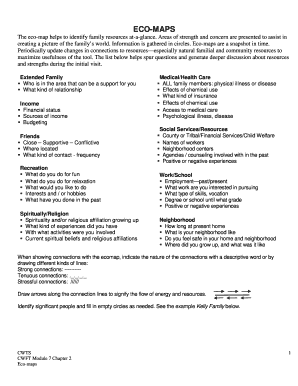
Ircles. Eco-maps are a snapshot in time. Periodically update changes in connections to resources—especially natural familial and community resources to maximize usefulness of the tool. The list below helps spur questions and generate deeper discussion about resources and strengths during the initial visit. Extended Family  Who is in the area that can be a support for you  What kind of relationship Income  Financial status  Sources of income  Budgeting Friends  Close – Suppo.

How it works
  • Open form

    Open form follow the instructions

  • Easily sign form

    Easily sign the form with your finger

  • Share form

    Send filled & signed form or save

How to fill out the MN CWFT Module 7 Chapter 2 Eco-Maps online

Filling out the MN CWFT Module 7 Chapter 2 Eco-Maps is an important step in identifying and visualizing family resources and connections. This guide will provide you with clear, step-by-step instructions to help you complete the eco-map effectively.

Follow the steps to fill out your eco-map online.

  1. Click ‘Get Form’ button to obtain the form and open it for editing.
  2. Begin by entering your name in the designated field at the top of the form. This identifies the individual or family that the eco-map represents.
  3. In the section labeled 'Extended Family/Significant Others,' fill in the names of family members who provide support or assistance. Consider their relationship to you and make note of significant connections.
  4. Move to the 'Neighborhood' section and provide details about your current residence. Describe the neighborhood, indicate how long you have lived there, and reflect on your feelings of safety.
  5. In the 'Work/School' field, outline your current employment or educational status. Include past experiences, potential career interests, and any relevant skills or training.
  6. Complete the 'Income' area by detailing your financial situation. List sources of income, expenses, and any relevant budgeting information.
  7. Fill in the 'Social Services/Resources' section with organizations or services relevant to your needs. Include names of contacts and any past experiences with these services.
  8. Provide health information in the 'Medical/Health Care' section. Include details about health conditions, insurance status, and access to medical resources.
  9. In the 'Friends' category, identify your close friends and their geographic location. Consider how often you are in contact and the nature of these relationships.
  10. Complete the 'Recreation' section by writing down activities you enjoy, those you would like to try, and your past hobbies.
  11. For the 'Spiritually/Religion' area, share your background with spirituality and any current practices or beliefs.
  12. Lastly, review your eco-map. Ensure all sections are filled accurately and all connections between circles are visually represented with descriptive lines as needed.
  13. When you have completed the eco-map and are satisfied with the information, you can save your changes, download the document, print it, or share it as necessary.

Start filling out your MN CWFT Module 7 Chapter 2 Eco-Maps online today!

Get form

Experience a faster way to fill out and sign forms on the web. Access the most extensive library of templates available.

Related content

Annual Progress and Services Report FY2024...

Jun 30, 2023 — This Annual Progress and Services Report (APSR) is the fourth report to...

Learn more
ANYL Sem Abstracts - Jimenez Group Wiki

by A Aiken — Urban air pollution is one of the leading causes of mortality worldwide...

Learn more
Questions & Answers

Get answers to your most pressing questions about US Legal Forms API.

Contact support

How to complete an eco map?

Completing an eco map involves a few simple steps that integrate both visualization and analysis. Begin by identifying the individual or family at the center of your map, then add surrounding connections and community resources. The MN CWFT Module 7 Chapter 2 Eco-Maps serves as a valuable tool in this task, assisting you in capturing the complexities of relationships and support systems.

The elements of an eco map typically include the individual or family unit, relationships with friends and family, resources in the community, and any other relevant systems. Each of these elements is represented by distinct symbols and lines indicating the nature of these interactions. By using the MN CWFT Module 7 Chapter 2 Eco-Maps, you can ensure all critical relationships and resources are accounted for, enhancing your understanding.

To fill out an eco map, start by placing the individual or family at the center and draw circles around them for each relevant connection. You then link these circles with lines to represent the strength of each relationship and direction of support. The MN CWFT Module 7 Chapter 2 Eco-Maps provides visual aids and templates that simplify this process, making it easier to visualize your support network.

An eco map includes a range of components that highlight relationships and services surrounding an individual or family. You will find symbols representing family members, community resources, and the flow of energy or support between these elements. The MN CWFT Module 7 Chapter 2 Eco-Maps guide you through the process of including these vital connections, fostering a more understanding of your social ecosystem.

An eco map includes various elements that showcase a person's or a family's social connections and environmental factors. This might involve relationships with family members, friends, community organizations, and healthcare providers. The MN CWFT Module 7 Chapter 2 Eco-Maps enhance your representation by helping to identify supportive resources and potential areas for improvement.

An eco map and a genogram serve different purposes in understanding relationships and systems. While a genogram focuses on family relationships and histories, an eco map visually represents a person's interactions within their environment. By utilizing the MN CWFT Module 7 Chapter 2 Eco-Maps, you can effectively illustrate connections with various social systems and resources, aiding in your comprehensive analysis.

Filling out an eco map involves several key steps. Begin with the individual or family at the center and then identify their connections to other significant people, groups, and resources outside of the family unit. Use various line styles or colors to indicate the levels of support or stress inherent in each relationship. The MN CWFT Module 7 Chapter 2 Eco-Maps offers exceptional methods and tips to help streamline this process effectively.

An ecomap typically includes several key components, such as the individual or family at the center, connections to various social systems, and distinct lines indicating the nature of those relationships. Each connection is usually color-coded or labeled to represent different qualities, like support or conflict. Completing an ecomap gives you a clear visual representation of connections, which you can explore further through resources like the MN CWFT Module 7 Chapter 2 Eco-Maps.

Get This Form Now!

Use professional pre-built templates to fill in and sign documents online faster. Get access to thousands of forms.

If you believe that this page should be taken down, please follow our DMCA take down process here.

Get MN CWFT Module 7 Chapter 2 Eco-Maps