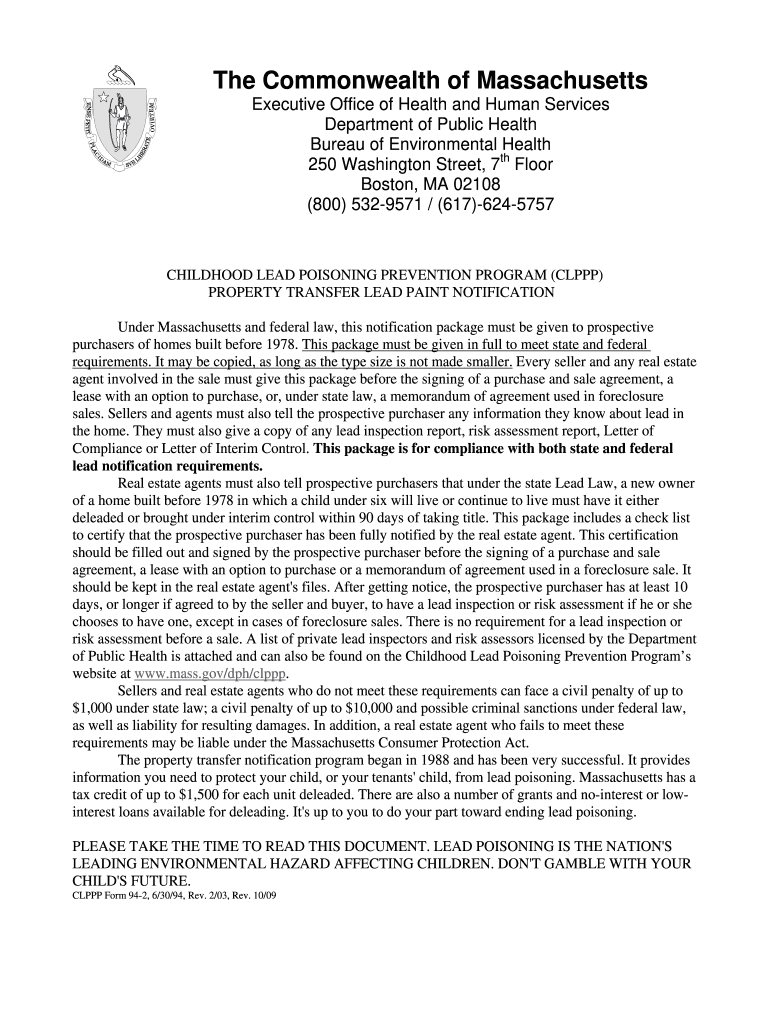
1 / (617)-624-5757 CHILDHOOD LEAD POISONING PREVENTION PROGRAM (CLPPP) PROPERTY TRANSFER LEAD PAINT NOTIFICATION Under Massachusetts and federal law, this notification package must be given to prospective purchasers of homes built before 1978. This package must be given in full to meet state and federal requirements. It may be copied, as long as the type size is not made smaller. Every seller and any real estate agent involved in the sale must give this package before the signing of a purchase .

Open form follow the instructions

Easily sign the form with your finger

Send filled & signed form or save
How to fill out the MA CLPPP 94-2 online
Filling out the MA CLPPP 94-2 form accurately is essential for compliance with Massachusetts and federal lead paint notification requirements. This guide will provide you with clear and supportive instructions to complete the form online, ensuring you meet all necessary obligations.
Follow the steps to effectively complete the MA CLPPP 94-2 online.
- Press the ‘Get Form’ button to acquire the form and open it in the editor.
- Begin by carefully reading the instructions included on the form to understand each section. Ensure you have all necessary documentation ready to reference, such as lead inspection reports or any known lead hazard disclosures.
- In the Seller’s Disclosure section, indicate whether lead-based paint and/or lead-based paint hazards are known to be present in the property by checking the appropriate box and providing necessary explanations.
- For available records and reports, check the appropriate option to confirm if you have provided all lead-related documentation to the purchaser. Circle any documents you are providing, such as lead inspection reports.
- In the Purchaser’s or Lessee Purchaser’s Acknowledgment section, have the purchaser initial to acknowledge receipt of all documents and the opportunity to conduct a lead assessment.
- Ensure that the Agent's Acknowledgment section is completed, confirming that the agent has informed the seller of their obligations regarding lead paint disclosure.
- Finally, review all filled sections for accuracy and completeness. The seller, purchaser, and agent should sign and date the certification of accuracy to confirm that all information provided is true and accurate.
- Once completed, save changes to the form. You can then download, print, or share the form as necessary to retain copies for your records.
Complete your MA CLPPP 94-2 form online today to ensure compliance with lead paint disclosure requirements.
Experience a faster way to fill out and sign forms on the web. Access the most extensive library of templates available.
Related content
Under Massachusetts and federal law, this notification package must be given to...
29 Childhood Lead Poisoning Prevention Program (CLPPP) Property Transfer Lead Paint...
Get answers to your most pressing questions about US Legal Forms API.
What is the lead law in Massachusetts for renters?
The lead law in Massachusetts requires landlords to comply with MA CLPPP 94-2, which mandates lead inspections in rental units where children under six live. Landlords must remediate any identified lead hazards and inform tenants about potential risks. This protective measure ensures a safer living environment for families and minimizes lead exposure.
What year was lead paint banned in Massachusetts?
Lead paint was banned in Massachusetts in 1978, the same year it was federally prohibited. However, many homes still contain lead paint, especially those built before this ban. MA CLPPP 94-2 focuses on mitigating risks associated with these older homes, ensuring they remain safe for occupancy.
How much does lead paint reduce home value?
Lead paint can significantly impact a home's value, often resulting in a decrease when buyers perceive lead hazards. The reduction in value varies based on location, the extent of lead risks, and potential remediation costs. Understanding MA CLPPP 94-2 can help owners strategize on addressing these issues effectively and may enhance their property's marketability.
Can a house with lead paint be sold?
A house with lead paint can indeed be sold in Massachusetts, but there are important legal considerations to keep in mind. Sellers must disclose the presence of lead paint to buyers, following the guidelines of MA CLPPP 94-2. Additionally, buyers often request lead inspections, which may influence their purchasing decisions.
What is the lead paint law in Massachusetts?
The lead paint law in Massachusetts aims to protect children from lead exposure by regulating lead paint in homes built before 1978. Under MA CLPPP 94-2, property owners are required to address lead hazards, especially in homes where children under six years old reside. This law mandates inspections, risk assessments, and proper remediation to ensure safety.
Can you sell a house with lead paint in Massachusetts?
Yes, you can sell a house with lead paint in Massachusetts. However, as a seller, you must comply with the MA CLPPP 94-2 regulations regarding lead paint disclosure. This means you need to inform prospective buyers about the presence of lead paint and provide them with specific documentation. It's vital to handle this process carefully to avoid potential legal issues.
What is the lead paint disclosure in Massachusetts?
The lead paint disclosure in Massachusetts requires sellers and landlords to provide information about lead paint risks in properties built before 1978. This requirement is part of MA CLPPP 94-2 and plays a critical role in safeguarding public health. If you're unsure how to prepare the necessary documents, US Legal Forms offers resources to simplify the process.
Do all homes built before 1978 have lead paint?
Not all homes built before 1978 contain lead paint, but many do. The presence of lead paint in older homes is a significant concern, and it is essential to check for lead paint hazards as stipulated in MA CLPPP 94-2. Conducting a lead inspection can identify potential risks and ensure safety for residents.
Can a homeowner remove lead paint in Massachusetts?
Yes, homeowners can remove lead paint in Massachusetts, but they must follow specific guidelines and regulations. It is crucial to comply with MA CLPPP 94-2, which promotes safe lead abatement practices. Hiring a certified lead-safe contractor is highly recommended to minimize risks associated with lead exposure.
How do I report lead in Massachusetts?
If you suspect lead in your home, you can report it to your local health department or the Massachusetts Department of Public Health. They will guide you through the reporting process as outlined in MA CLPPP 94-2. Timely reporting helps protect the community and ensures that lead hazards are addressed promptly.
Use professional pre-built templates to fill in and sign documents online faster. Get access to thousands of forms.
If you believe that this page should be taken down, please follow our DMCA take down process here.