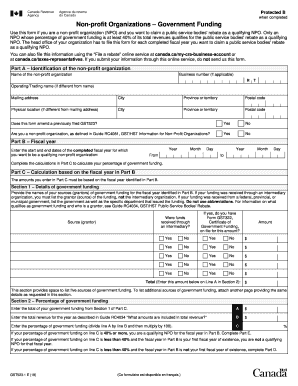
L year of existence. You may be a qualifying NPO based on your preceding fiscal years: • If the year indicated in Part B is your second fiscal year of existence, complete only Chart A in Section 1, as well as Line 1 of Section 2. • In any other case, complete both Charts A and B in Section 1, as well as Section 2. For examples and more information, see "How do you calculate your percentage of government funding?" on page 3. Section 1 – Details of government funding for year(s) immediately.
Open form follow the instructions
Easily sign the form with your finger
Send filled & signed form or save
How to fill out the Canada GST523-1 E online
This guide provides a comprehensive overview of how to complete the Canada GST523-1 E form, aimed at non-profit organizations seeking to claim a public service bodies' rebate. By following these clear steps, users with varying levels of experience can successfully navigate the online filing process.
Follow the steps to complete your Canada GST523-1 E form online.
- Click ‘Get Form’ button to obtain the form and open it in the online editor.
- In Part A, enter the identification details of your non-profit organization. Fill in your organization's name, business number if applicable, operating or trading name if different, mailing address, city, province or territory, and postal code. Also indicate the physical location if it differs from the mailing address.
- Answer whether this form amends a previously filed GST523. Indicate if you are a non-profit organization, as defined in Guide RC4081.
- In Part B, provide the start and end dates of the completed fiscal year for which you are claiming the rebate.
- Move to Part C for calculations; in Section 1, list the details of government funding sources for the fiscal year stated in Part B, including whether the funds were received through an intermediary and provide the corresponding amounts.
- In Section 2 of Part C, calculate the total government funding, total revenue, and the percentage of government funding. Ensure the calculated percentage is at least 40% to qualify.
- If needed, complete Part D based on earlier fiscal years if your percentage was below 40%. List the government funding sources for the previous years as applicable.
- In Part E, certify the information provided by filling in the authorized person's name, signing, and adding their title and contact number.
- Finally, review your entries for accuracy. Save your changes, and you may choose to download, print, or share the completed form.
Start your online application for the Canada GST523-1 E form today!
Experience a faster way to fill out and sign forms on the web. Access the most extensive library of templates available.
Related content
The Reference Index includes investment grade corporate bonds that have a minimum of one...
Get answers to your most pressing questions about US Legal Forms API.
What is the 90% rule for non-residents?
The 90% rule states that non-residents must stay in Canada for at least 90 days during the tax year to be eligible for certain benefits. This rule affects tax obligations and eligibility for deductions. Understanding the details of the 90% rule can help you navigate your responsibilities. For more information, refer to descriptions such as Canada GST523-1 E to grasp how this rule might impact you.
How to fill Canada Express Entry form?
Filling out the Canada Express Entry form involves providing personal information, work experience, and education details. Make sure you accurately complete each section to improve your chances of being selected. Utilize resources such as Canada GST523-1 E to understand the specific requirements. Additionally, using platforms like uslegalforms can help streamline the process and ensure accuracy.
Do I have to fill out a customs declaration form Canada?
Yes, you need to fill out a customs declaration form when entering Canada. This form is essential for declaring any goods you are bringing into the country. You must accurately list your items to comply with Canadian regulations. If you have questions about the customs process, consider checking resources like Canada GST523-1 E for detailed guidelines.
What is Canada's GST number?
Canada's GST number is a unique identifier assigned to businesses that collect Goods and Services Tax. This number is necessary for filing GST returns and ensuring compliance with tax regulations. If your business operates in Canada, obtaining this number is crucial for proper accounting and reporting. The Canada GST523-1 E guidance includes the necessary steps for acquiring your GST number.
Who is eligible for GST rebate in Canada?
Eligibility for the GST rebate in Canada is primarily targeted toward low or modest-income individuals and families. The criteria consider your income, marital status, and number of dependent children. This program aims to assist those most in need by alleviating some financial pressures. The Canada GST523-1 E document provides comprehensive details about eligibility and application processes.
What is a Class 1 medical device in Canada?
A Class 1 medical device in Canada is the least regulated category, involving products that present minimal risk to users. Items like bandages or simple surgical instruments fall under this classification. For businesses in the medical field, comprehending these classifications is vital for compliance with Canadian regulations, specifically those outlined in the context of the Canada GST523-1 E.
Who is eligible for the $250 rebate in Canada?
The $250 rebate in Canada typically targets low-income individuals and families. Eligibility depends on various factors such as income level, age, and family size. To fully grasp the details and requirements, consult the Canada GST523-1 E information. This rebate aims to provide financial relief to those who need it.
Does everyone get a GST check in Canada?
Not everyone receives a GST check in Canada. The GST credit is determined by individual eligibility, which is based on income and family size. Generally, low and modest-income families are more likely to qualify for this benefit. To know your eligibility, you can refer to the Canada GST523-1 E guidelines.
Can you file taxes while out of the country?
Yes, you can still file taxes while out of the country, and it's crucial to remain compliant with Canada GST523-1 E requirements. As a non-resident, you retain obligations for income earned in Canada. Platforms like USLegalForms can assist you with the correct forms and guidelines, making the process more manageable.
How do I submit my tax return in Canada?
You can submit your tax return in Canada by mailing a paper return or filing electronically through the CRA's web portal. Ensure that all information aligns with Canada GST523-1 E regulations to facilitate a smooth submission. Using services like USLegalForms can help ensure you meet all criteria and deadlines.
Use professional pre-built templates to fill in and sign documents online faster. Get access to thousands of forms.
If you believe that this page should be taken down, please follow our DMCA take down process here.