Cs declare this belief publicly every Sunday as part of the Liturgy of the Word and the Eucharist. Death, the final experience of every living person on earth, is a reality. Questions and concerns about death may be frightful, intimidating, and even avoided. Who will speak for me when I cannot speak for myself? How can I make sure the decisions made about my health care are morally right? These are questions being asked with increasing frequency. People often avoid questions like these until fac.
Open form follow the instructions
Easily sign the form with your finger
Send filled & signed form or save
How to fill out the MN Catholic Health Care Directive online
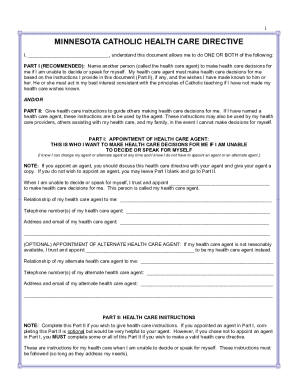
The Minnesota Catholic Health Care Directive is a crucial document that allows individuals to express their health care wishes and appoint a decision-maker in the event they become unable to communicate. This guide provides clear, step-by-step instructions for completing the directive online.
Follow the steps to successfully complete your health care directive.
- Click the ‘Get Form’ button to obtain the MN Catholic Health Care Directive and open it for editing.
- In Part I, designate a health care agent. Write the name of the person you trust to make health care decisions on your behalf if you cannot do so. Include their relationship to you, as well as their phone number and address.
- If you wish to appoint an alternate health care agent, fill in their information as well, ensuring you include their relationship, phone number, and address.
- Proceed to Part II to provide health care instructions. This section is vital if you prefer to guide your health care agent regarding your treatment preferences, especially if you do not appoint an agent.
- Include your personal beliefs and values about health care in ‘My Wishes’. This may outline your preferences regarding life-prolonging treatments and the use of medication.
- Complete any optional preferences about organ donation in the Anatomical Gift section, if applicable.
- In the section titled ‘This is what I want and do not want for my health care’, specify your preferences in various health scenarios, detailing treatments you want or do not want. Be as specific as possible.
- After completing all sections, review your directive carefully. Ensure that your instructions are clear and fully reflect your wishes.
- To finalize the document, sign and date it. You must either have it notarized or witnessed by two individuals who are not your health care agents.
- Once the document is complete, save your changes, and consider downloading and printing copies. Ensure that the signed directive is kept with your personal papers and shared with your health care provider, family, and your health care agent.
Start filling out your MN Catholic Health Care Directive online today to ensure your health care wishes are known.
Experience a faster way to fill out and sign forms on the web. Access the most extensive library of templates available.
Related content
by P Morrow · 2013 · Cited by 3 — The living will is a document that allows a patient...
Mar 12, 2020 — Directives for Catholic Health Care Services, as promulgated from time to...
by R MIRKES — An organization of Roman Catholic physicians presented a set of questions...
Get answers to your most pressing questions about US Legal Forms API.
What is an example of a health care directive statement?
A health care directive statement might say, 'I authorize my designated health care agent to make all medical decisions on my behalf if I am incapacitated.' This statement is crucial in the context of a MN Catholic Health Care Directive, as it empowers your agent to act according to your preferences and ensures your health care decisions align with your wishes.
What is an example of a directive statement?
An example of a directive statement would be, 'If I am unable to communicate my health care decisions, I do not wish to receive life-sustaining treatments, including mechanical ventilation.' This type of statement is essential in a MN Catholic Health Care Directive, as it clearly outlines your wishes regarding medical interventions and treatment preferences.
What is the Catholic advance directive for health care?
The Catholic advance directive for health care reflects the beliefs and values of Catholic teachings when it comes to medical decisions. This directive typically emphasizes the sanctity of life and the importance of palliative care. By using a MN Catholic Health Care Directive, you can align your health care choices with your spiritual beliefs, ensuring that your values are honored in times of need.
How to complete a medical directive?
Completing a medical directive involves several steps. First, outline your medical treatment preferences and select a health care agent who will advocate for you. Then, fill out the MN Catholic Health Care Directive form accurately, making sure to date and sign the document in front of witnesses as required by law. This ensures your wishes are respected and legally binding.
How do I create a health care directive in MN?
To create a health care directive in Minnesota, start by deciding on your health care preferences and appointing a health care agent. Use a template designed for a MN Catholic Health Care Directive to ensure you include all necessary details. After completing the document, it is advisable to sign it in the presence of witnesses to comply with Minnesota laws.
What is a medical directive example?
A medical directive example includes a document that states your preferences for medical treatment in specific situations. A well-structured MN Catholic Health Care Directive might cover scenarios like life support, pain management, and organ donation. It clearly communicates your wishes to healthcare providers and your loved ones to avoid confusion during critical times.
Can I write my own medical directive?
Yes, you can write your own medical directive. In Minnesota, a MN Catholic Health Care Directive must meet certain legal requirements to be valid. You should clearly outline your health care wishes and designate a trusted person to make decisions on your behalf if you are unable to do so. For convenience, you can use templates available on platforms like USLegalForms.
What makes an advance directive valid?
For an advance directive to be valid, it must be signed, dated, and often witnessed or notarized, depending on state laws. The document must clearly articulate the individual’s health care wishes and be created while the person is mentally competent. In Minnesota, following the guidelines for the MN Catholic Health Care Directive ensures legal validity in expressing one's health care preferences.
What is a Catholic advance directive?
A Catholic advance directive is a document that conveys a person's health care preferences in alignment with Catholic values. It addresses critical decisions about medical treatment while ensuring respect for life and dignity. By utilizing a MN Catholic Health Care Directive, individuals can ensure their health care choices reflect their spiritual beliefs.
What are the three types of advance directives?
The three types of advance directives include living wills, durable powers of attorney for health care, and DNR orders. Living wills provide specific instructions regarding types of medical treatment, while a durable power of attorney designates an individual to make health care decisions on one's behalf. These directives, including the MN Catholic Health Care Directive, help individuals convey their preferences clearly.
Use professional pre-built templates to fill in and sign documents online faster. Get access to thousands of forms.
If you believe that this page should be taken down, please follow our DMCA take down process here.