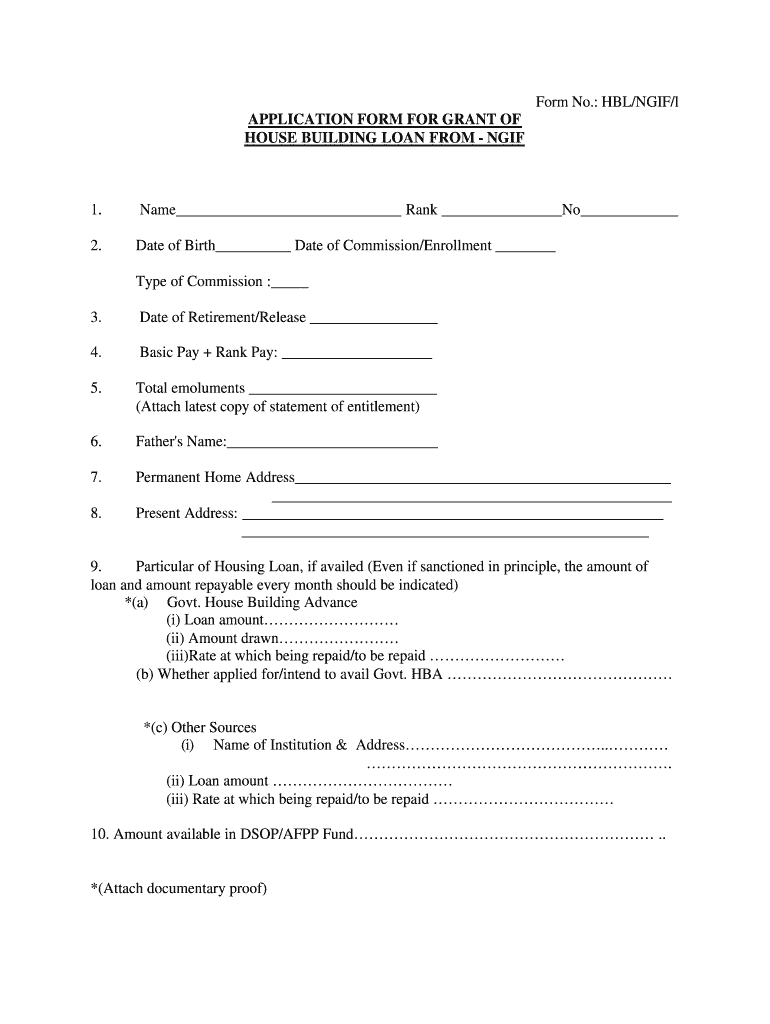
Commission/Enrollment ________ Type of Commission :_____ 3. Date of Retirement/Release _________________ 4. Basic Pay + Rank Pay: ____________________ 5. Total emoluments _________________________ (Attach latest copy of statement of entitlement) 6. Father's Name:____________________________ 7. Permanent Home Address__________________________________________________ _____________________________________________________ Present Address: __________________________________________________.

Open form follow the instructions

Easily sign the form with your finger

Send filled & signed form or save
How to fill out the India HBL/NGIF/1 online
This guide provides clear, step-by-step instructions for completing the India HBL/NGIF/1 application form for a house building loan. By following these detailed directions, users can effectively navigate the online process and ensure their application is completed accurately and efficiently.
Follow the steps to complete your application with ease.
- Press the ‘Get Form’ button to access the India HBL/NGIF/1 form and open it in your preferred editor.
- Fill in your name, rank, and number in the designated fields.
- Input your date of birth and the date of commission/enrollment alongside the type of commission.
- Provide your date of retirement or release.
- Enter your basic pay and rank pay.
- Indicate your total emoluments and attach the latest copy of your statement of entitlement.
- Provide your father's name.
- List your permanent home address and your current address.
- Detail any housing loan you have availed, including government house building advance specifics. Specify the loan amount, amount drawn, and the repayment rate.
- Answer whether you have applied for or intend to avail the government house building advance.
- For other sources, indicate the name of the institution, loan amount, and repayment rate.
- State the amount available in DSOP/AFPP fund and attach documentary proof.
- If the loan is for constructing a new house, provide details of the plot including cost, location, and whether it's developed.
- For construction estimates, specify the estimated cost and loan amount needed per floor.
- If the loan is for purchasing a ready-built house/flat, provide details including price, agency, and other relevant information.
- Indicate the maximum monthly repayment amount.
- Disclose if you or any family member already owns a house/flat and state the reasons for acquiring another property.
- Include a plan for meeting the total cost of the house with detailed sources.
- Read and agree to the declaration ensuring all information provided is accurate.
- Complete any additional required fields and gather relevant documentation for submission.
- Once all fields are completed, users can save changes, download the form, print it, or share it.
Complete your application for the India HBL/NGIF/1 online today.
Experience a faster way to fill out and sign forms on the web. Access the most extensive library of templates available.
Related content
... government checks, «while 78,896,000 people were working in the private sector...
... 1 8m 1 8k 1 8g 1 8f 1 7x 1 7u 1 7s 1 7c 1 7a 1 6x 1 6b 1 5w 1 5u 1 5q 1 5j 1 5e 1 5b 1...
Get answers to your most pressing questions about US Legal Forms API.
What is the full form of NGIS?
Naval Group Insurance Scheme(NGIS)
What is the difference between * ngIf and [* ngIf?
What is the difference between ngIf and *ngIf in Angular? ngIf is the directive. Because it's a structural directive (template-based), you need to use the * prefix to use it into templates. *ngIf corresponds to the shortcut for the following syntax (“syntactic sugar”):
What is * ngIf in Angular 7?
NgIf is a behavioral directive that allows us to toggle part of a template based on a conditional value. This conditional would be evaluated similarly to how JavaScript would evaluate an if (condition) {} statement, converting the value you supply to a truthy or falsy value and progressing ingly.
What is the definition of ngIf?
Definition and Usage The ng-if directive removes the HTML element if the expression evaluates to false. If the if statement evaluates to true, a copy of the Element is added in the DOM.
What is the use of ngIf?
The NgIf directive is used when you want to display or remove an element based on a condition. If the condition is false the element the directive is attached to will be removed from the DOM .
What is the full form of Ngif?
NAVAL GROUP INSURANCE FUND (NGIF) RULES FOR HOUSING LOAN Introduction 1.
Use professional pre-built templates to fill in and sign documents online faster. Get access to thousands of forms.
If you believe that this page should be taken down, please follow our DMCA take down process here.