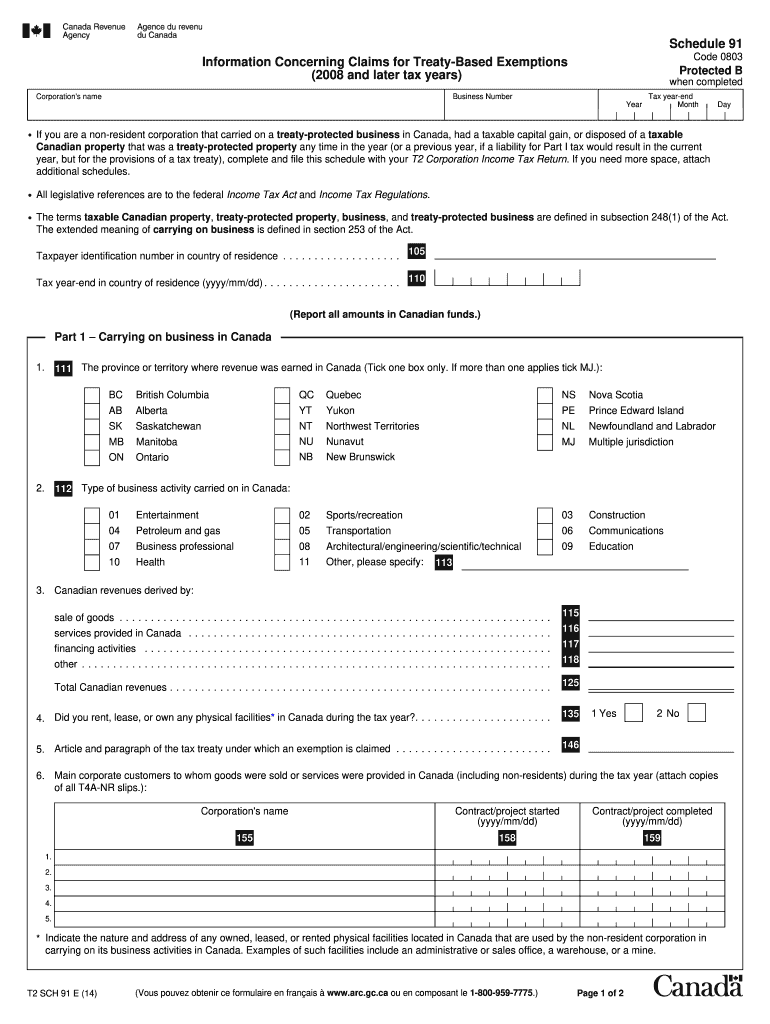
Day • If you are a non-resident corporation that carried on a treaty-protected business in Canada, had a taxable capital gain, or disposed of a taxable Canadian property that was a treaty-protected property any time in the year (or a previous year, if a liability for Part I tax would result in the current year, but for the provisions of a tax treaty), complete and file this schedule with your T2 Corporation Income Tax Return. If you need more space, attach additional schedules. • All leg.
Loading

Open form follow the instructions

Easily sign the form with your finger

Send filled & signed form or save
How to fill out the Canada T2 SCH 91 E online
Filling out the Canada T2 SCH 91 E form is essential for non-resident corporations engaged in treaty-protected business activities in Canada. This guide will provide you with clear, step-by-step instructions to ensure you complete the form accurately and efficiently.
Follow the steps to successfully complete the form online.
- Press the ‘Get Form’ button to access the T2 SCH 91 E form and open it for editing.
- Begin by entering the tax year-end information. Fill in the year, month, and day in the respective fields.
- Provide the business number and corporation's name in the designated fields.
- Specify the taxpayer identification number in your country of residence as well as the tax year-end in your country, using the appropriate format.
- In Part 1, indicate where the revenue was earned in Canada by ticking the appropriate box for the province or territory.
- Next, select the type of business activity being carried out in Canada by checking one of the listed options.
- Report your Canadian revenues derived from sales, services, and other activities in the relevant fields.
- If applicable, indicate whether you rented, leased, or owned any physical facilities in Canada during the tax year.
- Enter the article and paragraph of the tax treaty under which you claim an exemption.
- List your main corporate customers in Canada, noting the corporation's name and the start and completion dates of contracts/projects.
- Provide details of services offered by employees, including salaries and employment periods for both Canadian and non-resident employees.
- Indicate services provided by subcontractors in a similar manner, detailing payments and periods of service.
- If applicable, specify whether you have applied for a waiver of the withholding requirement and note the response from the Canada Revenue Agency.
- In Part 2, describe any taxable Canadian property disposed of, along with proceeds and costs.
- Finally, ensure you attach necessary forms and documentation as specified. Once completed, you can save changes, download, print, or share the form for submission.
Complete your Canada T2 SCH 91 E form online now to meet your filing requirements.
Experience a faster way to fill out and sign forms on the web. Access the most extensive library of templates available.
Related content
Descriptions of immigrant classes of admission eligible for lawful permanent resident...
Canada College, a community college within the. San Mateo County Community College...
Select the set of setup options you want to start with: • Import from the settings in a...
Get answers to your most pressing questions about US Legal Forms API.
Is taxable capital employed in Canada retained earnings?
Taxable capital employed in Canada is separate from retained earnings, although both are essential components of a corporation's financial picture. Retained earnings reflect profit reinvested into the business, while taxable capital employed refers to the total assets used in operations. Clarifying these distinctions is important for effective financial reporting under the guidelines of Canada T2 SCH 91 E.
What is the taxable capital employed in Canada for business limit reduction?
Taxable capital employed in Canada plays a vital role when calculating business limit reductions for small businesses. Corporations nearing the threshold may face a reduced business limit, impacting their access to certain tax benefits. Understanding your position regarding taxable capital is essential for tax strategy under Canada T2 SCH 91 E.
What is the taxable capital gain in Canada?
Taxable capital gain in Canada refers to the portion of a capital gain that is subject to taxation, usually half of the total gain. This amount must be reported on your T2 corporate tax return for accurate tax calculations. Properly accounting for taxable capital gains is crucial for any corporation wanting to comply with the Canada T2 SCH 91 E requirements.
What is taxable capital employed in Canada on T2?
Taxable capital employed in Canada pertains to the resources a corporation utilizes to conduct its business activities. This metric is essential for calculating various tax obligations and any applicable tax credits. Understanding this concept helps you make informed decisions and ensure compliance when filling out the Canada T2 SCH 91 E form.
Where do capital gains go on T2?
Capital gains are reported on the T2 tax form, typically found in Schedule 6 or directly on the T2 return itself. This section allows corporations to declare any realized gains from asset disposals. Properly identifying and reporting these gains is essential for accurate tax reporting under Canada T2 SCH 91 E.
What is the schedule 2 tax form in Canada?
The Schedule 2 tax form in Canada pertains to the T2 corporate tax return and is used to calculate and report tax credits or deductions for corporations. It helps businesses manage their tax obligations effectively. Understanding this form can significantly benefit your corporation, especially when it comes to minimizing tax liabilities under the Canada T2 SCH 91 E guidelines.
What is Schedule 91 in Canada taxes?
Schedule 91 is a crucial part of the Canada T2 tax form that helps corporations report their connected and controlled entities. It enables businesses to detail their ownership structure and is pivotal in the assessment of taxable income. By accurately completing Schedule 91, you ensure compliance with Canadian tax regulations and possibly optimize your tax position.
What is a T2 tax form in Canada?
The T2 tax form is a corporate income tax return that all resident corporations in Canada must file. It captures all comprehensive income information, including local and foreign income. Understanding the form's significance is vital for proper tax compliance, similar to how the Canada T2 SCH 91 E provides essential information about foreign income.
How do I claim foreign income on my Canadian tax return?
To claim foreign income on your Canadian tax return, report the income in Canadian dollars and complete the appropriate forms. This process ensures you accurately state your income from outside Canada. Following the guidance provided in sections like the Canada T2 SCH 91 E can ensure compliance with tax regulations.
How do I file a Nil T2 return in Canada?
Filing a Nil T2 return in Canada involves completing the T2 form and indicating that there is no income to report for the tax year. You submit this form to the Canada Revenue Agency, usually electronically. It’s essential, to be honest about your reporting, just like filling out the Canada T2 SCH 91 E.
Use professional pre-built templates to fill in and sign documents online faster. Get access to thousands of forms.
If you believe that this page should be taken down, please follow our DMCA take down process here.