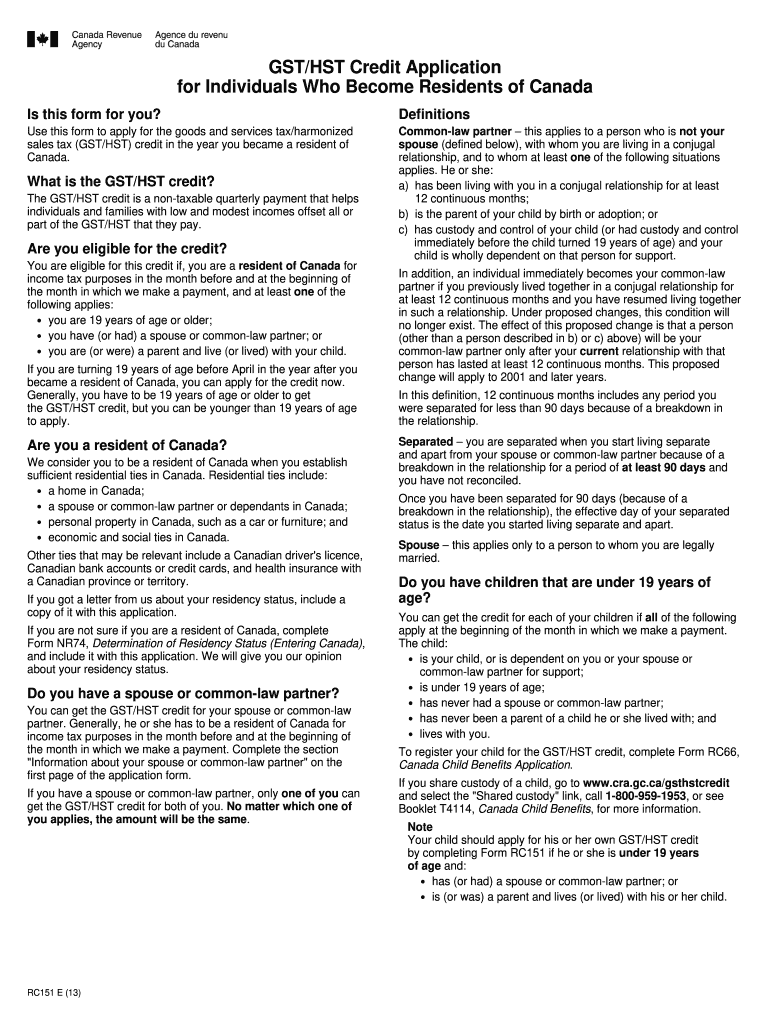
Ip. Under proposed changes, this condition will no longer exist. The effect of this proposed change is that a person (other than a person described in b) or c) above) will be your common-law partner only after your current relationship with that person has lasted at least 12 continuous months. This proposed change will apply to 2001 and later years. In this definition, 12 continuous months includes any period you were separated for less than 90 days because of a breakdown in the relationship. Se.
Loading

Open form follow the instructions

Easily sign the form with your finger

Send filled & signed form or save
How to fill out the Canada RC151 E online
The Canada RC151 E form is essential for individuals who are applying for the goods and services tax/harmonized sales tax (GST/HST) credit upon becoming residents of Canada. This guide will provide you with clear, step-by-step instructions to successfully complete the form online.
Follow the steps to fill out the Canada RC151 E form online.
- Click the ‘Get Form’ button to access the Canada RC151 E form and open it in your editor.
- Fill in Part A with your personal information, including your first and last name, date of birth, social insurance number, and mailing address. Ensure all details are accurate to avoid processing delays.
- In Part B, provide information about your spouse or common-law partner, including their name, date of birth, and social insurance number. If applicable, provide their different address.
- Complete Part C which covers your residency status. Enter the date you became a resident of Canada accurately.
- Proceed to Part D, where you will enter your income information. Include your income and that of your spouse or common-law partner from all sources for the required years.
- If you choose to set up direct deposit for your GST/HST credit payments, complete Part E with your banking information. Include branch, institution numbers, and account number.
- Finish with Part F by signing and dating the form to certify that all information is true and complete. This includes the signature of your spouse or common-law partner if applicable.
- After completing the form, you can save changes, download, print, or share it as needed.
Start filling out your Canada RC151 E form online today to ensure you receive your GST/HST credit efficiently.
Experience a faster way to fill out and sign forms on the web. Access the most extensive library of templates available.
Related content
5 AAC 21.366. Northern District King Salmon Management Plan. (a) The purpose of this...
Nov 11, 2022 — 10102 E. Knox Ave., Ste. 200. Spokane, WA 99206. Phone: 509 532 8888...
We are honoured to present the 2017 edition of the European Association of Urology (EAU)...
Get answers to your most pressing questions about US Legal Forms API.
How do I submit taxes to Canada?
To submit your taxes to Canada, you will need to gather all relevant financial documents, including T4 slips and receipts for deductions. Utilize the electronic tax filing system or submit your documents by mail with the Canada RC151 E form correctly filled out. This process helps ensure timely and accurate submissions. If you seek assistance, USLegalForms provides resources designed to assist you in preparing and submitting your taxes effectively.
Who is eligible for GST return in Canada?
Eligibility for the GST return in Canada depends on several factors, including your income level and residency status. Generally, individuals or families earning below a specific threshold may qualify for this benefit. To determine your eligibility, refer to the guidelines provided by the Canada Revenue Agency and consider utilizing the Canada RC151 E form for accurate filings. Using USLegalForms can streamline the process, ensuring you have the right documentation.
How to apply for Welcome Canada benefit?
To apply for the Welcome Canada benefit, start by visiting the official Government of Canada website. You will need to fill out the required forms, including the Canada RC151 E form, which is essential for processing your application. Make sure you gather all necessary documents before submitting your application online or by mail. If you encounter any issues, our platform, USLegalForms, offers guidance to help you navigate the process smoothly.
How much is the welcome to Canada benefit?
The Welcome to Canada benefit varies depending on your circumstances, such as family size and income level. Generally, this benefit is designed to assist newcomers in managing their initial expenses. To find specific amounts applicable to your situation, refer to the Canada RC151 E for detailed guidance. Look into resources from uslegalforms to simplify your application process and understand the requirements better.
Who qualifies for GST credit Canada?
Qualifications for the GST credit in Canada vary based on your income and family situation. Primarily, low to moderate-income individuals and families are eligible to receive this credit. When filing your taxes, make sure to check the Canada RC151 E form to confirm your eligibility. This will help ensure you receive the benefits to which you are entitled.
How do I apply for the $300 federal payment in Canada?
To apply for the $300 federal payment, you need to complete the necessary forms during your income tax filing. This payment is often linked to your annual tax return, ensuring that eligible individuals receive the amount. Utilizing the Canada RC151 E can guide you through the application process efficiently. For assistance, platforms like uslegalforms can provide valuable resources and templates.
Does everyone get a Canada carbon rebate?
Not everyone automatically receives a Canada carbon rebate. Eligibility mainly depends on your income, residence, and the province you live in. Typically, individuals and families in specific income brackets qualify for rebates when filing taxes. For detailed information and to determine if you qualify, consider reviewing the Canada RC151 E form.
Does everyone in Canada get GST rebate?
Not everyone in Canada receives the GST rebate; it is specifically designed for low- and middle-income individuals and families. Eligibility is contingent upon fulfilling certain income criteria and filing your tax returns accurately. Understanding your rights and potential benefits can be made easier with the help of the Canada RC151 E, which provides tailored support for applicants.
What is the Canada extra GST payment 2025?
The Canada extra GST payment for 2025 is a supplementary payment provided to eligible Canadians to help with inflation and increased living costs. This payment is typically distributed on an annual basis to qualifying individuals and families. To learn more about this process and how it impacts your finances, the Canada RC151 E can be a valuable resource, offering clear guidelines.
What is the 90% rule for newcomers to Canada?
The 90% rule for newcomers to Canada states that those migrating must be able to show they have a steady income that meets a specific percentage of the poverty line. This requirement helps ensure newcomers can support themselves and their families upon arrival. To navigate these rules, consulting resources such as the Canada RC151 E can provide necessary guidance and clarity.
Use professional pre-built templates to fill in and sign documents online faster. Get access to thousands of forms.
If you believe that this page should be taken down, please follow our DMCA take down process here.
This form is available in several versions. Select the version you need from the drop-down list below.