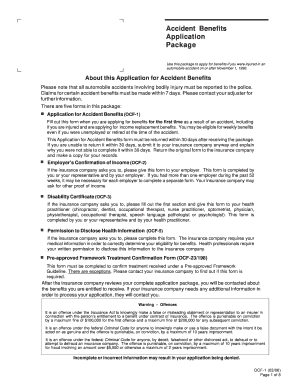
S Please note that all automobile accidents involving bodily injury must be reported to the police. Claims for certain accident benefits must be made within 7 days. Please contact your adjuster for further information. There are five forms in this package: Application for Accident Benefits (OCF-1) Fill out this form when you are applying for benefits for the first time as a result of an accident, including if you are injured and are applying for income replacement benefits. You may be eligible f.
Open form follow the instructions
Easily sign the form with your finger
Send filled & signed form or save
How to fill out the Canada OCF-1 online
The Canada OCF-1 form is essential for individuals applying for accident benefits following a motor vehicle accident. Completing the form thoroughly ensures your eligibility and expedites the processing of your application.
Follow the steps to complete the OCF-1 form effectively
- Press the ‘Get Form’ button to access the OCF-1 form and open it in your browser.
- Begin by providing your personal information in Part 1. Fill in your full name, gender, marital status, address, and contact details. Ensure your information is accurate as this will be used for further communications.
- You must provide your date of birth and indicate if anyone depends on you for financial support.
- In Part 2, fill out the representative information if applicable. This includes the name and relationship of the person helping you with the application.
- Make sure to include their contact details for effective communication.
- Move to Part 3 where you provide details about the accident. Include the date, time, and location of the accident. Specify your role (e.g., driver, passenger, pedestrian) and if police were involved.
- Describe the accident briefly and include any injuries sustained, as well as your hospital visit details if applicable.
- In Part 4, provide your automobile insurance details. Indicate whether you have your own policy, or if you were covered under someone else's policy at the time of the accident.
- List the names of policyholders, insurance companies, and any coverage details necessary for claim processing.
- For Part 5, state your employment status at the time of the accident. Specify if you were employed, unemployed, a student, or caregiver, and provide any related details.
- Use the provided templates to neatly present your work history and income information.
- Complete the subsequent parts regarding income replacement and caregiver status, as applicable. This involves detailing your income sources and whether you were providing care to dependents at the time of the accident.
- Make sure to attach any required documentation to support your claims.
- Once all sections are filled, review your application for any missing information. Accuracy is vital as incomplete forms may lead to denial of benefits.
- Finally, save your changes and choose to download, print, or share the completed form to submit it to your insurance provider.
Complete your Canada OCF-1 form online to ensure you receive the benefits you deserve.
Experience a faster way to fill out and sign forms on the web. Access the most extensive library of templates available.
Related content
This acquisition is at an attractive valuation, in the mid-6s in terms of EV to OCF 1...
Jan 26, 2024 — The United States-Mexico-Canada Agreement (USMCA) is projected to spur...
The OCF 4.0 uses a non-contacting ultrasonic sensor mounted over a flume or weir to...
Get answers to your most pressing questions about US Legal Forms API.
How to get Canada Express entry visa?
To acquire a Canada Express Entry visa, you must first determine your eligibility under one of the three immigration programs: Federal Skilled Worker, Canadian Experience Class, or Federal Skilled Trades. Afterward, you’ll need to create an online profile that includes your skills, work experience, and education. It is essential to stay updated with the latest requirements and criteria to enhance your chances. Consider utilizing platforms that guide you through application processes for better results.
How to get Canada sponsorship?
To obtain Canada sponsorship, you generally need a relative or spouse who is a Canadian citizen or permanent resident to sponsor you. The process involves submitting forms and various documentation to prove your relationship and eligibility. Engaging with the process carefully ensures a higher chance of success. For more guidance, various platforms offer resources and checklists to streamline this journey.
What do Ontario accident benefits cover?
Ontario accident benefits cover a range of services designed to aid your recovery after a car accident. These benefits may include medical and rehabilitation costs, income replacement for lost wages, and even caregiver support if necessary. By properly submitting your Canada OCF-1 form, you enhance your chances of receiving the benefits you rightfully deserve. Always keep records of your expenses for a smoother claims process.
What am I entitled to in an accident?
In the event of an accident in Ontario, you are entitled to various benefits. These include coverage for medical expenses, rehabilitation, and income replacement, depending on the severity of your injuries. Understanding your rights and completing the necessary forms, like the Canada OCF-1, can significantly aid in your recovery process. It is vital to consult with your insurance provider to clarify your entitlements.
What is a qualifying accident for accident insurance?
A qualifying accident for accident insurance occurs when an insured vehicle is involved in a collision, resulting in injuries or damage. This includes both minor fender benders and serious accidents that lead to significant injuries. It is important to file a report and complete the Canada OCF-1 form promptly to access your benefits. Make sure to understand the specific definitions outlined in your insurance policy.
Who is eligible for accident benefits in Ontario?
To qualify for accident benefits in Ontario, you generally need to be injured in a car accident, whether you're a driver, passenger, or pedestrian. If you hold an Ontario car insurance policy, you will likely receive benefits. These benefits can help cover medical expenses and lost wages. For a comprehensive understanding, refer to the Canada OCF-1 guidelines.
Whose insurance pays in a car accident in Ontario?
In Ontario, your own insurance typically pays for damages in a car accident, regardless of who is at fault. This system, known as the no-fault insurance system, ensures that you receive coverage quickly. However, if your injuries are severe, you may explore additional compensation through the at-fault driver’s insurance. The Canada OCF-1 form is crucial for navigating these claims.
What is the OCF 18?
The OCF 18 is the 'Declaration of Income' form, which allows claimants to declare their earnings and income loss resulting from a motor vehicle accident. This form is essential for determining compensable lost wages. Utilizing the information correctly can streamline your claim process under the Canada OCF-1.
What is OCF 21B?
OCF 21B is the 'Assessment of Attendant Care Needs' form used in Ontario for assessing the requirement for attendant care post-accident. It plays a vital role in detailing the support needed to ensure proper recovery. Understanding how to complete this form can significantly impact your benefits under the Canada OCF-1 framework.
What is accident benefits coverage in Canada?
Accident benefits coverage in Canada provides financial support to individuals injured in accidents. This coverage typically includes medical expenses, rehabilitation services, and income replacement. Familiarizing yourself with the Canada OCF-1 can help you better navigate your benefits.
Use professional pre-built templates to fill in and sign documents online faster. Get access to thousands of forms.
If you believe that this page should be taken down, please follow our DMCA take down process here.