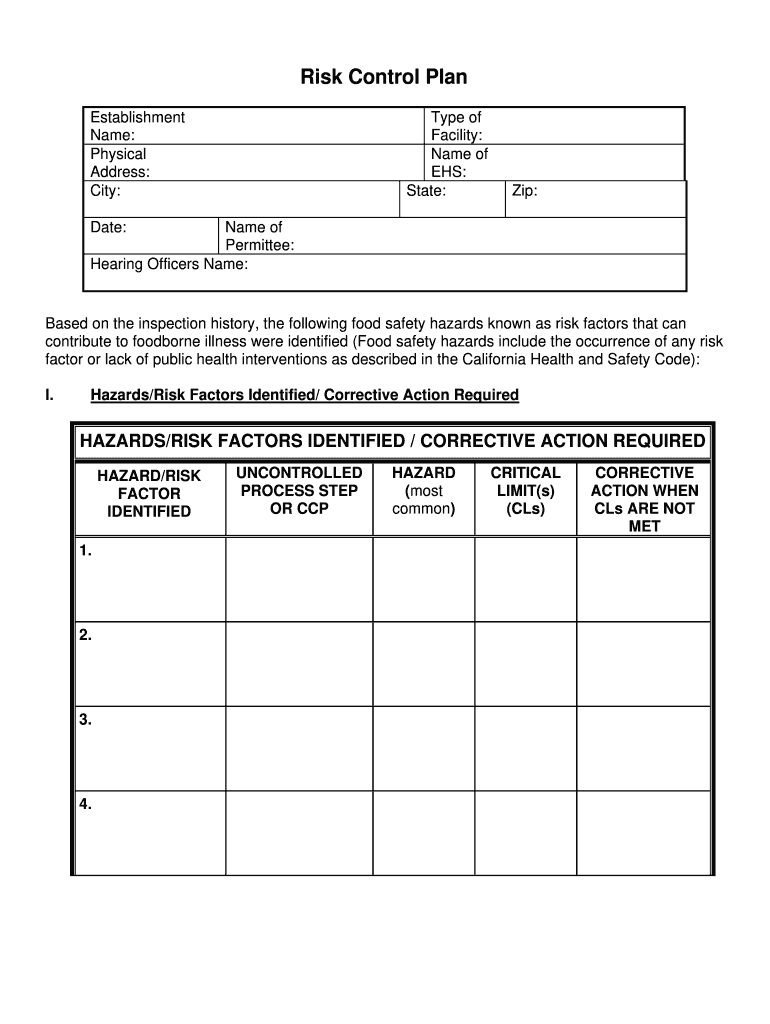
Owing food safety hazards known as risk factors that can contribute to foodborne illness were identified (Food safety hazards include the occurrence of any risk factor or lack of public health interventions as described in the California Health and Safety Code): I. Hazards/Risk Factors Identified/ Corrective Action Required HAZARDS/RISK FACTORS IDENTIFIED / CORRECTIVE ACTION REQUIRED HAZARD/RISK FACTOR IDENTIFIED 1. 2. 3. 4. UNCONTROLLED PROCESS STEP OR CCP HAZARD (most common) CRITICAL .
Loading

Open form follow the instructions

Easily sign the form with your finger

Send filled & signed form or save
How to fill out the FDA Risk Control Plan online
Completing the FDA Risk Control Plan online is essential for managing food safety hazards effectively. This guide will provide a clear and supportive approach to filling out each section of the plan with relevant information.
Follow the steps to complete your FDA Risk Control Plan
- Click ‘Get Form’ button to obtain the form and open it in the editor.
- Enter the establishment name in the designated field, ensuring it accurately reflects the official business name.
- Fill in the physical address of the establishment, including street address, city, state, and zip code, to provide a complete location.
- Specify the type of facility by selecting the applicable option from the provided list, clarifying the nature of the business.
- Provide the name of the Environmental Health Specialist (EHS) assigned to the establishment in the appropriate field.
- Input the date of form completion to document when the Risk Control Plan was created.
- Enter the name of the permittee, which is generally the person or entity responsible for the facility and its operations.
- Include the name of the hearing officer in the specified section, pertinent for any future hearings or inspections.
- Identify known food safety hazards based on inspection history, listing them sequentially in the provided space.
- For each identified hazard or risk factor, specify corrective actions required to mitigate said risks, and include relevant details.
- Detail any uncontrolled process steps or critical control points (CCPs) associated with each hazard identified.
- Define critical limits for each hazardous area and note corrective actions for instances when those limits are not met.
- Review all filled information for accuracy and completeness before proceeding.
- Once satisfied with the entries, save changes, then proceed to download, print, or share the completed form as needed.
Complete your FDA Risk Control Plan online today to ensure your establishment meets safety standards.
Experience a faster way to fill out and sign forms on the web. Access the most extensive library of templates available.
Related content
This manual is for regulators applying HACCP principles to risk-based retail and food...
by D Guidance · 2018 · Cited by 1 — In a HACCP plan, verification activities take...
(11) “RISK CONTROL PLAN (RCP)” means a mutually agreed upon written plan (between the...
Get answers to your most pressing questions about US Legal Forms API.
What does the FDA require for approval?
For product approval, the FDA requires comprehensive documentation that includes safety data, testing results, and adherence to regulatory standards. An effective FDA Risk Control Plan is crucial in presenting your commitment to safety and compliance. Ensuring all aspects of your product meet FDA expectations facilitates a smoother approval process.
Does FDA require RMP?
Yes, the FDA requires a Risk Management Plan for certain regulated products to ensure safety and efficacy. This requirement underscores the agency's commitment to public health. To meet these expectations efficiently, adopting an FDA Risk Control Plan is highly beneficial for companies.
What is the difference between RMP and REMS?
The RMP focuses on managing risks in food safety, while REMS, or Risk Evaluation and Mitigation Strategies, applies to specific drugs and medical products. Both aim to protect public health but operate in different sectors. Understanding these differences helps in creating a comprehensive FDA Risk Control Plan tailored to your business needs.
What is the RMP in the FDA?
The RMP, or Risk Management Plan, is a document required by the FDA to outline how risks related to food safety are identified and controlled. This plan is crucial for mitigating potential hazards in food production. Developing an FDA Risk Control Plan can support you in creating a robust RMP that meets FDA requirements.
Does FDA require risk management?
The FDA strongly encourages risk management as part of its regulatory framework. Companies are expected to assess and mitigate risks to comply with food safety standards. Utilizing an effective FDA Risk Control Plan streamlines this process, allowing businesses to implement effective risk management strategies.
Does the FDA require a HACCP plan?
Yes, the FDA mandates a Hazard Analysis Critical Control Point (HACCP) plan for certain food products. This proactive approach identifies potential hazards and implements controls to manage risks. Integrating an FDA Risk Control Plan can enhance your HACCP process, ensuring comprehensive safety measures are in place.
Who is required to have a food safety plan?
According to the FDA, anyone involved in food production must have a food safety plan. This includes manufacturers, processors, and importers. A well-structured FDA Risk Control Plan helps ensure compliance and enhances food safety practices across the supply chain.
What is the ISO standard for risk management?
The ISO standard for risk management is ISO 31000, which provides principles and guidelines for effective risk management. This standard emphasizes integrating risk management into organizational processes. By combining ISO 31000 with the FDA Risk Control Plan, organizations can develop comprehensive strategies for addressing risks effectively.
What is the ICH Q9 risk control?
ICH Q9 outlines guidelines for quality risk management applicable across the pharmaceutical and biotechnology sectors. It emphasizes a structured approach to identifying, assessing, and mitigating risks. Implementing ICH Q9 principles alongside an FDA Risk Control Plan can enhance your organization's risk management framework.
Which standard does FDA use for risk management?
The FDA primarily aligns with ISO 14971 for risk management in medical devices. Using this standard helps organizations develop effective risk control plans that align with FDA expectations and regulatory requirements. By following these guidelines, you can enhance your risk management practices significantly.
Use professional pre-built templates to fill in and sign documents online faster. Get access to thousands of forms.
If you believe that this page should be taken down, please follow our DMCA take down process here.