Hydrology Indicators: Primary Indicators (minimum of one required; check all that apply) Secondary Indicators (minimum of two required) Surface Water (A1) Water-Stained Leaves (B9) Surface Soil Cracks (B6) High Water Table (A2) Aquatic Fauna (B13) Sparsely Vegetated Concave Surface (B8) Saturation (A3) Hydrogen Sulfide Odor (C1) Drainage Patterns (B10) Water Marks (B1) Oxidized Rhizospheres on Living Roots (C3) Dry-Season Water Table (C2) Sediment Deposits (B2) Presence of Reduce.
Loading

Open form follow the instructions

Easily sign the form with your finger

Send filled & signed form or save
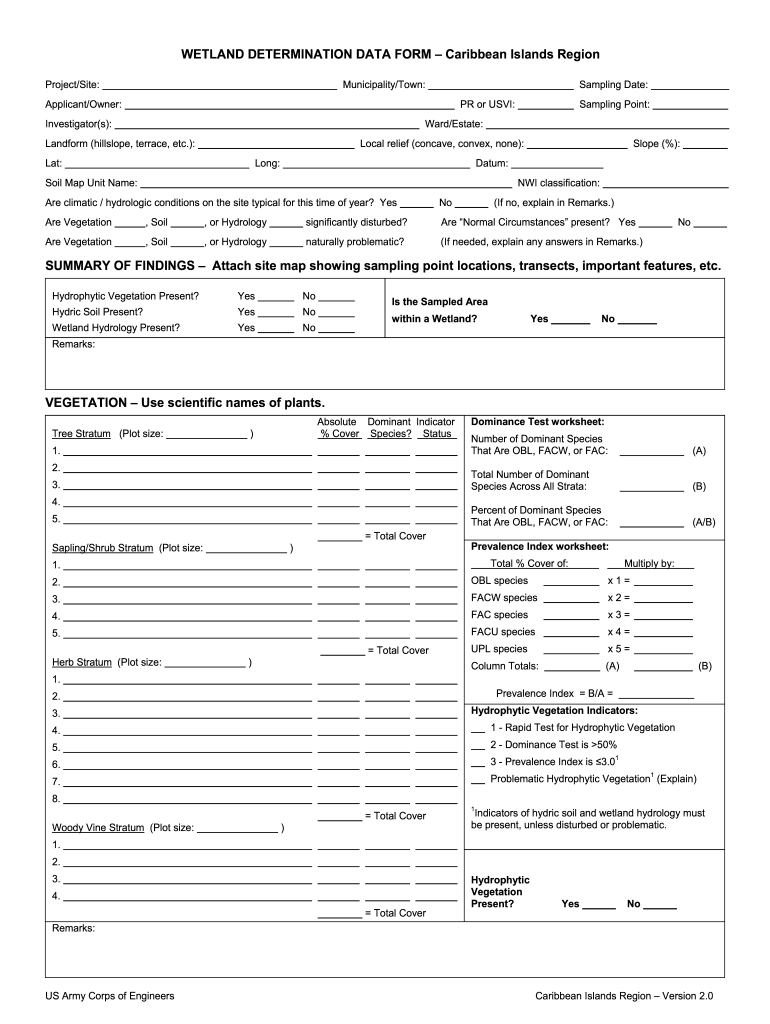
How to fill out the Wetland Determination Data Form - Caribbean Islands Region online
Filling out the Wetland Determination Data Form for the Caribbean Islands Region is essential for assessing wetland characteristics. This guide provides clear instructions to navigate each section of the form online, ensuring users are well-equipped to complete it accurately.
Follow the steps to effectively complete the Wetland Determination Data Form online.
- Select the ‘Get Form’ button to acquire the Wetland Determination Data Form and open it in your preferred editor.
- Begin by entering the municipality or town where the project or site is located. Specify the project or site name, followed by the sampling date, and indicate if it is under Puerto Rico (PR) or the U.S. Virgin Islands (USVI).
- Fill in the details of the applicant or owner and the investigator(s) involved in the assessment. Provide the sampling point, ward or estate, and describe the local relief of the area.
- Detail the landform and input the longitude and latitude coordinates of your location. Assess the slope percentage and apply the appropriate datum, including any NWI classification.
- Evaluate the climatic and hydrologic conditions at the site. Indicate whether these conditions are typical for the time of year and provide explanations in the remarks section if necessary.
- Assess if any vegetation, soil, or hydrology indicators are disturbed or problematic. Indicate the presence of 'Normal Circumstances' and note the relevancy of these conditions in the remarks section.
- In the summary of findings section, attach a site map that illustrates sampling point locations, transects, and other important features relevant to your findings.
- Indicate whether hydrophytic vegetation, hydric soil, and wetland hydrology are present. For each aspect, respond with a 'Yes' or 'No' and provide remarks where necessary.
- Proceed to the vegetation section where you will use the scientific names of plants. Fill out the different strata including tree, sapling/shrub, herb, and woody vine strata, providing cover percentages and the dominant species.
- In the soil section, describe the soil profile, including matrix colors and redox features at specific depths. Document any hydric soil indicators and provide observations on problematic hydric soils if applicable.
- Assess the hydrology indicators by checking primary and secondary indicators relevant to your observations. Document whether surface water and water tables are present in the wetland area.
- Once all sections are completed, review your entries for accuracy. You can then save changes, download, print, or share the completed document as needed.
Complete your Wetland Determination Data Form online today to ensure compliance and accurate assessment of wetland conditions.
Experience a faster way to fill out and sign forms on the web. Access the most extensive library of templates available.
Related content
Form, ENG Form 6116-3, Wetland Determination Data Sheet - Caribbean Islands Region ·...
by BJ Bleichner · 2008 — The second phase of the thesis was to compare those guidelines...
by G Barnes · 1998 · Cited by 10 — PDF | This paper is a compilation of three reports...
Get answers to your most pressing questions about US Legal Forms API.
What does it mean if you have wetlands on your property?
Having wetlands on your property means that certain environmental regulations apply, which can affect land use and development plans. Wetlands are vital ecosystems that support biodiversity, but they may also introduce challenges for property owners. Understanding your wetland status through the Wetland Determination Data Form - Caribbean Islands Region can help you navigate these responsibilities and protect your land effectively.
How do you do a wetland delineation?
Wetland delineation involves assessing a site to identify the boundaries of wetlands based on existing ecological indicators like soil, vegetation, and hydrology. This assessment often requires fieldwork and expertise in wetland ecology. Utilizing the Wetland Determination Data Form - Caribbean Islands Region can facilitate this process, providing a structured format for recording findings and ensuring compliance with state and federal guidelines.
How to get a wetlands determination?
To obtain a wetlands determination, you typically need to complete a formal application with the necessary documentation, which includes the Wetland Determination Data Form - Caribbean Islands Region. Engaging with professionals who specialize in wetlands can streamline this process, ensuring accurate assessment and compliance with regulations. It's essential to gather all relevant site information before submitting your application.
What is the 50/20 rule in wetland delineation?
The 50/20 rule is a guideline used in wetland delineation to assess aquatic areas based on vegetation and hydrology. According to this rule, if 50% or more of the area shows wetland characteristics in one spot, it is classified as a wetland; if only 20% meets these criteria in another area, it is not. Understanding the 50/20 rule helps landowners navigate their responsibilities regarding the Wetland Determination Data Form - Caribbean Islands Region.
What does a wetland determination mean?
A wetland determination signifies whether an area meets the criteria to be classified as a wetland. This classification affects property development, land use, and environmental protection efforts. By obtaining the Wetland Determination Data Form - Caribbean Islands Region, you gain clarity on your land's wetland status and the associated responsibilities.
What is a wetland determination?
A wetland determination is a process used to identify and classify wetlands on a specific piece of property. This process helps landowners understand the extent of wetlands on their land and the regulations that may apply. For those using the Wetland Determination Data Form - Caribbean Islands Region, this process ensures compliance with environmental laws and helps protect valuable ecosystems.
What are the criteria for wetland delineation?
The criteria for wetland delineation involve examining three key aspects: soil moisture levels, the types of vegetation present, and water circulation patterns. Each criterion plays a vital role in confirming whether an area is designated as a wetland. By utilizing the Wetland Determination Data Form - Caribbean Islands Region, you can systematically evaluate and record these important details, enhancing your understanding and compliance.
What is the 50/20 rule for wetlands?
The 50/20 rule for wetlands is a practical framework used to assess wetland presence based on specific measurements of soil and vegetation. According to this rule, if the area has 50% hydric soils and 20% wetland plants, it qualifies as a wetland. Using the Wetland Determination Data Form - Caribbean Islands Region can guide you through applying this rule correctly.
What 3 major factors are used to delineate a wetland?
The three major factors used to delineate a wetland include soil characteristics, the presence of water, and the type of vegetation in the area. Soil that holds water for certain periods, specific plant types, and standing water are indicators of wetland environments. You can effectively record this information with the Wetland Determination Data Form - Caribbean Islands Region to facilitate accurate reporting.
How are wetlands determined?
Wetlands are determined through a careful evaluation of three main criteria: soil type, vegetation, and hydrology. Professionals use instruments and observations to assess these elements, which are crucial for identifying wetland areas. The Wetland Determination Data Form - Caribbean Islands Region provides a structured way to document findings, ensuring clarity and compliance.
Use professional pre-built templates to fill in and sign documents online faster. Get access to thousands of forms.
If you believe that this page should be taken down, please follow our DMCA take down process here.