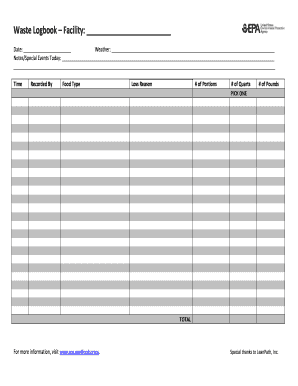
Waste Logbook Facility: Date: Weather: Notes/Special Events Today: Time Recorded By Food Type Loss Reason # of Portions # of Quarts PICK ONE # of Pounds TOTAL For more information, visit www.epa.gov/foodscraps.
Open form follow the instructions
Easily sign the form with your finger
Send filled & signed form or save
How to fill out the EPA Waste Logbook online
The EPA Waste Logbook is an essential tool for tracking food waste in facilities. This guide provides clear instructions on how to accurately complete the logbook online, ensuring compliance and promoting sustainable practices within food service operations.
Follow the steps to accurately complete the EPA Waste Logbook online.
- Click the ‘Get Form’ button to access the EPA Waste Logbook and open it for editing.
- Enter the facility name in the designated field to identify where the waste is being logged.
- Fill in the date of the log entry, ensuring it reflects the correct day for accurate record-keeping.
- Document the weather conditions in the provided space as this may affect food waste patterns.
- Use the section labeled 'Notes/Special Events Today' to record any relevant information or unusual occurrences that may impact food waste.
- For each entry, specify the recorded time of waste disposal in the time field.
- Enter your name in the 'Recorded By' field to identify who filled out the log.
- Fill out the 'Food Type' section with a clear description of the item being logged.
- State the 'Loss Reason' for the food waste. This is crucial for identifying patterns and potential changes.
- Indicate the quantity of waste by recording the number of portions disposed of, which helps in quantifying waste.
- Choose whether to record the weight in quarts or pounds and fill out the respective field appropriately.
- Check the total section to ensure all entries reflect accurate cumulative figures for the day.
- After completing the logbook, review all entries for accuracy.
- You can then save changes, download, print, or share the completed form as needed.
Start logging your waste online today and contribute to sustainable food management.
Experience a faster way to fill out and sign forms on the web. Access the most extensive library of templates available.
Related content
Track pre-consumer food waste at the time of discard. Record waste on the logbook...
U.S. EPA, (1985). "Handbook - Remedial Action at Waste Disposal Sites"; EPA/625/6-85/006;...
This Federal Facilities Forum Issue Paper: Site Characterization For Munitions...
Get answers to your most pressing questions about US Legal Forms API.
How to track food waste in restaurants?
To track food waste in restaurants, implement a daily logging system in your EPA Waste Logbook. Record the amount and types of food waste, and regularly review this information to determine where reductions can be made. Engaging your team in this practice promotes awareness and a commitment to reducing waste.
How do you keep track of waste?
Keeping track of waste involves consistent logging in a designated tracking tool, such as your EPA Waste Logbook. Establish daily routines for recording waste, and encourage staff participation to ensure comprehensive data collection. This approach helps in assessing and mitigating waste effectively.
How to carry out a waste audit?
To carry out a waste audit, gather a team and review all waste generated within a specific period. Use your EPA Waste Logbook to document types and quantities of waste. Afterward, analyze the data to identify areas for improvement and develop strategies to reduce waste.
How long does the EPA recommend you keep shipping records for universal waste?
The EPA recommends keeping shipping records for universal waste for at least three years. By maintaining these records in your EPA Waste Logbook, you can ensure compliance and readily access information for audits or inspections.
What are the EPA requirements for hazardous waste labeling?
The EPA requires that hazardous waste is clearly labeled with the appropriate identifiers, including the type of waste and the words 'Hazardous Waste.' Ensure you maintain accurate records in your EPA Waste Logbook to adhere to these guidelines and avoid potential fines.
How do you record food waste?
To record food waste, designate time each day to log discarded items in your EPA Waste Logbook. Include details such as the type and quantity of waste. This practice not only helps in measuring waste trends but also aids in finding opportunities for reduction.
How to track waste in a restaurant?
Tracking waste in a restaurant requires a systematic approach. Use your EPA Waste Logbook to document waste daily, including both food and non-food items. Engaging staff in the process helps improve accuracy and fosters a culture of sustainability.
How to calculate waste in a restaurant?
To calculate waste in a restaurant, start by monitoring all areas where food is handled. Record the amount of food that gets discarded daily. By consistently tracking this information in your EPA Waste Logbook, you can identify patterns and adjust purchasing and menu options to minimize waste.
How to fill out a waste profile?
Filling out a waste profile requires meticulous attention to detail. You need to highlight the specific types of waste, their quantities, and their disposal methods. By documenting this information in an organized manner using the EPA Waste Logbook, you ensure that your waste management practices align with regulatory requirements, demonstrating your commitment to environmental stewardship.
How do you complete a waste audit?
Completing a waste audit involves evaluating the types and quantities of waste generated at your facility. Begin by conducting a thorough inventory of your waste and categorizing it based on its characteristics. Using the EPA Waste Logbook simplifies this process by allowing you to document your findings systematically, making compliance and future audits much easier.
Use professional pre-built templates to fill in and sign documents online faster. Get access to thousands of forms.
If you believe that this page should be taken down, please follow our DMCA take down process here.