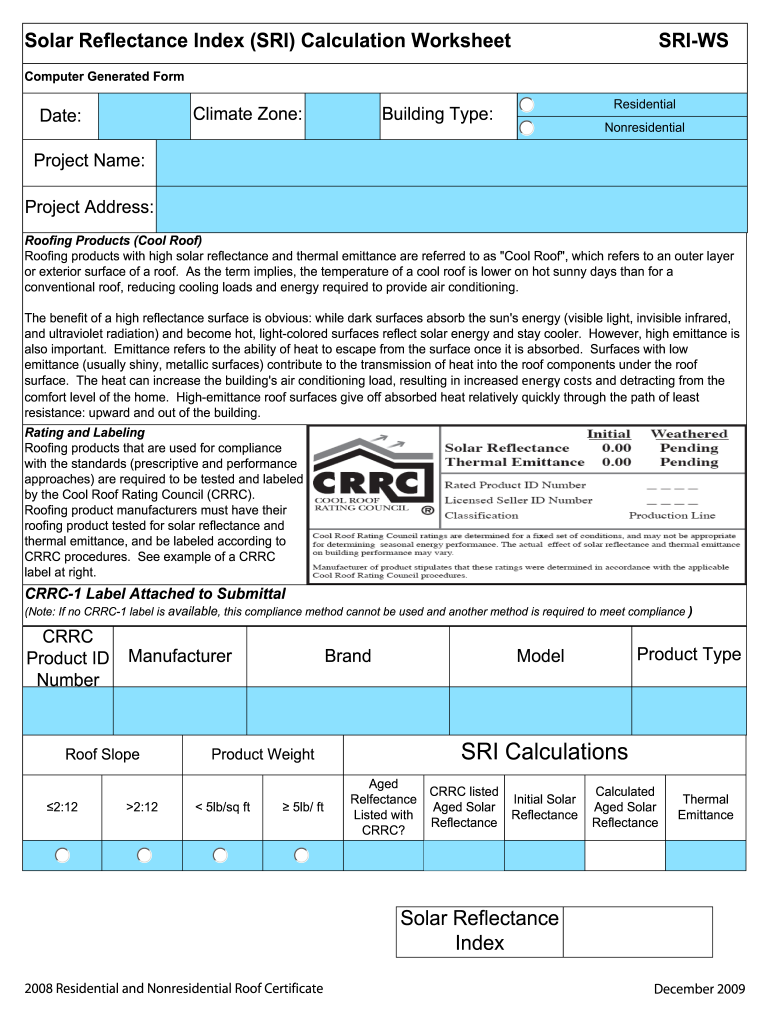
Ts (Cool Roof) Roofing products with high solar reflectance and thermal emittance are referred to as "Cool Roof", which refers to an outer layer or exterior surface of a roof. As the term implies, the temperature of a cool roof is lower on hot sunny days than for a conventional roof, reducing cooling loads and energy required to provide air conditioning. The benefit of a high reflectance surface is obvious: while dark surfaces absorb the sun's energy (visible light, invisible infrared, and ultra.
Loading

Open form follow the instructions

Easily sign the form with your finger

Send filled & signed form or save
How to fill out the SRI-WS online
The Solar Reflectance Index Calculation Worksheet (SRI-WS) is essential for assessing the performance of roofing products in terms of solar reflectance and thermal emittance. This guide will provide you with step-by-step instructions to successfully complete the SRI-WS online.
Follow the steps to complete the SRI-WS accurately.
- Click ‘Get Form’ button to access the SRI-WS and open it in your selected editor.
- Enter the climate zone relevant to your project in the designated field. This is important for ensuring that your roofing materials meet specific local requirements.
- Specify the date on which you are completing the form. This helps to maintain accurate records for your project documentation.
- Select the building type from the options provided: Residential or Nonresidential. This classification impacts compliance requirements and energy efficiency evaluations.
- Fill in the project name and project address. This information will identify the specific project related to your SRI calculations.
- For the roofing products, indicate whether they are classified as 'Cool Roof' by checking the appropriate option. Remember, high reflectance and thermal emittance are key features for this classification.
- Attach the CRRC-1 label to the submission if available. If it is not available, be aware that this compliance method cannot be utilized, and an alternative method must be sought.
- Input the product ID number and manufacturer name for the roofing product you are evaluating. This ensures accurate tracking and compliance verification.
- Indicate the roof slope by selecting either ≤2:12 or >2:12, based on your project's specifications.
- Fill in fields for product weight, product type, and model. These details contribute to the comprehensive assessment of roof performance.
- Specify the aged reflectance, initial solar reflectance, calculated aged solar reflectance, and thermal emittance values as provided by the CRRC.
- Finally, calculate and record the Solar Reflectance Index based on the entered values. This index is crucial for determining compliance with performance standards.
- Once all fields are complete, you can save changes, download the form, print it for physical records, or share it as needed.
Complete your SRI-WS online today to ensure your roofing project meets all necessary compliance standards.
Experience a faster way to fill out and sign forms on the web. Access the most extensive library of templates available.
Related content
Roofing products with high solar reflectance and thermal emittance are referred to as...
On 5-6 June 2003 a workshop (WS) was held at Chiang Mai University to share experiences on...
Precisa converter US Dollars em Sri Lankan Rupees? A Currency.Wiki oferece taxas de...
Get answers to your most pressing questions about US Legal Forms API.
How can USLegalForms aid in understanding SRI-WS?
USLegalForms offers a wealth of resources and legal documentation that can help you understand and navigate SRI-WS effectively. Whether you need forms for construction projects or guidance on regulations associated with building materials, USLegalForms simplifies the process. This platform ensures you're well-prepared and informed in your decision-making.
Is higher or lower SRI better?
Higher SRI values are generally better as they indicate more effective solar energy reflection. A higher SRI helps keep your buildings cooler, promoting energy efficiency. Thus, when selecting roofing or exterior materials, aiming for a higher SRI is beneficial.
What is the difference between SRI and LRV?
SRI and LRV are both measurements of a material's reflective properties, but they measure different aspects. SRI focuses on solar heat absorption while LRV, or Light Reflectance Value, measures visible light reflectance. Understanding both can help you make informed decisions about material selections.
What is a good SRI for a roof?
A good SRI for a roof typically ranges between 0 and 1, with higher numbers indicating better reflectance. Generally, an SRI above 0.30 is considered effective for reducing heat buildup in buildings. A roof with a good SRI not only aids in energy savings but also enhances overall comfort.
What does SRI mean in construction?
SRI in construction is related to the Solar Reflectance Index, used to gauge how well materials reflect solar energy. This value is crucial for selecting materials that contribute to energy efficiency. Using materials with an appropriate SRI can improve sustainability in your construction projects.
What does SRI mean in paint?
In the context of paint, SRI refers to the Solar Reflectance Index, which assesses how reflective the paint is under sunlight. Paints with a high SRI help reduce heat absorption, keeping your spaces cooler. Choosing a paint with a good SRI can significantly enhance your building's energy performance.
What does SRI stand for in roofing?
SRI in roofing stands for Solar Reflectance Index. This measure indicates how well a roofing material reflects solar energy. A higher SRI means greater energy efficiency for your home, leading to potential savings on cooling costs.
What is the standard solar reflectance index?
The solar reflectance index (SRI) is a measure of the constructed surface's ability to reflect solar heat, as shown by a small temperature rise. It is defined so that a standard black surface (reflectance 0.05, emittance 0.90) is 0 and a standard white surface (reflectance 0.80, emittance 0.90) is 100.
How SR and Sri are different?
SR is the fraction of solar energy that is reflected by a surface on a scale of 0 to 1. It doesn't factor in emissions of thermal radiation the way SRI does.
What does Sri mean in roofing?
The Solar Reflectance Index (SRI) is an indicator of the ability of a roof surface to return solar energy to the atmosphere. Roofing material surfaces with a higher SRI will be cooler than surfaces with a lower SRI under the same solar energy exposure, especially on a sunny day.
Use professional pre-built templates to fill in and sign documents online faster. Get access to thousands of forms.
If you believe that this page should be taken down, please follow our DMCA take down process here.