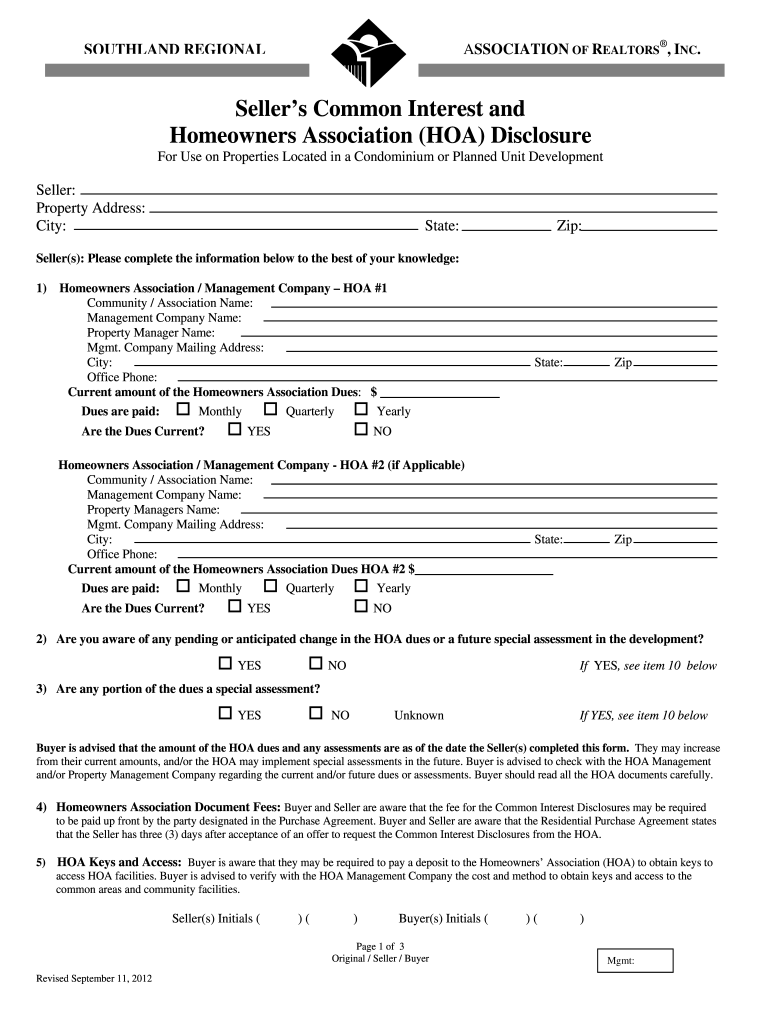
Seller: Property Address: City: State: Zip: Seller(s): Please complete the information below to the best of your knowledge: 1) Homeowners Association / Management Company – HOA #1 Community / Association Name: Management Company Name: Property Manager Name: Mgmt. Company Mailing Address: City: Office Phone: Current amount of the Homeowners Association Dues: $ ___________________ Quarterly Yearly Dues are paid: Monthly Are the Dues Current? YES State: Zip NO Homeowne.
Loading

Open form follow the instructions

Easily sign the form with your finger

Send filled & signed form or save
How to fill out the Seller’s Common Interest & HOA Disclosure online
Completing the Seller’s Common Interest & HOA Disclosure online can streamline the process of providing essential information about a property situated in a condominium or planned unit development. This guide will help you navigate every section of the form with clear, step-by-step instructions.
Follow the steps to successfully complete your disclosure form.
- Press the ‘Get Form’ button to obtain the Seller’s Common Interest & HOA Disclosure form and open it in your preferred online editor.
- Begin by filling out the seller's details including the property address, city, state, and zip code. Ensure that all information is accurate and up-to-date.
- Complete the section regarding the Homeowners Association (HOA). Start with HOA #1 by providing the community or association name, management company name, and property manager details.
- Input the current amount of the HOA dues, and select the frequency (quarterly, yearly, or otherwise) in which these dues are paid. Indicate whether the dues are current by checking 'YES' or 'NO'.
- If applicable, repeat the previous step for HOA #2 to ensure all associations connected to your property are documented.
- Answer questions 2 through 8 regarding any changes in dues, special assessments, violations, pending maintenance, nuisances, and any parking facilities provided, ensuring to include details if applicable.
- For questions 9 through 14, indicate what items and services are included in the HOA dues and note any community amenities available to residents.
- If you answered 'YES' to any questions from 2 to 8, ensure that you prepare an addendum with detailed explanations or documentation, as required.
- Review the form to confirm that all fields are filled out to the best of your knowledge and understanding. Seek advice if necessary to ensure accuracy.
- Once all steps are complete, save the changes made to the document. You can then download, print, or share the completed form as needed.
Start filling out the Seller’s Common Interest & HOA Disclosure online today to ensure a smooth and informed selling process.
Experience a faster way to fill out and sign forms on the web. Access the most extensive library of templates available.
Related content
Associations will see significant changes to the form for providing resale...
HOA dues are approximately $60 per year. There are no common areas that are owned or...
Feb 12, 2021 — Increases in interest rates or decreases in mortgage availability may...
Get answers to your most pressing questions about US Legal Forms API.
What happens if a seller lies on a disclosure in NC?
If a seller lies on a disclosure in North Carolina, they may face serious legal consequences, including potential lawsuits from the buyer. The state emphasizes the importance of honesty in Seller’s Common Interest & HOA Disclosure, and misleading information can lead to claims of fraud. Buyers who discover falsehoods in the disclosure can seek recourse, highlighting the importance of accurate and truthful information in real estate transactions.
Which Florida statute requires sellers of property subject to a mandatory homeowners association to provide buyers with a disclosure summary?
In Florida, the statute that mandates sellers of properties in a mandatory homeowners association to present buyers with a disclosure summary is Section 720.401 of the Florida Statutes. This law is crucial for ensuring that potential buyers are aware of their rights and obligations related to the Seller’s Common Interest & HOA Disclosure. By providing this summary, sellers help maintain transparency during the real estate transaction.
Which one of the following statements is true regarding HOA disclosure certificates?
HOA disclosure certificates serve as an important tool in real estate transactions, revealing key details about the association’s financial health and any outstanding obligations. One true statement is that these certificates typically disclose any fees owed and any special assessments planned for the community. Buyers should carefully review this document for a clear understanding of the Seller’s Common Interest & HOA Disclosure implications.
What is a homeowners association statement?
A homeowners association statement is a document that provides essential information about the rules and regulations governing a community managed by an HOA. It details aspects such as fees, assessments, and any community standards that may apply. Understanding this statement is crucial for potential buyers as it outlines the expectations and obligations associated with living in a Seller’s Common Interest & HOA Disclosure community.
What happens if you refuse the HOA?
Refusing to comply with HOA rules can lead to various consequences, including fines or legal action. The HOA can enforce its regulations under the governing documents, which is why you should familiarize yourself with the Seller’s Common Interest & HOA Disclosure. If you find yourself facing conflicts with the HOA, platforms like USLegalForms can provide you with the necessary legal documents to navigate disputes effectively. Understanding your options will empower you to manage your relationship with the HOA.
What is an HOA resale disclosure?
An HOA resale disclosure is a document that provides essential information about community rules, fees, and financial obligations. This disclosure ensures that potential buyers understand what they are agreeing to before purchasing a property. The Seller’s Common Interest & HOA Disclosure highlights the importance of reviewing these documents carefully. As a seller, sharing this information promotes transparency and can aid in a smoother transaction.
Can an HOA prevent you from selling?
Yes, a Homeowners Association (HOA) can impose restrictions that may delay or prevent a sale. For instance, they often require prospective buyers to be approved by the HOA itself. Understanding the Seller’s Common Interest & HOA Disclosure is crucial, as it outlines these specific rules. Always review these disclosures to avoid unexpected hurdles during your sale.
Are houses with HOA harder to sell?
Houses within an HOA can be more challenging to sell depending on the community's reputation and the fees involved. However, many buyers appreciate the regulations and amenities offered by HOAs. When appropriately disclosed in the Seller’s Common Interest & HOA Disclosure, these attributes can enhance marketability if potential buyers understand the benefits.
Who is responsible for paying HOA fees?
The homeowner is responsible for paying HOA fees, which fund community maintenance and services. If a property is part of a Seller’s Common Interest & HOA Disclosure, it is vital to understand these fees and their implications for ownership. Buyers should review past payment histories to better gauge potential future expenses.
Are tenants responsible for HOA fees?
In most cases, tenants are not responsible for paying HOA fees; these fees are usually the obligation of the property owner. However, the lease agreement may specify different arrangements. Understanding the nuances of the Seller’s Common Interest & HOA Disclosure can help both landlords and tenants clarify their financial responsibilities.
Use professional pre-built templates to fill in and sign documents online faster. Get access to thousands of forms.
If you believe that this page should be taken down, please follow our DMCA take down process here.
This form is available in several versions. Select the version you need from the drop-down list below.