We use cookies to improve security, personalize the user experience, enhance our marketing activities (including cooperating with our marketing partners) and for other business use.
Click "here" to read our Cookie Policy. By clicking "Accept" you agree to the use of cookies. Read less
Read more
Accept
Loading
Form preview
  • US Legal Forms
  • Form Library
  • More Forms
  • More Multi-State Forms
  • Money Matters

Get Money Matters

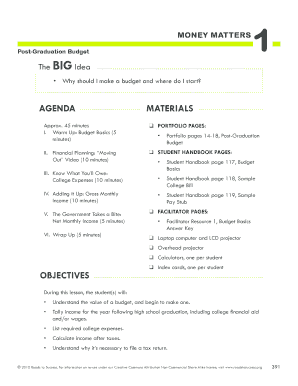
: II. Financial Planning: Moving Out Video (10 minutes) STUDENT HANDBOOK PAGES: Portfolio pages 14-18, Post-Graduation Budget III. Know What You ll Owe: College Expenses (10 minutes) Student Handbook page 117, Budget Basics Student Handbook page 118, Sample College Bill IV. Adding it Up: Gross Monthly Income (10 minutes) Student Handbook page 119, Sample Pay Stub V. The Government Takes a Bite: Net Monthly Income (5 minutes) VI. Wrap Up (5 minutes) F.

How it works

  1. Open form

    Open form follow the instructions

  2. Easily sign form

    Easily sign the form with your finger

  3. Share form

    Send filled & signed form or save

How to fill out the Money Matters online

Filling out the Money Matters form is an essential step in managing your finances post-graduation. This guide will provide you with a clear, step-by-step approach to complete your online form effectively.

Follow the steps to fill out the Money Matters form accurately.

  1. Click the ‘Get Form’ button to access the Money Matters document and open it in your chosen online editor.
  2. Begin by reviewing the section titled 'College Expenses'. List out all relevant costs associated with your college education, such as tuition, housing, meal plans, and books. Ensure you collect accurate figures from your college's website or your acceptance letter.
  3. Move on to 'College Income'. Here, you will need to detail all sources of income that will assist in covering your college expenses, including financial aid awards, family contributions, and any personal savings.
  4. Calculate the total for both 'College Expenses' and 'College Income'. Enter these figures in their respective boxes provided on the form.
  5. Subtract your total college expenses from your total college income to determine your financial standing. This will help you identify if you have a surplus or a shortfall.
  6. Next, calculate your 'Gross Monthly Income' by estimating your earnings from jobs you anticipate holding. Ensure these figures represent monthly income.
  7. Move to 'Net Monthly Income' and account for taxes withheld, generally estimated at 30% of your gross income. Subtract this amount from your gross income to find your net pay.
  8. Lastly, review all completed sections. You can now save your changes, download the document, print it out, or share it as necessary.

Complete your Money Matters form online today to prepare for your financial future!

Get form

Experience a faster way to fill out and sign forms on the web. Access the most extensive library of templates available.
Get form

Related content

Money Matters
The tax credit application form and the IRS Publication are available at www.irs.gov or by...
Learn more
Money Matters
Combinable with financial aid, loans, or scholarships. â–«Must enroll each semester...
Learn more
The Matter of Money
Aug 28, 2023 — This page contains details about Fallen London Actions. Perhaps it is...
Learn more

Related links form

CASM Critical Appraisal Of Systematic Review Or Meta-Analysis 2007 CA Stockton Service Wheel Wheel Customization Form 2011 OPM RI 20-7 2018 VA Form 21-0960A-4 2014

Questions & Answers

Get answers to your most pressing questions about US Legal Forms API.

Contact support

Yes, the 70/20/10 rule can work effectively for many people striving to manage their finances. This approach gives you the flexibility to enjoy your spending while simultaneously focusing on savings and debt reduction. By adopting this rule, you can create a balanced financial strategy that addresses your present and future money matters. If you're seeking tools to streamline this budgeting method, consider using platforms like US Legal Forms for guidance on financial documentation.

Monetary matters involve aspects related to currency and financial transactions. Effectively managing these matters is essential for maintaining financial health, whether it’s for personal use or within a business. Money Matters highlights the importance of understanding your currency-related decisions and their implications. Using tools available through US Legal Forms can help you address various monetary matters with confidence.

Making $100 a day can be achieved through part-time work or side gigs such as freelance writing, graphic design, or delivering groceries. You might also consider offering services like cleaning or dog walking in your neighborhood. Focus on your skills and what you enjoy, as this can make earning money matters feel more fulfilling and achievable.

To get $500 quickly as a kid, consider various ways to earn money like doing yard work, pet sitting, or offering tutoring services to younger children. You could also explore selling items you no longer need, such as toys or clothes, through online marketplaces or garage sales. Remember, money matters, and staying organized with your earnings can help you track your progress towards that goal.

Financial matters refer to the various aspects that involve managing money, assets, and liabilities. This includes budgeting, investing, saving, and understanding debts. Money Matters play a crucial role in your financial health and stability, as they influence your decisions and future financial goals. Understanding these aspects can help you navigate through money management effectively.

The 70-20-10 rule is a straightforward budgeting method that provides an effective framework for handling Money Matters. Under this rule, you allocate 70% of your income to necessary expenses, 20% to savings or debt repayment, and 10% to fun and leisure activities. This structure allows for financial security while leaving room for enjoyment, making it easier to manage your finances. By adopting this rule, you can create a sustainable budget that aligns with your life goals.

Deciding between the 70/20/10 and 50/30/20 budgeting rules often depends on your specific financial goals and lifestyle. The 70/20/10 rule allocates 70% of your income to essentials, 20% to savings, and 10% to discretionary spending, which emphasizes a balanced approach to managing Money Matters. On the other hand, the 50/30/20 rule is more lenient, dedicating 50% to needs, 30% to wants, and 20% to savings, which may better suit those who prioritize flexibility in their spending habits. Consider your financial situation and choose the method that aligns with your needs.

Get This Form Now!

Use professional pre-built templates to fill in and sign documents online faster. Get access to thousands of forms.
Get form
If you believe that this page should be taken down, please follow our DMCA take down processhere.

Industry-leading security and compliance

US Legal Forms protects your data by complying with industry-specific security standards.
  • In businnes since 1997
    25+ years providing professional legal documents.
  • Accredited business
    Guarantees that a business meets BBB accreditation standards in the US and Canada.
  • Secured by Braintree
    Validated Level 1 PCI DSS compliant payment gateway that accepts most major credit and debit card brands from across the globe.
Get Money Matters
Get form
Form Packages
Adoption
Bankruptcy
Contractors
Divorce
Home Sales
Employment
Identity Theft
Incorporation
Landlord Tenant
Living Trust
Name Change
Personal Planning
Small Business
Wills & Estates
Packages A-Z
Form Categories
Affidavits
Bankruptcy
Bill of Sale
Corporate - LLC
Divorce
Employment
Identity Theft
Internet Technology
Landlord Tenant
Living Wills
Name Change
Power of Attorney
Real Estate
Small Estates
Wills
All Forms
Forms A-Z
Form Library
Customer Service
Terms of Service
Privacy Notice
Legal Hub
Content Takedown Policy
Bug Bounty Program
About Us
Help Portal
Legal Resources
Blog
Affiliates
Contact Us
Delete My Account
Site Map
Industries
Forms in Spanish
Localized Forms
State-specific Forms
Forms Kit
Legal Guides
Real Estate Handbook
All Guides
Prepared for You
Notarize
Incorporation services
Our Customers
For Consumers
For Small Business
For Attorneys
Our Sites
US Legal Forms
USLegal
FormsPass
pdfFiller
signNow
airSlate WorkFlow
DocHub
Instapage
Social Media
Call us now toll free:
+1 833 426 79 33
As seen in:
  • USA Today logo picture
  • CBC News logo picture
  • LA Times logo picture
  • The Washington Post logo picture
  • AP logo picture
  • Forbes logo picture
© Copyright 1997-2025
airSlate Legal Forms, Inc.
3720 Flowood Dr, Flowood, Mississippi 39232
Form Packages
Adoption
Bankruptcy
Contractors
Divorce
Home Sales
Employment
Identity Theft
Incorporation
Landlord Tenant
Living Trust
Name Change
Personal Planning
Small Business
Wills & Estates
Packages A-Z
Form Categories
Affidavits
Bankruptcy
Bill of Sale
Corporate - LLC
Divorce
Employment
Identity Theft
Internet Technology
Landlord Tenant
Living Wills
Name Change
Power of Attorney
Real Estate
Small Estates
Wills
All Forms
Forms A-Z
Form Library
Customer Service
Terms of Service
Privacy Notice
Legal Hub
Content Takedown Policy
Bug Bounty Program
About Us
Help Portal
Legal Resources
Blog
Affiliates
Contact Us
Delete My Account
Site Map
Industries
Forms in Spanish
Localized Forms
State-specific Forms
Forms Kit
Legal Guides
Real Estate Handbook
All Guides
Prepared for You
Notarize
Incorporation services
Our Customers
For Consumers
For Small Business
For Attorneys
Our Sites
US Legal Forms
USLegal
FormsPass
pdfFiller
signNow
airSlate WorkFlow
DocHub
Instapage
Social Media
Call us now toll free:
+1 833 426 79 33
As seen in:
  • USA Today logo picture
  • CBC News logo picture
  • LA Times logo picture
  • The Washington Post logo picture
  • AP logo picture
  • Forbes logo picture
© Copyright 1997-2025
airSlate Legal Forms, Inc.
3720 Flowood Dr, Flowood, Mississippi 39232