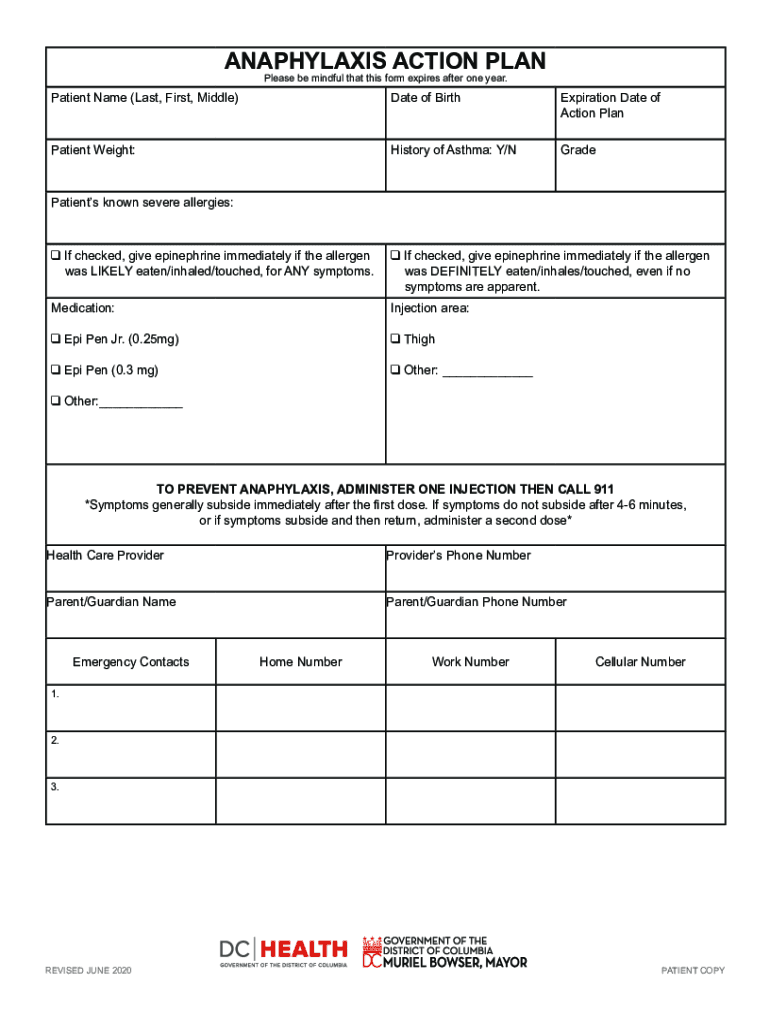
Rade Patient s known severe allergies: q If checked, give epinephrine immediately if the allergen was LIKELY eaten/inhaled/touched, for ANY symptoms. q If checked, give epinephrine immediately if the allergen was DEFINITELY eaten/inhales/touched, even if no symptoms are apparent. Medication: Injection area: q Epi Pen Jr. (0.25mg) q Thigh q Epi Pen (0.3 mg) q Other: q Other: TO PREVENT ANAPHYLAXIS, ADMINISTER ONE INJECTION THEN CALL 911 *Symptoms generally s.
Loading

Open form follow the instructions

Easily sign the form with your finger

Send filled & signed form or save
How to fill out the DC Anaphylaxis Action Plan online
The DC Anaphylaxis Action Plan is a crucial document for individuals with severe allergies. This guide provides detailed, step-by-step instructions on how to complete the form online, ensuring that you provide all necessary information to manage potential anaphylactic reactions effectively.
Follow the steps to complete your online Anaphylaxis Action Plan.
- Click ‘Get Form’ button to obtain the form and open it in the editor.
- Enter the patient’s name in the fields for Last, First, and Middle names. This information helps identify the individual whose allergies are documented.
- Input the patient’s date of birth to ensure accurate identification and age-related considerations in treatment.
- Provide the expiration date of the action plan. This is vital, as the plan must be updated annually.
- Record the patient’s weight, as this may influence medication dosages.
- Indicate whether the patient has a history of asthma by selecting Yes or No. This information is essential for emergency response.
- Specify the patient's current grade which may be relevant in school settings and for emergency contacts.
- List the patient's known severe allergies. This section is critical for determining appropriate emergency responses.
- Check the appropriate boxes to indicate emergency action steps for each allergen, clarifying when to administer epinephrine.
- Select the type of epinephrine auto-injector, specifying which of the options—EpiPen Jr., , or other—is applicable, and indicate the injection site.
- Fill in the health care provider's name and phone number for further communications or clarifications.
- Provide the name and phone numbers for the parent or guardian along with emergency contacts, ensuring that multiple contact methods are available.
- Review the 'Follow these 4 simple steps to give the ® auto-injector' instructions and familiarize yourself with them, since they are crucial during an emergency.
- Read through additional important points and signs to watch for, ensuring you understand what actions to take in an emergency.
- Once you have filled out all sections of the form, save your changes, and download or print the document for your records and emergency access.
Complete your DC Anaphylaxis Action Plan online to ensure you are prepared for allergy emergencies.
Experience a faster way to fill out and sign forms on the web. Access the most extensive library of templates available.
Related content
As a Parent/Guardian: 1. Administer ® or ® Jr. through the clothing if necessary, call...
Feb 13, 2017 — 10 Action plans serve as an important tool for anaphylaxis education and...
Jul 26, 2021 — Objectives—This report presents final 2019 data on U.S. deaths, death...
Get answers to your most pressing questions about US Legal Forms API.
What is the Ascia action plan?
The Ascia action plan is a specific framework used to manage anaphylaxis in patients with known allergies. This plan includes detailed instructions and emergency responses, forming a critical part of a DC Anaphylaxis Action Plan. By following the Ascia action plan, individuals can effectively minimize risks and ensure safety during allergic reactions.
Who should have an individualised anaphylaxis care plan developed?
An individualised anaphylaxis care plan should be developed for anyone with a known allergy that poses a risk for anaphylaxis. Children, in particular, benefit greatly from having a DC Anaphylaxis Action Plan in place, as they may not recognize the symptoms or know how to respond. Parents and caregivers should work closely with healthcare professionals to ensure the plan is thorough and personalized.
Who enforces allergy regulations?
Allergy regulations are typically enforced by various governmental health agencies at both state and federal levels. In the United States, both the Food and Drug Administration (FDA) and the Centers for Disease Control and Prevention (CDC) play significant roles. Understanding these regulations is crucial when creating a proper DC Anaphylaxis Action Plan, as they guide safe practices in managing allergies.
Who completes Ascia action plans?
Ascia action plans are usually completed by healthcare professionals who specialize in allergies. This could include allergists or pediatricians with experience in anaphylaxis care. Each DC Anaphylaxis Action Plan should be customized to meet the needs of the patient, ensuring efficient and effective care is provided.
What should be included in an individual allergy action plan?
An individual allergy action plan should include several key components: the child’s allergies, symptoms of anaphylaxis, medication administration instructions, and emergency contact information. Additionally, it should detail steps to take in case of an allergic reaction, making it a comprehensive DC Anaphylaxis Action Plan. This ensures that anyone who interacts with the child knows the correct procedures during an emergency.
Who completes an Ascia action plan?
An Ascia action plan is typically completed by a healthcare professional, such as a pediatrician or allergist, who understands the child's allergy history. Once the healthcare provider has assessed the situation, they will create a tailored DC Anaphylaxis Action Plan. This ensures that the plan addresses the unique needs of the child and outlines appropriate emergency responses.
Who can fill out an allergy action plan?
In general, any individual who has a child with allergies can fill out a DC Anaphylaxis Action Plan. This typically includes parents, guardians, or caregivers. It's essential that the person filling out the plan understands the child's specific allergies and reaction symptoms. Properly completed plans can provide vital information to anyone who cares for the child.
How do you report an allergic reaction?
To report an allergic reaction, you should inform your healthcare provider immediately. Providing details, such as the type of allergen, symptoms, and any treatments that were administered, will aid in proper assessment. Utilizing a DC Anaphylaxis Action Plan can help streamline this process by documenting information clearly. Accurate reporting contributes to better understanding and management of allergies, benefiting both the individual and the wider community.
Can someone with a green action plan still have anaphylaxis?
Yes, someone with a green action plan can still experience anaphylaxis. A green action plan indicates that an individual may be at a lower risk for severe reactions; however, allergic responses can still occur unexpectedly. It is essential to have a DC Anaphylaxis Action Plan that addresses all possible scenarios, ensuring that everyone is prepared and knows what to do in case of an emergency. Remember, vigilance is key to preventing anaphylaxis.
What is the protocol for anaphylaxis?
The protocol for anaphylaxis includes immediate recognition and treatment of symptoms. The first step is to administer epinephrine, followed by calling emergency medical services. Having a DC Anaphylaxis Action Plan in place allows individuals to act quickly and effectively during a reaction. This plan outlines critical actions and necessary contacts, ensuring a coordinated response.
Use professional pre-built templates to fill in and sign documents online faster. Get access to thousands of forms.
If you believe that this page should be taken down, please follow our DMCA take down process here.