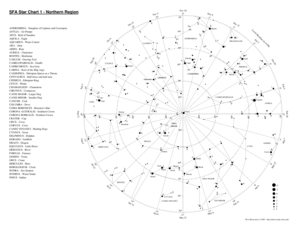
1 6 22 Jul Alcor Mizar URSA MAJOR h 15 l 6 Ju Cor Caroli 1 LEO MINOR 30 12h May 22 2 1 0 40 CANES VENATICI 13 h Jun 6 Merak Phecda 50 14 h Jun 21 Dubhe 60 Megrez Alioth Alkaid BOOTES GEMINI LYNX h Ma 8 r2 2 h h 17 6 Aug A 9 pr 6 30 50 60 70 80 40 Capella 7h Mar 7 Polaris.
Open form follow the instructions
Easily sign the form with your finger
Send filled & signed form or save
How to fill out the SFA Observatory SFA Star Chart 1 Northern Region online
Filling out the SFA Observatory SFA Star Chart 1 Northern Region online is essential for accurately locating celestial bodies in the northern hemisphere. This guide will provide you with clear and detailed steps to help you complete the chart effectively.
Follow the steps to fill out the SFA Star Chart online.
- Click the ‘Get Form’ button to obtain the form and open it in your preferred online editor.
- Familiarize yourself with the chart layout, which includes various celestial objects and their respective coordinates. Ensure you understand the right ascension and declination measurements represented on the chart.
- Begin entering the necessary information regarding the observation date and time. This information is crucial for determining the correct orientation of the chart.
- Strategically locate the north horizon line, and refer to the chart to identify the position of Polaris and other significant stars like Dubhe and Merak that aid in navigation.
- Once you have set the date and time and identified the north horizon, proceed to identify and mark the field of view, which includes the objects visible in the sky.
- Review the chart to ensure that all entries are accurate. Adjust any details if necessary, based on real-time observations.
- Finally, save your changes. You can download, print, or share the completed form as needed.
Get started by filling out your SFA Star Chart online today!
Experience a faster way to fill out and sign forms on the web. Access the most extensive library of templates available.
Related content
May 5, 2000 — The Solar and Heliospheric Observatory. (SOHO) is a mission of...
SFA Star Chart 1 - Northern Region. −2. −1. 0. 1. 2. 3. 4. 5. µ λ θ ρ β δ γ ε...
Jun 1, 2025 — The Church of England is the established church in England, and is...
Get answers to your most pressing questions about US Legal Forms API.
How to learn how to read the stars?
Learning to read the stars can be a gratifying journey. Begin by utilizing resources like the SFA Observatory SFA Star Chart 1 Northern Region to familiarize yourself with key celestial bodies. Pair your learning with nighttime observation, and you will gradually improve your stargazing proficiency over time.
How to read a star map for beginners?
Reading a star map for beginners starts with identifying basic constellations and star patterns. Use the SFA Observatory SFA Star Chart 1 Northern Region as a tool to familiarize yourself with these easy-to-spot formations. As you gain confidence, you can venture into more complex configurations, enhancing your stargazing skills.
How to understand a star chart?
Understanding a star chart requires recognizing symbols and layout. The SFA Observatory SFA Star Chart 1 Northern Region provides clarity by using distinct markers for stars and constellations. Take time to explore the features that are shown, and you'll soon find it easier to interpret the wonders of the night sky.
How to study a star chart?
Studying a star chart involves consistent practice and keen observation. Focus on one section of the SFA Observatory SFA Star Chart 1 Northern Region at a time, noting the positions of stars and constellations. Over time, you'll develop a stronger familiarity with the sky that will make stargazing more enjoyable and intuitive.
How to find the zenith on a star chart?
To find the zenith, look for the point directly overhead on your star chart. The SFA Observatory SFA Star Chart 1 Northern Region can guide you by showing the celestial objects that will be near your zenith at any given time. This perspective enhances your understanding of sky organization and offers a remarkable viewing experience.
How to use a star finder chart?
Using a star finder chart like the SFA Observatory SFA Star Chart 1 Northern Region is simple. Align the chart with the direction you are facing and match the stars in the sky with those on the chart. This will help you identify constellations and brighten your stargazing experience.
How to read a star chart for beginners?
For beginners, start by familiarizing yourself with the SFA Observatory SFA Star Chart 1 Northern Region. Look for recognizable constellations and use them as reference points to locate other stars. Remember, practice and patience are key, so take your time and enjoy the journey of discovering the night sky.
How to read a star approach chart?
Reading a star approach chart involves understanding its layout and symbols. First, locate the legend that explains the symbols, lines, and markers. The SFA Observatory SFA Star Chart 1 Northern Region provides a clear guide that helps you identify key celestial bodies and navigate the night sky with ease.
On which SFA star chart will you find the Big Dipper which is part of Ursa Major?
You will find the Big Dipper, part of the constellation Ursa Major, on the SFA Observatory SFA Star Chart 1 Northern Region. This chart is specifically designed to help users locate major constellations, including the Big Dipper. Its clear layout allows for easy navigation and identification of this iconic grouping of stars.
What is an equatorial star map?
An equatorial star map is designed to represent the positions of stars in relation to the celestial equator. This type of map is especially useful for tracking stars' movement across the night sky. With the SFA Observatory SFA Star Chart 1 Northern Region, you can enhance your stargazing experience by understanding equatorial maps and their significance.
Use professional pre-built templates to fill in and sign documents online faster. Get access to thousands of forms.
If you believe that this page should be taken down, please follow our DMCA take down process here.