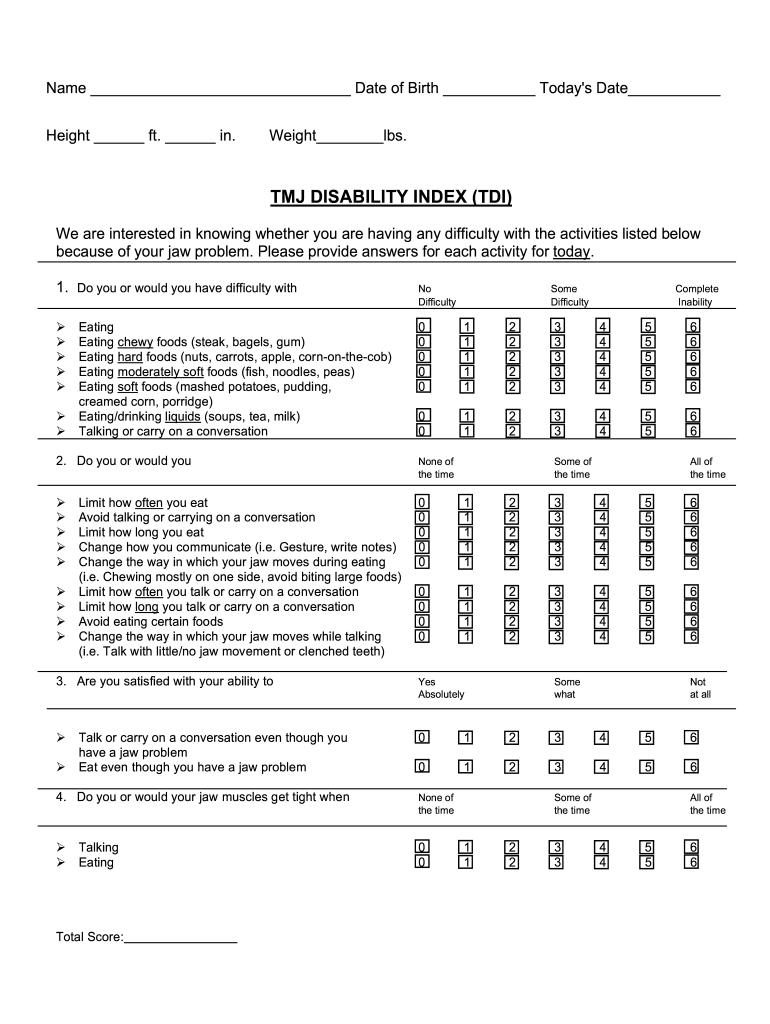
Name Date of Birth Today 's Date Height ft. in.Weight lbs.TMJ DISABILITY INDEX (TDI) We are interested in knowing whether you are having any difficulty with the activities listed below because of.
Loading

Open form follow the instructions

Easily sign the form with your finger

Send filled & signed form or save
How to fill out the TMJ Disability Index (TDI) online
The TMJ Disability Index (TDI) is a valuable tool designed to assess the impact of jaw problems on daily activities. Completing this index accurately online can help in understanding and addressing your specific difficulties.
Follow the steps to fill out the TMJ Disability Index (TDI) online.
- Press the ‘Get Form’ button to access the TMJ Disability Index. This will allow you to open the form in a suitable editor for completion.
- Begin by filling out your personal information at the top of the form, including your name, date of birth, today's date, height, and weight.
- In section one, indicate your level of difficulty with various eating activities. For each activity listed, choose an appropriate score based on your experience today.
- Proceed to section two, where you will describe any limitations you face in relation to eating and communication. Again, select scores that reflect your current situation.
- In section three, assess your satisfaction with your ability to communicate and eat despite any jaw problems. Provide your scores.
- For section four, indicate whether your jaw muscles tense up during talking or eating, and choose the corresponding score.
- Confirm all your selections and review the form for accuracy. Ensure all fields are completed as required.
- At the final step, save your changes. You may also choose to download, print, or share the completed TMJ Disability Index for your records.
Complete the TMJ Disability Index online to better understand your condition.
Experience a faster way to fill out and sign forms on the web. Access the most extensive library of templates available.
Related content
by G Fisch · 2021 · Cited by 31 — Our objectives were to determine the effect of...
Nov 19, 2018 — • The TMD Disability Index (also referred to as the Steigerwald Maher...
Get answers to your most pressing questions about US Legal Forms API.
How to score jaw functional limitation scale?
Scoring the jaw functional limitation scale involves evaluating how TMJ symptoms affect daily activities. You would consider pain levels, ability to open and close your jaw, as well as discomfort when chewing or speaking. The TMJ Disability Index (TDI) serves as a comprehensive guide to scoring these limitations accurately. Utilizing resources from uslegalforms can help you better understand how to navigate this process and improve your quality of life.
How much disability will I get for TMJ?
The extent of disability benefits you may receive for TMJ depends on your TMJ score and the overall assessment of your condition. Factors like the degree of pain, physical limitations, and their effect on your daily life are considered to determine compensation. Using the TMJ Disability Index (TDI) can provide insights into your potential benefits. Additionally, exploring resources on platforms like uslegalforms can empower you to navigate the application process successfully.
What disability rating is TMJ?
Disability ratings for TMJ can differ greatly, often ranging from mild to severe based on the specific circumstances of each case. The TMJ Disability Index (TDI) assists in accurately assessing these ratings by gauging jaw functionality and associated discomfort. A thorough examination incorporating the TDI can lead to a justified disability rating, facilitating your access to benefits. This clarity can significantly impact your treatment plan and support options.
What is the TMJ score?
The TMJ score is a numerical representation of the functional limitations caused by temporomandibular joint disorders. This score is derived from the TMJ Disability Index (TDI), where healthcare providers assess various aspects of jaw function and pain. A higher score usually indicates a greater level of disability and need for intervention. Understanding your TMJ score can be crucial for seeking appropriate treatment options.
What is the disability rating for TMJ?
The disability rating for TMJ varies based on the severity of your symptoms and their impact on daily life. This evaluation considers factors such as pain levels, jaw movement limitations, and overall functional ability. The TMJ Disability Index (TDI) is a tool used by professionals to help determine this rating. By utilizing this index, individuals can gain clarity on their condition and what support they might qualify for.
Can you live with TMJ your whole life?
Many people manage TMJ symptoms throughout their lives effectively. While the condition may be chronic, effective treatments and lifestyle adaptations can minimize its impact. Using resources like the TMJ Disability Index (TDI) can help you monitor the condition. Staying proactive in your treatment and care can promote a better quality of life.
What is the most effective treatment for TMJ?
The treatment for TMJ varies, but common approaches include physical therapy and pain management. Some individuals find relief through jaw exercises, stress management techniques, and medications. In severe cases, dental interventions or surgery may be necessary. Continuous evaluation using the TMJ Disability Index (TDI) can help track your progress.
Is TMJ classed as a disability?
TMJ can be classified as a disability under certain circumstances. If TMJ significantly affects your daily functioning and quality of life, it may meet criteria for disability benefits. The TMJ Disability Index (TDI) helps evaluate its impact. It's advisable to gather comprehensive documentation to support your claim.
Can you go on disability for TMJ?
You can qualify for disability benefits with a diagnosis of TMJ disorders, provided it severely impacts your ability to work. Evidence, such as your TMJ Disability Index (TDI) score, plays a crucial role in your application. If your condition interferes with daily activities, you may have a valid claim. Consulting with a legal expert can help navigate the process.
Can TMJ pain be caused by stress?
Yes, stress can significantly contribute to TMJ pain. Elevated stress levels can lead to muscle tension in your jaw, exacerbating TMJ symptoms. It’s essential to manage stress through mindfulness, exercise, or other relaxation techniques. Addressing stress can improve your TMJ Disability Index (TDI) and overall quality of life.
Use professional pre-built templates to fill in and sign documents online faster. Get access to thousands of forms.
If you believe that this page should be taken down, please follow our DMCA take down process here.