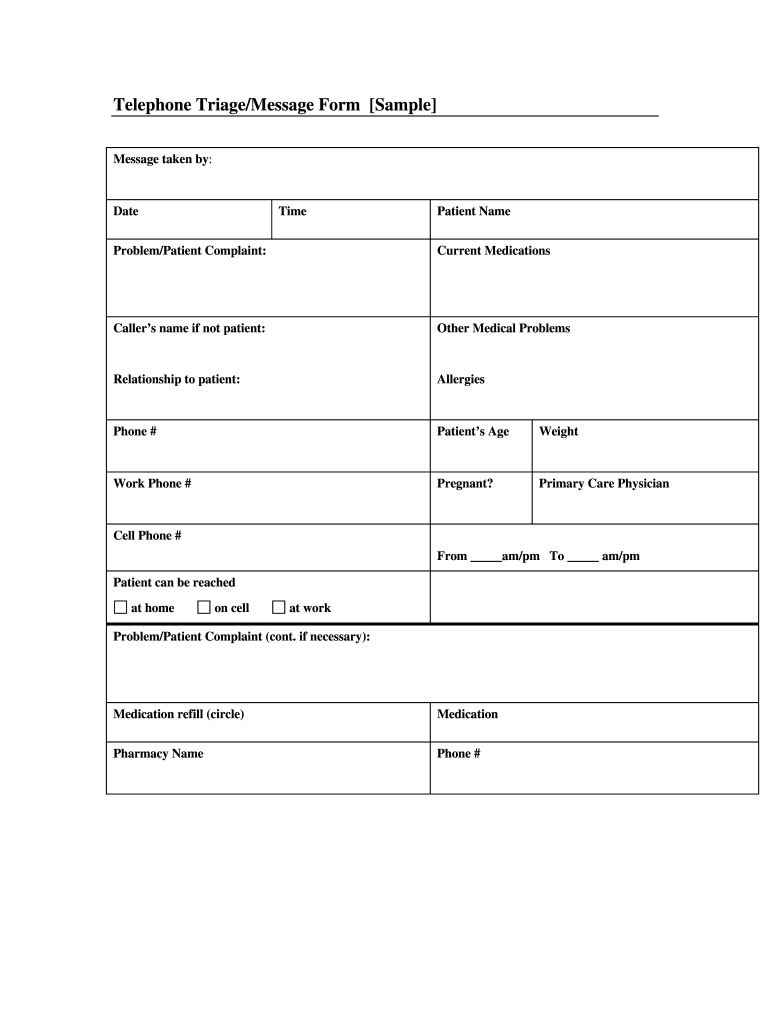
to patient: Allergies Phone # Patient’s Age Weight Work Phone # Pregnant? Primary Care Physician Cell Phone # From _____am/pm To _____ am/pm Patient can be reached at home on cell at work Problem/Patient Complaint (cont. if necessary): Medication refill (circle) Medication Pharmacy Name Phone # Follow up: ER referral Appointment made for ________________ at _________ Physician to call. Physician called on ______________ at _________. Pharmacy called. Refill ready at _________.
Loading

Open form follow the instructions

Easily sign the form with your finger

Send filled & signed form or save
How to fill out the Telephone Triage/Message Form online
Completing the Telephone Triage/Message Form online is a straightforward process designed to capture essential patient information. This guide provides step-by-step instructions to ensure accurate and efficient form filling, catering to various user needs.
Follow the steps to successfully complete the form.
- Press the ‘Get Form’ button to access the form and open it in your preferred editing tool.
- Begin by entering the details of the message taken by the individual assisting the patient, including the date and time of the call.
- Fill in the patient's name and specify their problem or complaint clearly. This information is crucial for the follow-up process.
- Document the current medications the patient is taking to help assess their health situation accurately.
- If the caller is not the patient, enter the caller's name and any relevant relationship to the patient.
- List any other medical problems the patient may have and any known allergies to ensure complete medical history.
- Provide contact information, including the patient's phone number, age, weight, and whether they are pregnant.
- Identify the primary care physician and include additional phone numbers like the work phone and cell phone where applicable.
- Indicate the times the patient can be reached by checking the appropriate options (home, cell, work) and inserting time slots.
- Continue detailing any additional complaints as necessary in the provided space, ensuring all issues are documented.
- If a medication refill is requested, circle the appropriate option and fill in the medication name, pharmacy name, and its contact number.
- Update the follow-up section with details for referrals, appointments made, and any communications regarding treatment plans.
- Provide clinical advice given to the patient and ensure that patient understanding of the treatment plan is noted.
- Complete any comments section as needed, especially regarding the patient’s understanding of when to seek further help.
- Once you have filled out all sections, you can save changes, download, print, or share the completed form as necessary.
Complete your documents online today for efficient patient management.
Experience a faster way to fill out and sign forms on the web. Access the most extensive library of templates available.
Related content
by E Towle · 2009 · Cited by 15 — Telephone triage is essential in oncology, involving...
by J Mays-Scott · 2018 · Cited by 1 — Telephone triage uses trained nurses with...
The process can happen by telephone/virtually or in person, and the outcome will be...
Get answers to your most pressing questions about US Legal Forms API.
What should be included on a telephone triage documentation?
Telephone triage documentation should include the caller's contact information, the reason for the call, and any symptoms described. It’s also essential to record advice provided and any follow-up actions taken. Using a standardized Telephone Triage/Message Form ensures that your documentation is comprehensive and consistent.
How to be a good triage phone nurse?
A good triage phone nurse excels in communication and empathy. Engage actively with callers, listen to their concerns, and ensure you thoroughly document each interaction using a Telephone Triage/Message Form. By staying organized and prioritizing patient care, you can enhance the overall effectiveness of your triage process.
How to do phone triage?
To perform phone triage successfully, familiarize yourself with common medical conditions and their symptoms. Use a Telephone Triage/Message Form to guide your questions and record responses. This structured approach helps you evaluate the situation accurately and provide appropriate recommendations.
Is telephone triage difficult?
Telephone triage can be challenging, especially without the right tools. However, with practice and a solid Telephone Triage/Message Form, you can streamline the process. By developing your skills and gaining experience, you will find that telephone triage becomes more manageable and effective.
How to triage a telephone call?
To triage a telephone call effectively, first establish a calm environment to encourage open communication. Utilize a Telephone Triage/Message Form to guide the conversation and capture necessary details. After assessing the information, you can guide the caller towards the best next steps, whether that involves providing advice or referring them to a healthcare provider.
What questions to ask when triaging?
When triaging, ask open-ended questions to gather essential information. Inquire about symptoms, duration, and any previous treatments related to the caller's issue. Utilizing a Telephone Triage/Message Form can help you organize these inquiries effectively, ensuring nothing is overlooked.
How to triage a phone call?
To triage a phone call, start by listening attentively to the caller's issue. Use a Telephone Triage/Message Form to document key details, such as the nature of the problem and any relevant medical history. Then, prioritize calls based on urgency, ensuring that those needing immediate assistance receive it promptly.
How do you do a triage assessment?
Conducting a triage assessment involves gathering essential information, evaluating the urgency of the situation, and determining the best action. It's important to listen carefully and to document responses accurately. A Telephone Triage/Message Form can simplify this process and help maintain clarity.
What is a telephone triage?
Telephone triage refers to the process of evaluating a caller's needs and determining the appropriate response. It involves listening actively, asking relevant questions, and providing initial guidance when necessary. The Telephone Triage/Message Form aids in ensuring every call is handled consistently and efficiently.
What is a telephone triage assessment?
A telephone triage assessment is a systematic evaluation of a caller's needs conducted over the phone. The assessment considers the urgency and context of the caller's situation. By employing a Telephone Triage/Message Form, organizations can efficiently document and manage these assessments.
Use professional pre-built templates to fill in and sign documents online faster. Get access to thousands of forms.
If you believe that this page should be taken down, please follow our DMCA take down process here.