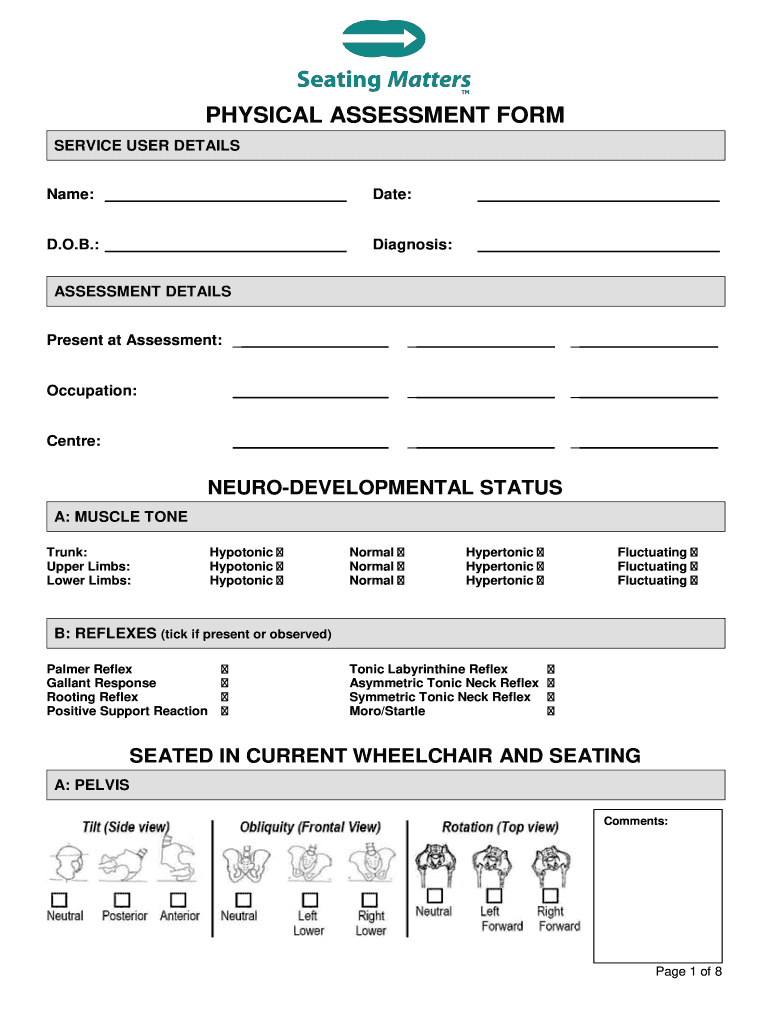
SSESSMENT DETAILS Present at Assessment: __________________ _________________ _________________ Occupation: __________________ _________________ _________________ Centre: __________________ _________________ _________________ NEURO-DEVELOPMENTAL STATUS A: MUSCLE TONE Trunk: Upper Limbs: Lower Limbs: Hypotonic Hypotonic Hypotonic Normal Normal Normal Hypertonic Hypertonic Hypertonic Fluctuating Fluctuating Fluctuating B: REFLEXES (tick if present or observed) Palmer Reflex Gallant.
Loading

Open form follow the instructions

Easily sign the form with your finger

Send filled & signed form or save
How to fill out the Seating Matters Physical Assessment Form online
Filling out the Seating Matters Physical Assessment Form online is a crucial step in assessing the physical needs of a service user. This guide will walk you through each section of the form, providing clear instructions on how to complete it effectively and accurately.
Follow the steps to fill out the form with ease.
- Press the ‘Get Form’ button to obtain the form and open it for editing.
- Begin with the 'Service User Details' section. Enter the user's name, date, date of birth, and diagnosis in the corresponding fields.
- Proceed to the 'Assessment Details' section. Fill in who was present during the assessment, their occupation, and the center name.
- In the 'Neuro-developmental Status' subsection A, you will assess muscle tone for the trunk, upper limbs, and lower limbs. Mark the appropriate tone for each area.
- In subsection B, tick the reflexes that are present or observed such as Palmer Reflex or Rooting Reflex.
- Then, move to the 'Seated in Current Wheelchair and Seating' section. Provide comments for each subsection including pelvis, trunk, lower extremities, upper extremities, and head & neck.
- Continue to the 'Supine Lying' section and fill in the assessments for the pelvis, trunk, and other parts while making necessary observations.
- In the 'Identifying Level of Risk of Pressure' section, answer the risk factor questions by ticking 'Yes' or 'No' as applicable.
- Next, move to the 'Linear Measurements' section, and fill in the basic and advanced measurements in the provided fields.
- Conclude your filling process by reviewing all sections for completeness. Once satisfied, you can save changes, download, print, or share the form as needed.
Begin filling out the Seating Matters Physical Assessment Form online today to ensure the best support for your needs.
Experience a faster way to fill out and sign forms on the web. Access the most extensive library of templates available.
Related content
Seating/Mobility Evaluation. To be completed by Physiatrist or Physical/Occupational...
This article addresses how to maximize the spinal cord injured patient's functional...
Mobility and Seating Related Goals: Section 1: Medical Background. Cause: Injury Health...
Get answers to your most pressing questions about US Legal Forms API.
How to do a seating assessment?
To conduct a seating assessment, begin by gathering detailed information from the individual using the Seating Matters Physical Assessment Form. This form guides you through standard procedures for measuring body dimensions and assessing posture. Next, analyze the collected data to identify areas needing improvement. Ultimately, integrate this information into recommendations that optimize seating solutions tailored to the individual's unique requirements.
What are the measurements for seating assessment?
The measurements for a seating assessment typically include seat depth, width, height, backrest angles, and armrest dimensions. Specific details can be recorded using the Seating Matters Physical Assessment Form, offering a clear framework for evaluation. These metrics are fundamental in achieving a supportive and comfortable seating arrangement. Proper measurement contributes directly to improved posture and user satisfaction.
How do you measure for seating?
Measuring for seating requires attention to several key dimensions, which can vary based on individual needs. The Seating Matters Physical Assessment Form includes measurements for seat width, depth, and height, as well as back and armrest positions. This form streamlines the measurement process, ensuring accuracy and relevance. Accurate measurements facilitate the creation of a seating system that accommodates both comfort and support.
How do you measure for seating occupational therapy?
In occupational therapy, measuring for seating involves assessing the individual's body dimensions and physical abilities. The Seating Matters Physical Assessment Form provides a structured approach to capture critical measurements such as seat height, depth, and back support needs. This detailed data helps therapists to design seating solutions that promote independence and comfort. By focusing on these specifics, occupational therapists can better support their clients' functional goals.
What is the basic seating assessment?
The basic seating assessment evaluates an individual's needs for proper seating and mobility. This process often utilizes the Seating Matters Physical Assessment Form to gather essential information about posture, comfort, and safety. By understanding these factors, providers can create a personalized plan that enhances the user's overall well-being. Ultimately, this assessment ensures that the seating solution is tailored to meet individual physical requirements.
What are the 4 P's of occupational therapy?
The 4 P's of occupational therapy are Purpose, Person, Process, and Product. These elements work together to create effective therapeutic strategies. The Seating Matters Physical Assessment Form incorporates these principles by ensuring that all aspects of the individual's needs are evaluated. This ensures that the chosen seating solution aligns with therapeutic goals and enhances the user's experience.
What is the posture for sitting occupational therapy?
In occupational therapy, proper sitting posture involves keeping the feet flat on the ground, knees at a 90-degree angle, and back supported by the chair. It’s essential to align the head, neck, and spine to ensure optimal stability and comfort. The Seating Matters Physical Assessment Form guides this assessment to create effective strategies tailored to each individual. Proper posture enhances engagement in daily activities.
What are the three main goals of seating and positioning?
The three main goals of seating and positioning are to enhance comfort, support optimal function, and promote postural alignment. By focusing on these objectives, practitioners improve the user’s overall stability and reduce the risk of pressure injuries. Utilizing the Seating Matters Physical Assessment Form helps practitioners set clear goals that meet the individual needs of each client. This results in a more effective seating strategy.
What are the seating guidelines for occupational therapy?
Seating guidelines for occupational therapy focus on ensuring proper posture, support, and comfort for the individual. These guidelines recommend assessing the person’s physical abilities and specific needs, while also considering various seating options. The Seating Matters Physical Assessment Form assists in documenting these essential considerations. By adhering to these guidelines, practitioners can significantly enhance the user’s quality of life.
How do you measure seated position?
To measure seated position effectively, ensure that the individual is securely seated with their back against the backrest. Use a plumb line or a measurement tool to assess alignment from the head through the pelvis. Make sure to consider the angles of the hips, knees, and ankles for optimal comfort. The Seating Matters Physical Assessment Form helps capture these important metrics.
Use professional pre-built templates to fill in and sign documents online faster. Get access to thousands of forms.
If you believe that this page should be taken down, please follow our DMCA take down process here.