Loading
Form preview
  • US Legal Forms
  • Other Templates
  • Industry Forms
  • Industry Insurance & Medical Forms
  • Reinforcement Assessment

Get Reinforcement Assessment

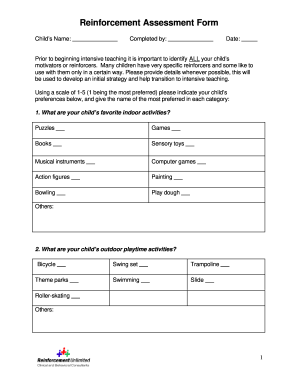
Reinforcement Assessment Form Childs Name: Completed by: Date: Prior to beginning intensive teaching it is important to identify ALL your childs motivators or reinforcers. Many children have very.

How it works

  1. Open form

    Open form follow the instructions

  2. Easily sign form

    Easily sign the form with your finger

  3. Share form

    Send filled & signed form or save

How to fill out the Reinforcement Assessment online

The Reinforcement Assessment form is a vital tool in identifying a child's motivators and preferences, which aid in developing effective strategies for intensive teaching. This guide outlines clear steps to help you complete the form accurately and efficiently online.

Follow the steps to accurately complete the Reinforcement Assessment form.

  1. Press the ‘Get Form’ button to access the Reinforcement Assessment form and open it in your document editor.
  2. In the 'Child’s Name' field, enter the full name of the child for whom the assessment is being completed. This will help in personalizing the strategy based on their unique preferences.
  3. For each section of preferences, use a scale of 1-5 to rate your child's motivations where 1 indicates the most preferred item. Provide the name of the highest-rated item in each category.
  4. Move to the outdoor activities section, selecting options such as biking or swimming, and include any additional activities your child enjoys.
  5. Complete the food-related sections by detailing your child's favorite snacks and beverages, ensuring to include any brand names they love.
  6. Explain your child’s preferences for pets and favorite songs they like, ensuring a comprehensive understanding of their interests.
  7. In the final field, offer any additional insights that could help in planning learning strategies, ensuring to detail anything important relevant to your child's likes and dislikes.
  8. Once all fields are completed thoughtfully, you can save your changes, download the completed form, print it, or share it as required.

Complete your Reinforcement Assessment form online today to support your child's learning journey!

Get form

Experience a faster way to fill out and sign forms on the web. Access the most extensive library of templates available.
Get form

Related content

A comparison of reinforcer assessment methods: the...
by J Northup · 1996 · Cited by 204 — We compared three methods of stimulus preference...
Learn more
Stimulus Preference Assessments
A stimulus preference assessment is a systematic tool or method used to determine what...
Learn more
human-observing-behavior-maintained-by-s-EN.pdf
by GY Tomanari · 2004 · Cited by 19 — The present study approaches the assessment of...
Learn more

Related links form

SponSor Pledge Form - The Alpha Center - Alphacenter-sc Implant Dentistry Copyright Transferdisclosure Form Address Information Systems Products Order Form Fillable Dcjs 2214 A

Questions & Answers

Get answers to your most pressing questions about US Legal Forms API.

Contact support

The concurrent schedule of reinforcer assessment evaluates multiple reinforcers at the same time, providing a comprehensive view of preferences. This method allows you to understand how different options compete with each other. Incorporating this approach into your Reinforcement Assessment yields rich data that guides effective motivational strategies.

A reinforcement assessment is a systematic way of identifying and measuring the impact of reinforcers on behavior. This assessment helps in determining which rewards can effectively motivate individuals to achieve specific outcomes. Ultimately, it informs your strategies for enhancing performance and satisfaction.

Running a reinforcer assessment involves selecting appropriate methods to observe preferences and effectiveness of different reinforcers. You can use both direct observation and structured trials to measure responses to each reinforcer. By compiling the data, you can make informed decisions during your Reinforcement Assessment.

To conduct a reinforcer assessment, first, gather a list of potential reinforcers based on observations. Next, implement various assessment methods, such as paired choice or multiple stimulus assessments, to evaluate the effectiveness of these reinforcers. This systematic approach provides valuable insights for your Reinforcement Assessment.

The three types of reinforcer assessment include preference assessments, reinforcer efficacy assessments, and functional analyses. Preference assessments help identify what individuals like, while efficacy assessments determine how well these reinforcers work in practice. Understanding these types enhances the quality of your Reinforcement Assessment.

To assess potential reinforcers, start by observing individual preferences. You can provide a range of rewards and note which options draw the most interest. This initial observation helps identify effective reinforcers for further testing during your Reinforcement Assessment.

The four types of reinforcement are positive reinforcement, negative reinforcement, punishment, and extinction. Positive reinforcement entails introducing a pleasant stimulus to encourage behavior. Negative reinforcement involves removing an unpleasant condition to increase behavior, while punishment aims to decrease undesired actions. Extinction occurs when reinforcement is removed, leading to a decrease in behavior. Incorporating these types in a Reinforcement Assessment can effectively shape behavior.

The four types of schedules of reinforcement include fixed ratio, variable ratio, fixed interval, and variable interval schedules. Fixed ratio schedules provide reinforcement after a set number of responses, while variable ratio schedules offer rewards after an unpredictable amount. Fixed interval schedules deliver reinforcement after a specific time, and variable interval schedules reinforce responses at varying times. Understanding these schedules is vital during a Reinforcement Assessment to optimize behavior modification strategies.

The four types of reinforcement learning include supervised learning, unsupervised learning, semi-supervised learning, and self-supervised learning. Supervised learning uses labeled data to teach models. Unsupervised learning identifies patterns in unlabeled data, while semi-supervised learning combines both. Self-supervised learning generates labels from the data itself, making all these types crucial in a Reinforcement Assessment context, particularly in educational technology.

Reinforcement in assessment refers to the use of positive or negative stimuli to promote desired behaviors during evaluation. This process helps establish a favorable learning environment, motivating individuals to engage with the material. In a Reinforcement Assessment, understanding how reinforcement influences performance can significantly improve the assessment outcomes. Effective reinforcement strategies can lead to enhanced learning experiences.

Get This Form Now!

Use professional pre-built templates to fill in and sign documents online faster. Get access to thousands of forms.
Get form
If you believe that this page should be taken down, please follow our DMCA take down processhere.
Get Reinforcement Assessment
Get form
  • Adoption
  • Bankruptcy
  • Contractors
  • Divorce
  • Home Sales
  • Employment
  • Identity Theft
  • Incorporation
  • Landlord Tenant
  • Living Trust
  • Name Change
  • Personal Planning
  • Small Business
  • Wills & Estates
  • Packages A-Z
  • Affidavits
  • Bankruptcy
  • Bill of Sale
  • Corporate - LLC
  • Divorce
  • Employment
  • Identity Theft
  • Internet Technology
  • Landlord Tenant
  • Living Wills
  • Name Change
  • Power of Attorney
  • Real Estate
  • Small Estates
  • Wills
  • All Forms
  • Forms A-Z
  • Other Templates
  • Legal Hub
  • About Us
  • Help Portal
  • Legal Resources
  • Blog
  • Affiliates
  • Contact Us
  • Delete My Account
  • Site Map
  • Industries
  • Forms in Spanish
  • Localized Forms
  • State-specific Forms
  • Forms Kit
  • Real Estate Handbook
  • All Guides
  • Notarize
  • Incorporation services
  • For Consumers
  • For Small Business
  • For Attorneys
  • USLegal
  • FormsPass
  • pdfFiller
  • signNow
  • altaFlow
  • DocHub
  • Instapage
Form Packages
  • Adoption
  • Bankruptcy
  • Contractors
  • Divorce
  • Home Sales
  • Employment
  • Identity Theft
  • Incorporation
  • Landlord Tenant
  • Living Trust
  • Name Change
  • Personal Planning
  • Small Business
  • Wills & Estates
  • Packages A-Z
Form Categories
  • Affidavits
  • Bankruptcy
  • Bill of Sale
  • Corporate - LLC
  • Divorce
  • Employment
  • Identity Theft
  • Internet Technology
  • Landlord Tenant
  • Living Wills
  • Name Change
  • Power of Attorney
  • Real Estate
  • Small Estates
  • Wills
  • All Forms
  • Forms A-Z
  • Other Templates
Customer Service
  • Legal Hub
  • About Us
  • Help Portal
  • Legal Resources
  • Blog
  • Affiliates
  • Contact Us
  • Delete My Account
  • Site Map
  • Industries
  • Forms in Spanish
  • Localized Forms
  • State-specific Forms
  • Forms Kit
Legal Guides
  • Real Estate Handbook
  • All Guides
Prepared for you
  • Notarize
  • Incorporation services
Our Customers
  • For Consumers
  • For Small Business
  • For Attorneys
Our Sites
  • USLegal
  • FormsPass
  • pdfFiller
  • signNow
  • altaFlow
  • DocHub
  • Instapage
Social Media
Call us now toll free:
+1 833 426 79 33
As seen in:
© Copyright 1999-2026 airSlate Legal Forms, Inc. 17 Station Street, Suite 303, Brookline, MA 02445
  • Your Privacy Choices
  • Terms of Service
  • Privacy Notice
  • Content Takedown Policy
  • Bug Bounty Program