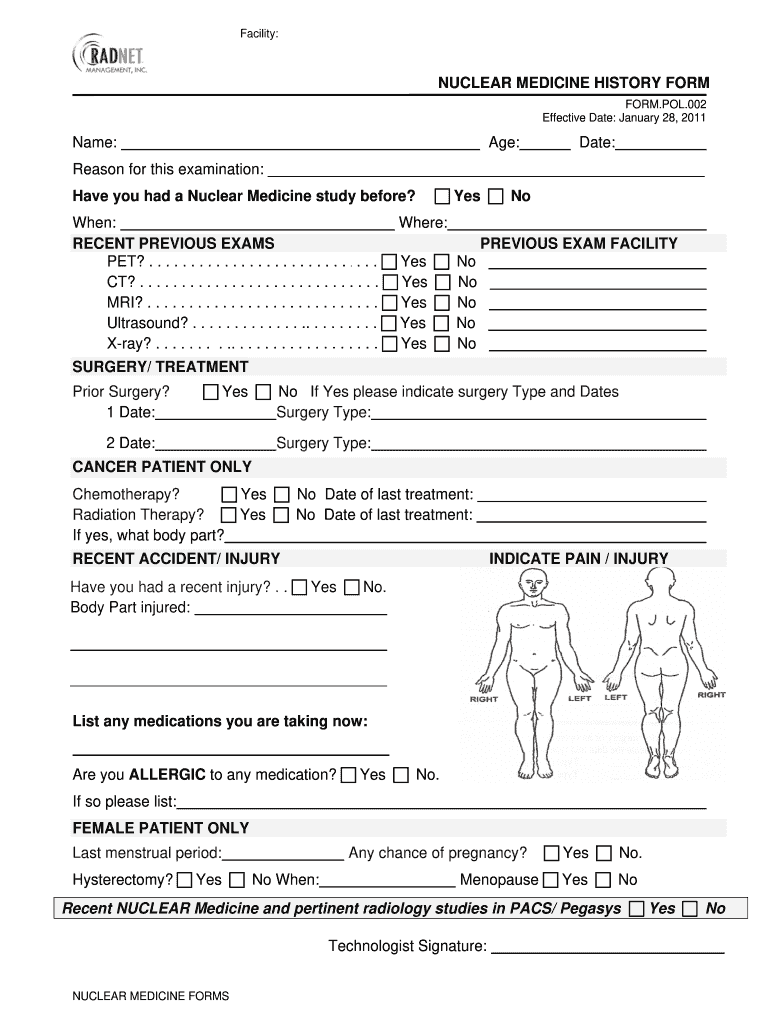
Facility: NUCLEAR MEDICINE HISTORY FORM FORM.POL.002 Effective Date: January 28, 2011 Name: Age: Date: Reason for this examination: Have you had a Nuclear Medicine study before? Yes When: Where: RECENT.
Loading

Open form follow the instructions

Easily sign the form with your finger

Send filled & signed form or save
How to fill out the RadNet Nuclear Medicine History Form online
Completing the RadNet Nuclear Medicine History Form online is a crucial step in ensuring accurate medical evaluations. This guide provides clear and concise instructions to help users navigate the form effectively and accurately.
Follow the steps to successfully complete the form online.
- Press the ‘Get Form’ button to acquire the form and access it in the online editor.
- Enter your name in the designated field. Ensure it matches your identification for consistency.
- Input your age in the respective area clearly and accurately.
- Fill in today's date to record when you are completing the form.
- Specify the reason for your examination in the provided blank space.
- Indicate whether you have undergone a Nuclear Medicine study before by selecting Yes or No.
- If applicable, record the date and location of any previous Nuclear Medicine studies.
- Assess your history with other recent exams by marking Yes or No for options including PET, CT, MRI, Ultrasound, and X-ray.
- If you have had surgeries, indicate whether you have had prior surgery and provide details regarding the type and date.
- For individuals with a cancer history, specify if you received chemotherapy or radiation therapy, including dates and body parts affected.
- Indicate if you have experienced a recent injury and specify the body part that was affected.
- List any medications you are currently taking in the designated field.
- Indicate any known allergies to medications by choosing Yes or No, and if applicable, list those medications.
- Female patients should fill out the section regarding their last menstrual period, hysterectomy status, chances of pregnancy, and menopause status.
- Indicate if there are any recent Nuclear Medicine studies relevant to your case by marking Yes or No.
- Finally, review all entries for accuracy before saving your changes. You can download, print, or share the completed form as needed.
Start completing your RadNet Nuclear Medicine History Form online today to ensure a smooth and efficient medical evaluation process.
Experience a faster way to fill out and sign forms on the web. Access the most extensive library of templates available.
Related content
Jul 24, 2025 — RadNet has 140 radiation air monitors in 50 states and runs 24 hours a...
Aug 4, 2017 — You are to interview and examine (as appropriate) all patients seen in the...
Get answers to your most pressing questions about US Legal Forms API.
What is the most commonly used nuclear medicine?
The most commonly used nuclear medicine is -99m, often utilized due to its ideal properties for imaging. This radioactive substance has a short half-life, which minimizes your exposure while providing clear images. It plays a crucial role in various types of scans, from cardiac assessments to bone scans. To streamline the process and ensure nothing is missed, use the RadNet Nuclear Medicine History Form when preparing for your test.
Why would a doctor order a nuclear medicine scan?
A doctor may order a nuclear medicine scan to diagnose, manage, or monitor certain conditions related to organs, bones, or tumors. These scans provide valuable functional information that other imaging tests may miss. By understanding how organs behave, doctors can make better-informed decisions about treatment plans. Completing the RadNet Nuclear Medicine History Form can help the doctor determine the best approach for you.
What is nuclear medicine history?
Nuclear medicine history refers to your past experiences with nuclear medicine tests and treatments, including any reactions or side effects. This history is vital for healthcare providers to tailor your care appropriately. Accurately documenting your nuclear medicine history ensures safer, more effective tests in the future. Using the RadNet Nuclear Medicine History Form can simplify this process for both you and your healthcare team.
What happens at a nuclear medicine appointment?
During a nuclear medicine appointment, healthcare professionals will explain the procedure and prepare you for the test. You may need to change into a gown, and a radioactive material will be administered, often through an injection. Afterward, you'll lie down while images are captured. Bringing along your RadNet Nuclear Medicine History Form will help streamline your appointment.
What is a nuclear medicine report?
A nuclear medicine report is a detailed document created after your nuclear medicine test. It includes the findings from the imaging scans, explaining how well your organs are functioning. This report is crucial for your doctor to determine the next steps in your healthcare plan. You can submit your completed RadNet Nuclear Medicine History Form to ensure your doctor has all necessary information for interpretation.
What is the basic principle of nuclear medicine?
The basic principle of nuclear medicine revolves around the use of radioactive materials to visualize and analyze bodily functions. By tracking the radiation emitted from these materials, healthcare providers can observe how organs work. This technique allows greater insight into diseases often undetectable through conventional imaging. Completing the RadNet Nuclear Medicine History Form can enhance the accuracy of your diagnosis.
What does a nuclear medicine test consist of?
A nuclear medicine test involves injecting a small amount of radioactive material into your body. This material emits energy, which can be detected by a special camera. The images produced help doctors see how your organs and tissues are functioning. To streamline this process, the RadNet Nuclear Medicine History Form can help gather essential information about your medical history.
What are the two major types of nuclear radiation?
The two major types of nuclear radiation are alpha radiation and beta radiation. Alpha particles consist of two protons and two neutrons, while beta radiation involves high-energy electrons or positrons. By providing a complete medical history through the RadNet Nuclear Medicine History Form, you can assist healthcare professionals in making informed decisions regarding exposure and treatment options.
What are the two types of nuclear medicine?
The two types of nuclear medicine are planar imaging, which captures two-dimensional images, and single-photon emission computed tomography (SPECT), which provides three-dimensional images of the body. Each type offers unique benefits for diagnosing conditions. Utilizing the RadNet Nuclear Medicine History Form ensures that your provider is aware of which method is suitable for your medical history.
What are the two main forms of nuclear medicine?
The two main forms of nuclear medicine are diagnostic and therapeutic nuclear medicine. Diagnostic nuclear medicine involves using radioactive substances to take images and evaluate organ function. In contrast, therapeutic nuclear medicine uses radioisotopes to treat certain diseases. Filling out the RadNet Nuclear Medicine History Form can clarify which approach might be best for you.
Use professional pre-built templates to fill in and sign documents online faster. Get access to thousands of forms.
If you believe that this page should be taken down, please follow our DMCA take down process here.